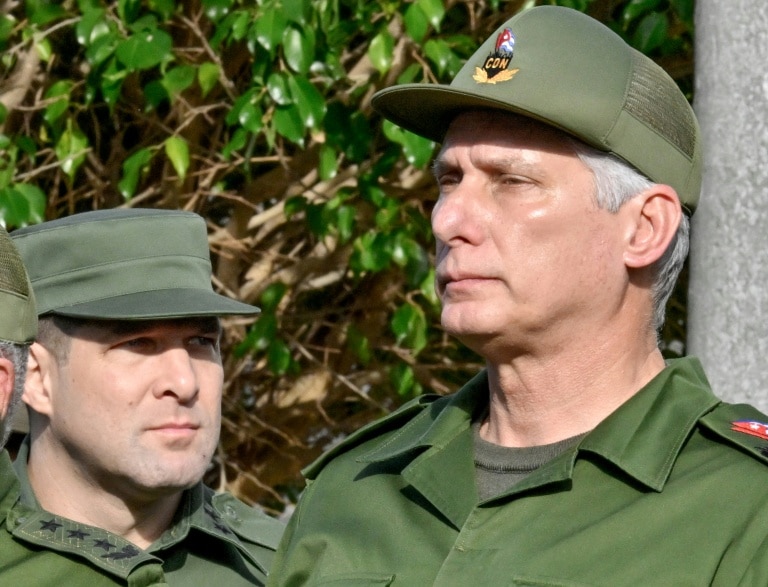
Tensions between long-standing adversaries the United States and Cuba have surged to new heights in recent days, bringing with them fears of direct military confrontation and a deepening humanitarian crisis on the Caribbean island. On Monday, Cuban President Miguel Diaz-Canel issued a stark warning that any U.S. military attack on the country would trigger a catastrophic bloodbath with unforeseeable, far-reaching consequences, even as the U.S. Department of the Treasury unveiled a new round of punitive sanctions targeting Havana’s top intelligence apparatus and senior leadership.
Diaz-Canel’s public statement came one day after U.S. news outlet Axios published an exclusive report citing unnamed American intelligence officials, which claimed Cuba had acquired more than 300 military drones from Russia and Iran, and was weighing potential drone strikes against U.S. targets. The alleged targets named in the report included the U.S. military base at Guantanamo Bay located on Cuban territory, American military vessels operating in the region, and even targets within the U.S. state of Florida. This unconfirmed report quickly fueled widespread global speculation that the Trump administration was actively considering full-scale military action to overthrow Cuba’s long-standing communist government.
In a post shared on the social platform X, the Cuban leader reiterated that his country poses no military threat to the United States or any other sovereign nation. While he did not directly refute or confirm the allegations surrounding the reported drone stockpile, Diaz-Canel made clear that Cuba retains the absolute, legitimate right to arm itself in self-defense against any outside military aggression.
Cuba’s top diplomatic representative to the United Nations echoed this defiant tone in an interview with AFP in New York. “If someone tried to invade Cuba, Cuba will fight back, no doubt about it,” Ernesto Soberon Guzman told reporters. He referenced the 1960s Bay of Pigs invasion, when a U.S.-backed assault on Cuba was soundly defeated by Cuban forces. “In the 60s, they (the US) tried to invade Cuba, and they were defeated. Of course, everybody can say this is a different situation. Yes, it is. But the will of the people of Cuba has not changed,” he added.
Alongside the rising rhetorical conflict, the U.S. moved to ramp up economic pressure on Havana on Monday. The new sanctions target Cuba’s primary intelligence agency, plus nine senior Cuban nationals, including the nation’s cabinet ministers for communications, energy, and justice. A statement from the Treasury Department’s Office of Foreign Assets Control confirmed that several top leaders of the Cuban Communist Party and at least three senior military generals were also added to the U.S. sanctions list.
This latest action is part of a broader campaign of intensified pressure the U.S. has waged against Cuba since January. The strategy mirrors the U.S. military intervention that ousted the Venezuelan government earlier that year, with former President Donald Trump openly musing about removing Cuba’s sitting leadership. Most impactful, Washington cut off one of Cuba’s last remaining economic lifelines by halting all oil shipments from Venezuela, Havana’s primary fuel supplier, and threatened to impose tariffs on any third country that moved to cover the resulting fuel gap.
The U.S. oil blockade has dramatically worsened a already severe humanitarian and energy crisis across Cuba. The island now suffers from increasingly frequent and extended national blackouts, as its aging, dilapidated power plants struggle to operate without sufficient fuel to run backup generators. The Cuban government has repeatedly accused Washington of intentionally crippling the island’s economy through the fuel blockade to create a pretext for a full military intervention to overthrow its government, after decades of economic pressure failed to force regime change.
The Axios drone report was not an isolated development: it came just days after Central Intelligence Agency Director John Ratcliffe traveled to Havana for closed-door negotiations with Cuban officials. It also aligned with ongoing U.S. media reports that the Trump administration was preparing to file criminal charges against 94-year-old Raul Castro, the brother of iconic Cuban revolutionary leader Fidel Castro, as another element of its pressure campaign.
Amid the growing crisis, Cuba has received critical support from Mexico’s left-wing government. On Monday, the island took delivery of its fifth shipment of humanitarian aid from Mexico since February. Unlike previous aid shipments, which were transported by Mexican navy vessels, journalists from AFP observed that this consignment was carried by a commercial merchant ship sailing under a Panamanian flag. The vessel is carrying a total of 1,700 tons of relief supplies. According to Cuban Food Industry Minister Alberto Lopez, the shipment includes powdered milk and beans earmarked for distribution to children and elderly residents, the most vulnerable groups affected by the ongoing crisis.