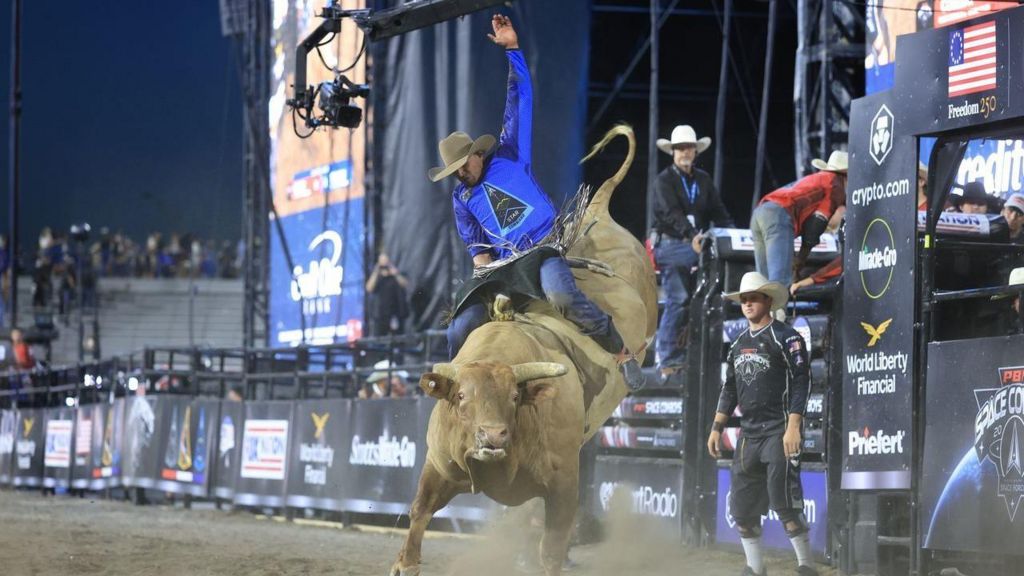
On a sweltering July Saturday in Colorado Springs, two seemingly disparate worlds collided inside the Air Force Academy’s Falcon Stadium: the dust, grit and roar of professional bull riding and the crisp, disciplined tradition of U.S. military service. What unfolded was a one-of-a-kind event dubbed PBR Space Cowboys, staged to mark the 250th anniversary of the United States, and doubling as an unconventional, high-stakes recruitment push for two of the nation’s fastest-growing security agencies: the U.S. Space Force and U.S. Border Patrol.
Thirty-three new Air Force and Space Force recruits, many still young and fresh-faced, lined up first to take their oath of enlistment, while just off the main floor, 33 bull riders clad in leather chaps waited to face off against 1,600-pound horned bovines. For event organizers, the pairing of Western rodeo culture and modern military strength was no random accident. Professional Bull Riders (PBR) CEO Sean Gleason framed the partnership as a natural alignment of core values.
“Our cowboys, and the cowboys in our audience, they believe in hard work, honesty, integrity, help your neighbour, some selflessness,” Gleason told reporters on site. “So that’s what it takes to be in the military or in the US Border Patrol or any type of first responder.” This is not a new collaboration: Border Patrol has held the title of “Official Federal Law Enforcement Officers of the Professional Bull Riders” since 2008, a relationship that has expanded dramatically amid the Trump administration’s intensified focus on border security.
Over the past year, President Trump has advanced sweeping border policy, signing legislation last summer requiring the hiring of 3,000 new Border Patrol agents, and approving a $70 billion border security package earlier this month that allocates $26 billion specifically to Border Patrol, with much of that funding earmarked for recruitment and retention. The agency announced earlier this week that it has surpassed 21,000 active agents for the first time since its founding in 1924, and recruitment numbers are surging: between January and April 2025 alone, the agency received 34,650 applications, a 44% jump from the same period in 2024. The Department of Homeland Security attributes this historic spike to new administration policies and generous incentives, including signing bonuses of up to $60,000 and starting salaries of $50,741 that can climb to more than $110,000.
At the PBR event, those recruitment efforts were on full display. A Border Patrol SUV and recruitment tent were positioned front and center in the event’s outdoor Fan Zone, just feet away from a children’s junior rodeo area and a main stage blaring live country music. For many young attendees, the tent opened doors they never thought possible. Eighteen-year-old Cody Price, who had deferred his admission to the University of Colorado Boulder to explore service options, had long dreamed of joining the military but was disqualified due to asthma. Unlike the armed forces, Border Patrol does not disqualify candidates with well-managed asthma, and after speaking with recruiters who walked him through both the benefits and challenges of the role, Price left with new prospects.
Similarly, 19-year-old Davin, a Grand Junction native who declined to share his last name, had always wanted to follow his grandfather and older brothers into military service, but a heart condition barred him from enlistment. “The restriction’s a little less heightened with the Border Patrol,” he explained. After meeting with recruiters, he added, “I feel really confident in it after that conversation.” Davin said he is drawn to the agency’s culture of patriotism and camaraderie, and the chance to make a tangible difference for the country.
Border Patrol was not the only agency courting talent at the event. The U.S. Space Force, the youngest branch of the U.S. military founded by the Trump administration in 2019, co-sponsored the event and brought its own recruitment team to connect with attendees. Tasked with protecting U.S. interests in, from and to outer space, Space Force is in a period of rapid expansion, with a goal to double its active personnel over the next five years. In February, the branch exceeded its annual recruitment goal by 125%, but it faces stiff competition for skilled workers, going head-to-head with Silicon Valley tech giants and major aerospace companies for top talent.
A Space Force spokesperson told the BBC that the PBR event offered a unique opportunity to introduce the branch to young adults and their families, “showcasing the vital role Guardians play in our national security and the outstanding career paths available to the next generation.” Gleason echoed that framing, drawing a throughline between the Western pioneers who settled the American frontier and the space professionals who are now exploring a new frontier: “The cowboys tamed the West, and Space Force is going to tame… space.”
By the end of the day, the event drew more than 30,000 attendees, exceeding organizers’ expectations. Beyond the bull riding, the celebration featured a flyover, a performance by country music superstar Tim McGraw, and a drone show that lit up the night sky with images of a bull rider, a cowboy hat, and the Space Force logo. When the emcee asked all active-duty service members and veterans in the crowd to stand, nearly half the stadium rose to their feet in recognition.
For PBR, the sold-out event is further evidence of the sport’s exponential growth in recent years, a milestone Gleason calls particularly meaningful after years of planning to bring the event to the Air Force Academy. For the U.S. military and law enforcement agencies, the event is just one example of the creative, out-of-the-box recruitment strategies being deployed to meet growing personnel targets amid shifting demographics and evolving public interest in public service.