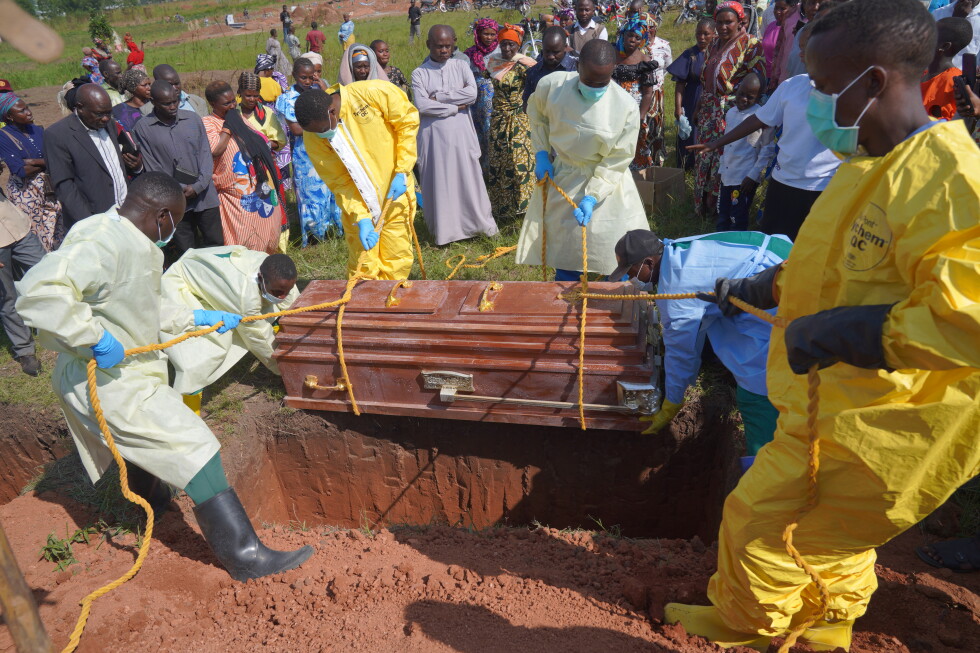
BUNIA, Democratic Republic of Congo – A rapidly expanding Ebola outbreak in eastern Congo has outpaced international and local containment efforts, crossing a grim milestone this week with more than 3,000 fatalities recorded across over 6,100 confirmed cases, new government data released Wednesday confirms.
According to figures from Congo’s Ministry of Health, the outbreak has reached 6,186 confirmed infections since the World Health Organization declared it a global public health emergency in mid-May, with 3,007 confirmed deaths to date. Health officials confirm this is now the fastest-growing Ebola outbreak in recorded history, with transmission accelerating far more quickly than contact tracing and public health teams can respond.
The crisis has upended daily life for communities across affected regions, forcing many residents to flee high-transmission zones to seek safety. Jean-Claude Angwanzia, a Bunia resident who relocated from Mambassa in the Ituri province epicenter, described widespread insecurity and a lack of visible public health support. “I had to flee the area because of the danger looming over us,” he said, noting infected bodies were often mishandled and health workers were rarely seen in the hardest-hit communities.
Local economic and daily activity has slowed dramatically as fear of transmission spreads. Papy Baraka, a public transportation driver based in Bunia, told reporters he has been forced to reduce the number of passengers he carries per trip to lower exposure risk. “The disease puts everyone at risk, and daily life has slowed to a crawl. We are afraid,” he said.
In recent weeks, the virus has expanded its reach at an alarming rate: just last week, two additional health zones in North Kivu province reported their first cases, pushing the total number of affected jurisdictions to 60 across six Congo provinces. The fatality rate in North Kivu is significantly higher than in other impacted regions.
A new assessment released Tuesday by the U.S. Centers for Disease Control and Prevention (CDC) echoed on-the-ground accounts of failing containment, concluding current response efforts “remained below established response targets.” The report warned that the virus’s spread across dozens of health zones signals “uncontrolled expansion of the outbreak.” CDC data shows only 15% to 20% of new confirmed cases stem from known transmission chains, meaning the vast majority of new infections are occurring through unknown, untraced contacts.
Multiple interconnected factors have fueled the outbreak’s unrelenting spread. The eastern Congo region where the virus is concentrated has long grappled with ongoing armed conflict, which disrupts access to impacted communities. Health care workers responding to the crisis have also faced repeated targeted attacks, and have staged multiple strikes over delayed pay and inadequate working conditions. A highly mobile population of artisanal miners moving across regional borders, combined with long-underfunded and underdeveloped local health infrastructure, has further hampered response efforts. Even the recent reopening of schools in the outbreak’s epicenter has sparked widespread concern about rapid transmission among crowded student populations.
The World Health Organization warns the outbreak is on track to surpass the deadliest Ebola event in history: the 2014-2016 West African regional outbreak that killed more than 11,000 people across three countries. The Africa CDC added that official case counts are likely a significant undercount, estimating the actual number of infections could be three times higher than reported due to weak surveillance and contact tracing systems. Even at the current confirmed count, this is already the deadliest Ebola outbreak in Congo’s history.
Unlike previous Ebola outbreaks that have been effectively contained with existing vaccines, the current outbreak is caused by the rare Bundibugyo Ebola virus, for which no fully approved vaccine or targeted treatment currently exists. A small number of vaccine candidates are in late-stage development, however, and last week the Congolese government launched distribution of the Ervebo vaccine – which successfully controlled previous Ebola outbreaks – to front-line health workers in Kisangani, the capital of northeastern Tshopo province. WHO officials note Ervebo may provide at least partial protection against the current variant.