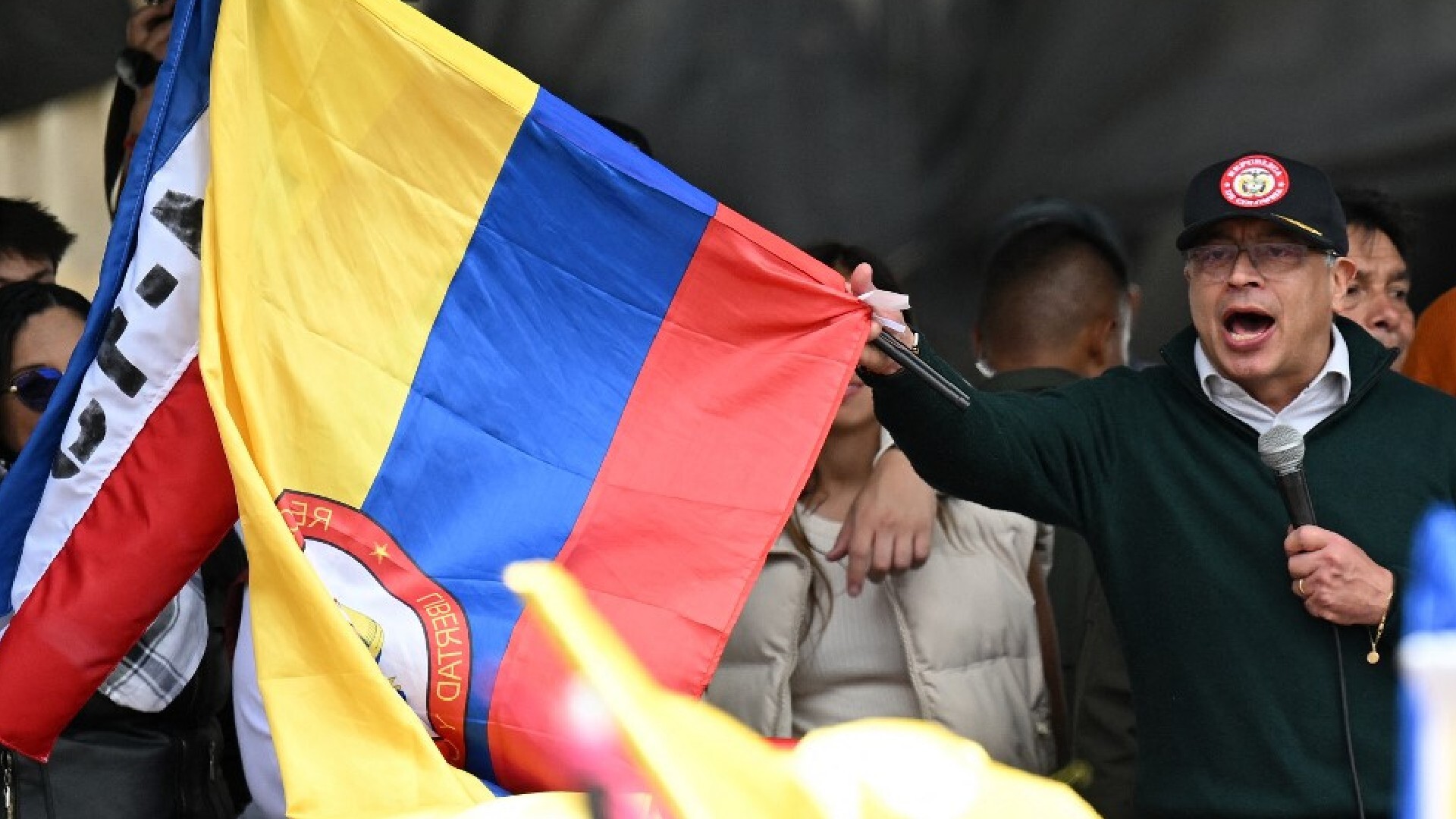
Against the backdrop of growing international outrage over Israel’s military campaign in Gaza, Colombian President Gustavo Petro has made history by implementing a complete, ironclad ban on all coal exports to Israel – a move that campaigners say proves an energy embargo on Israel is achievable with sufficient political will, while also laying bare the gap between rhetoric and action from other high-profile nations that have publicly backed Palestinian rights.
The road to the full embargo began in 2024, when Petro first issued a decree banning Israeli-bound coal exports. But a critical loophole allowed multinational mining corporations to continue shipments to honor pre-existing contracts. By July 2025, that loophole was being actively exploited: the Maltese-flagged cargo vessel *Fortune*, loaded with coal mined by U.S. firm Drummond, departed Colombia’s Puerto Drummond bound for Israel’s Hadera port in open defiance of the spirit of the 2024 ban. Within hours of the *Fortune*’s departure, Petro ordered the Colombian navy to intercept and block all further coal supplies to Israel. On August 28, 2025, a revised, closed-loophole decree entered into force, cutting off all Colombian coal exports to Israel entirely.
“Not a ton of coal leaves for Israel, and I take responsibility,” Petro pledged. As Colombia was Israel’s single largest supplier of coal for electricity generation, exports dropped to zero within months. By November 2025, the ban was fully enforced.
The push for the embargo originated from grassroots pressure, not just presidential policy. Weeks after the outbreak of Israel’s military operation in Gaza in October 2023, Palestinian trade unions called on Colombia to end energy exports, a demand quickly taken up by Sintracarbon, Colombia’s largest mineworkers union. When the 2024 loophole allowed 28 Drummond ships to deliver coal to Israeli ports between October 2024 and April 2025, a broad coalition of union organizers, Indigenous groups, and BDS activists raised the alarm, forcing the government to close the regulatory gap.
Indigenous communities in Colombia’s coal-producing regions have framed the issue as a “double genocide,” linking the extraction of coal for Israel’s military to their own long-running displacement and environmental harm. In La Guajira, the Wayuu people have spent decades fighting the Cerrejon mine, one of the world’s largest open-pit coal operations, run by Anglo-Swiss mining giant Glencore. The Global Legal Action Network (GLAN) has documented more than 336,000 cases of respiratory illness in the region directly tied to toxic mine dust, with elevated long-term risks of cancer and genetic damage. Glencore has denied wrongdoing, saying it upholds international human rights standards and runs community development programs, but the company faces ongoing legal action: in 2017, Colombia’s constitutional court ordered a halt to Cerrejon’s expansion over plans to divert a critical water source for the Wayuu, prompting Glencore to launch an international arbitration claim against the Colombian state for millions in compensation.
Colombia’s coal sector also carries a legacy of paramilitary violence against organized labor. The country is the deadliest in the world for trade unionists, with more than 3,000 organizers murdered since the 1990s. Both Drummond and Glencore (via its subsidiary Prodeco) have been accused of financing and colluding with far-right paramilitary groups between 1996 and 2006, sharing intelligence on targeted union leaders. A 2014 report collected testimony from ex-paramilitaries, victims, and former employees supporting the allegations, which both companies have repeatedly denied, calling testimonies unreliable. In 2023, Colombia’s attorney general’s office announced it would put Drummond’s current and former chief executives on trial for conspiracy to finance paramilitarism, a charge the company continues to reject. Campaigners also note a historical link between Israeli mercenaries and Colombian paramilitaries: Yair Klein, an Israeli ex-soldier, was convicted by a Colombian court in 2001 for training AUC militias in the 1980s.
Today, the Colombian embargo faces political uncertainty: the country will hold its second round of presidential elections in June 2026, and far-right candidate Abelardo de la Espriella, who won 43.7% of the first-round vote, has pledged to reverse the ban, restore full diplomatic ties with Israel, and open a Colombian embassy in Jerusalem. Even so, campaigners celebrate the embargo as proof that political will can cut off energy supplies that enable military operations.
In March 2026, Colombia co-chaired a landmark meeting of 40 nations in The Hague, convened by The Hague Group, a coalition working to enforce international law amid the Gaza conflict. At the meeting, participating governments including China, Saudi Arabia, and Spain committed to ban fuel exports to Israel, implement stricter port and transit controls, and restrict the movement of arms, military supplies, and dual-use goods bound for Israel. But a closer look at trade data reveals that many signatory nations have failed to follow through on their commitments, with some even increasing energy exports to fill the gap left by Colombia.
The most prominent example is South Africa, which co-chaired the The Hague meeting and is the lead claimant in the landmark genocide case against Israel at the International Court of Justice (ICJ). As Colombian exports fell to zero, South Africa’s coal shipments to Israel surged by 87% to fill the gap. Even before the full Colombian embargo, South Africa was Israel’s second-largest coal supplier in the first half of 2024, accounting for 60% of all Israeli coal imports. Most of this coal powers Israel’s national electricity grid, which supplies energy to Israeli Defense Force bases, weapons manufacturing facilities, surveillance infrastructure, and illegal settlements in the occupied West Bank – even as Israel restricts electricity access for Palestinian civilians in Gaza and the West Bank.
South African activists from the BDS Coalition have called on the government to enforce a ban, pointing out that the government is legally obligated under its own constitution and the Genocide Convention to prevent trade that supports alleged international crimes. South African attorney Sirhaan Che Khan notes that the government already has the power to implement export restrictions without new parliamentary approval, using the same International Trade Administration Act powers it invoked to restrict medical supply exports during the COVID-19 pandemic. The WTO’s trade rules also include security exceptions for actions taken to uphold UN Charter obligations for peace and security – a standard Colombia has already invoked without facing legal challenge.
Despite this, the South African government has failed to act. BDS coordinator Roshan Dadoo said activist requests for meetings with trade officials have yielded no commitments, with Trade Minister Parks Tau arguing a ban could face legal challenges under WTO rules and that political consensus is impossible in the country’s unity government, which includes the pro-Israel Democratic Alliance alongside the ANC. A government source, speaking anonymously to Middle East Eye, said businesses harmed by a ban could sue the state without new legislation, even though activists say existing law already grants the executive sufficient power. The South African Department of Trade, Industry and Competition did not respond to requests for comment by publication time, leaving a stark contradiction between the country’s bold international legal stance against Israel’s actions and its ongoing trade in energy.
Brazil, another high-profile signatory that has publicly backed South Africa’s ICJ case and recalled its ambassador to Israel after Lula compared Israel’s actions to the Holocaust, has similarly continued supplying energy to Israel via indirect routes. In 2024, Brazil became Israel’s fourth-largest crude oil supplier, accounting for 9% of Israel’s imports. State-owned Petrobras claims it never sells crude directly to Israel, only to third-party refineries, and has no control over the final destination of refined products. But union leaders say that is a deliberate loophole.
Leandro Lanfredi, a leader of Brazil’s National Federation of Oil Workers, told Middle East Eye that Brazilian crude is redirected to Italian refineries, which then process and ship it to Israel. In June 2025, after a combination of an Iranian drone strike on Israel’s largest refinery in Haifa (which took the facility offline for months) and scheduled maintenance at Ashdod’s refinery crashed Israeli domestic refining output to a 30-year low, demand for imported refined fuel surged. Data collected by Lanfredi shows that the share of Brazilian crude in the blend at Italy’s Saras refinery in Sardinia jumped from a historical average of 7% to 47% in June 2025, just as the refinery began exporting an estimated 45,000 tons of refined petroleum to Israel. “Of course Petrobras knows who their clients are,” Lanfredi said, noting that the Brazilian government owns more than 50% of voting shares in the state oil giant and has the regulatory power to enforce a ban, but has resisted to avoid friction with private investors. Brazil’s foreign ministry did not respond to requests for comment.
Activists say Brazil has a clear precedent for such action: in 1985, center-right President Jose Sarney implemented a full oil and arms embargo against apartheid South Africa, proving that even moderate administrations can enforce energy embargoes for human rights. “If it was possible for him to do it, it is more than possible for President Lula,” Badra El Cheikh of the Palestine Institute for Public Diplomacy told MEE.
The core barrier to broader action, activists say, is fear of U.S. retaliation. “I think most of all, they are afraid of the backlash that could come from Israel’s biggest partner in crime, which is the US. They’re afraid of sanctions, and afraid of anything that the US might do against their economies,” El Cheikh explained. Ana Sanchez, general coordinator of Global Energy Embargo for Palestine (GEEP), added that energy deals face far less international regulation than arms sales, which are at least constrained by the Arms Trade Treaty. Many governments also hide behind the false claim that an energy embargo targets civilians, she said, ignoring that energy powers the military machine that drives the conflict.
For campaigners, Colombia’s successful implementation of a full embargo proves that the gap between global rhetoric on Palestinian rights and action is not inevitable – it is a choice, rooted in political priorities rather than legal or economic constraint.