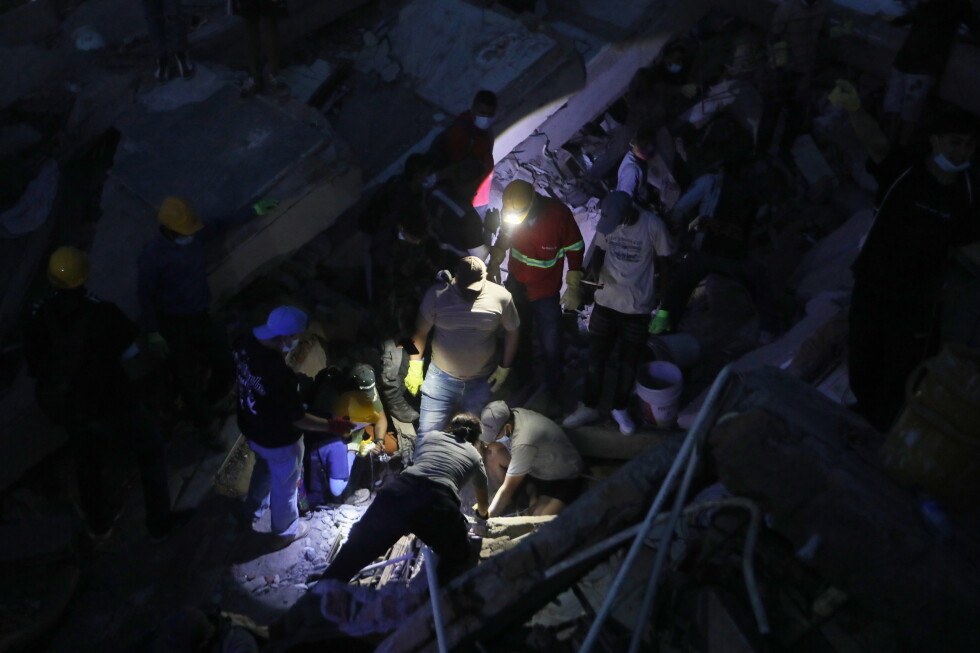
In the early hours of Tuesday, frantic search and rescue operations spread across dozens of urban and rural communities in western Colombia, just one day after a powerful 7.4-magnitude earthquake tore through the region, leaving a trail of death, destruction, and uncertainty for thousands of residents.
The tremor, which struck Monday, shook major population centers including Cali, Pereira, Quibdo, and dozens of smaller surrounding towns. Preliminary assessments confirm at least 111 people have been confirmed dead, and an estimated 1,600 structures across the affected area have been damaged or completely reduced to rubble. With heavy machinery struggling to reach some hard-hit remote areas, soldiers, professional rescue teams, civilian volunteers, and anxious family members have formed human chains to move chunks of concrete and debris by hand, digging through wreckage in hopes of finding survivors trapped beneath fallen buildings.
By Monday evening, more than 2,700 people had been registered as missing, with desperate relatives sharing photos and details of their unaccounted-for loved ones on community-run online platforms. Among those searching is Dana Carolina Zamora, who posted a picture of her 60-year-old uncle Miguel Ángel Zamora, a farmer who lived in a rural zone outside the town of El Cairo, just a short distance from the earthquake’s epicenter in San Jose Del Palmar.
Local officials estimate that 80 percent of El Cairo — a small community of roughly 7,000 residents — suffered structural damage. Zamora explained that her uncle lived in a traditional home constructed from sticks and mud, a building type widely known to be extremely vulnerable to seismic activity. “We are afraid. We hope that is not the case, that he is all right and that it is only a communication failure. But we haven’t heard anything from him,” Zamora told reporters, voicing a mix of hope and anxiety shared by hundreds of other waiting families.
The epicenter of the quake falls within Choco, a region long ranked as one of Colombia’s poorest and most underserved areas. The region is also frequently destabilized by clashes between competing armed groups, and much of its territory can only be reached by air, boat, or overland jungle routes. As of early Tuesday, full assessments of damage in the most remote parts of Choco were still out of reach, leaving authorities unable to confirm the full scope of human and structural loss.
The disaster marks the first major national crisis for Colombia’s new president, Abelardo de la Espriella, who was just sworn into office last Friday. The conservative leader, who has already drawn national division over his promise to launch an all-out crackdown on criminal gangs, traveled to Choco’s capital Quibdo on Monday night to survey the damage firsthand. During his visit, he announced the mobilization of “the entire military and police apparatus” to support response efforts, deploying military engineers, specialized rescue teams, and search and rescue dogs to affected areas. He also unveiled immediate support measures for displaced residents, including rental subsidies for homeowners forced to leave damaged properties while repairs are completed. “Choco will never again be the ‘land of the forgotten,’” he pledged in remarks Monday.
The international community has already begun mobilizing support for Colombia’s response. The U.S. State Department announced an immediate contribution of $15.5 million to fund emergency shelter, food distributions, and other critical life-saving aid. Governments across Latin America have also offered assistance, joining the effort to support relief operations.
For Colombians, the earthquake has stirred fresh trauma, coming just weeks after two consecutive major quakes devastated neighboring Venezuela in late June. That disaster destroyed hundreds of buildings and killed more than 6,300 people, leaving many across the Andean region already on edge ahead of Monday’s tremor.
Even for those who escaped unharmed, the scope of the destruction has left lasting shock. Mónica Sánchez, who owns a small work uniform manufacturing company in Pereira — one of the hardest-hit urban centers — saw an interior wall of her factory collapse during the quake. She and her 12 employees managed to evacuate to safety just moments before the structure gave way. “It was shocking — the city fell down around us,” she said of the terrifying experience.