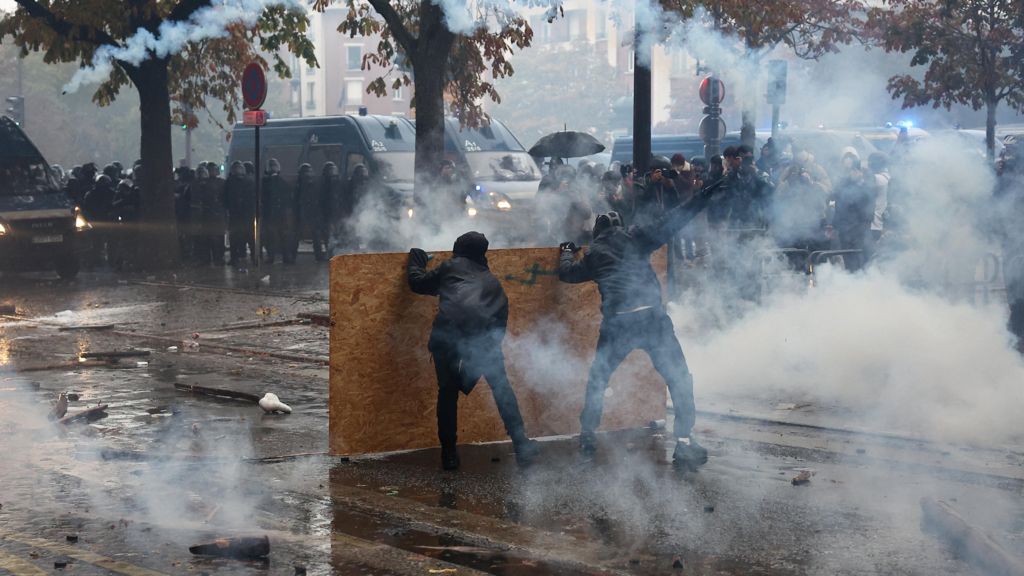
On Saturday, a wave of largely peaceful demonstrations spread across French cities to voice public anger over soaring living costs and inadequate school conditions, only to descend into scattered late-night skirmishes between radical demonstrators and law enforcement that marked a tense follow-up to the unprecedented rioting that roiled the country the previous weekend. More than 70,000 uniformed officers, including elite counter-terrorism and organized crime units, were deployed nationwide alongside targeted movement restrictions ordered by local prefectures, as the Macron administration sought to avoid a repeat of the widespread looting, arson, and chaos that had left over 2,000 businesses damaged, 1,000 police officers injured, and hundreds of millions of euros in losses per France’s Chambers of Commerce and Industry. The official government tally put Saturday’s total turnout at 410,000 attendees, while trade union organizers claimed the figure reached 800,000, with an additional 13,000 people holding a separate peaceful rally in Orléans against the far-right National Rally party. As daylight faded, unrest flared across multiple urban centers: in Paris’s Porte de Vincennes district, masked groups hurled projectiles at officers and smashed the windows of a nearby car dealership, prompting baton charges and targeted crowd dispersal operations. In the southern port city of Marseille, demonstrators set fire to makeshift barricades constructed from discarded rubbish bins and metal sheeting, with footage capturing a law enforcement vehicle navigating through a burning street blockade. In Bordeaux, protesters ripped wooden boards off commercial storefronts to build additional barricades, while in Lyon, police launched tear gas grenade assaults to clear a crowd that had gathered in a pre-designated restricted zone, with a local student protester describing being engulfed in acrid fumes within minutes of the assembly forming. French Interior Minister Laurent Nuñez confirmed late Saturday that roughly 1,000 people had been taken into custody, with that figure projected to rise in subsequent hours, and reported two severe civilian injuries in Toulouse and Clermont-Ferrand respectively. Nuñez noted that several thousand radical activists had positioned themselves at the rear of otherwise peaceful marches, including a core group of 500 known repeat rioters. Under a decree issued by President Emmanuel Macron earlier that week, only demonstrations formally organized by registered trade unions were granted legal authorization, and fast-track judicial proceedings in recent days have already resulted in hundreds of jail sentences for individuals convicted of vandalism, arson, or looting. Many peaceful attendees shared their deep-seated frustration with the BBC: 26-year-old Paris resident Zelie stated that widespread overtaxation and eroding purchasing power had left ordinary people suffering for years under the Macron administration, with no formal outlet to voice their grievances. Teenage demonstrators echoed that sentiment, noting that while they condemned the looting seen the prior weekend, the outbreak of violence stemmed from systemic poverty and heavy-handed police tactics, and that protests would continue until the government delivered tangible policy changes to address their demands.