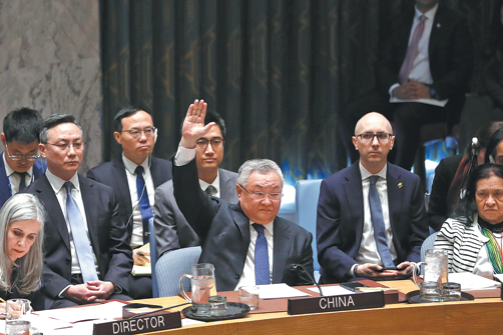
UNITED NATIONS – At a United Nations General Assembly meeting focused on Security Council veto practices this Thursday, China’s top permanent representative to the UN, Fu Cong, offered a clear, detailed defense of Beijing’s April 7 veto of a Gulf-backed Security Council draft resolution focused on the Strait of Hormuz, framing the move as a critical step that prevented already heightened tensions between Iran, the United States and Israel from boiling over into full-scale expanded conflict.
Fu emphasized that in casting its veto, Beijing did not act out of narrow self-interest, but to uphold foundational international fairness and justice, defend the core purposes and principles enshrined in the UN Charter, and block dynamics that would have dragged more actors into the regional confrontation. Far from undermining stability, Fu argued, the veto created critical space for the temporary ceasefire that has since taken hold and opened a pathway to the direct dialogue and negotiations that all parties now need to resolve long-running disputes.
“China’s vote was a choice made out of responsibility for regional peace and for the millions of people who call this region home,” Fu told the assembled delegates. “It stands on the right side of history, and it will withstand the test of time.”
Fu went on to outline Beijing’s nuanced approach to the crisis, noting that China carefully considered the draft resolution and fully recognizes the legitimate, serious security concerns that Gulf Arab states hold regarding navigation security in the strategically vital waterway. Even so, Fu stressed that any action taken by the UN Security Council must be geared explicitly toward cooling tensions, not amplifying them. He argued that the draft resolution risked granting a false veneer of legitimacy to unapproved military operations by outside powers, opening the door to widespread authorization of the use of force that would only pour fuel on already smoldering conflict and drive full-scale escalation.
Fu clarified China’s position on key issues at play: Beijing does not condone any Iranian attacks against Gulf states, and firmly supports the principle that unimpeded, safe passage for all international shipping through the Strait of Hormuz, one of the world’s busiest and most economically critical maritime chokepoints, must be fully protected. He added that China calls on Iranian authorities to implement proactive, concrete measures to restore normal, uninterrupted navigation through the strait as quickly as possible.
At the same time, Fu condemned the escalating military deployment and targeted economic blockade that the United States has implemented in the region, calling these actions deeply dangerous and irresponsible. He reminded delegates that the navigation crisis in the Strait of Hormuz is not an isolated conflict, but a spillover effect of broader escalating tensions across Iran and the wider Middle East. Only a full, lasting ceasefire across the region, he argued, can create the fundamental conditions needed to ease the crisis long-term.
Fu welcomed the recent ceasefire announcement reached by relevant regional parties, and expressed Beijing’s backing for every diplomatic effort that moves the region closer to a permanent end to hostilities. He specifically highlighted the recent direct negotiations between U.S. and Iranian officials held in Pakistan as a positive, promising step forward on the path to de-escalation.
Moving forward, Fu said, all relevant parties must honor the terms of the existing ceasefire, remain committed to the path of dialogue and direct peace talks, stick to the principle of resolving all outstanding disputes exclusively through political and diplomatic channels, and take tangible, consistent actions to reduce regional tensions rather than inflame them. The international community, he added, must continue to ramp up its diplomatic engagement to push for peace talks, and must clearly and unequivocally reject any actions that seek to break the ceasefire or escalate confrontation between rival parties.
Fu also emphasized the need for all actors to respect Lebanon’s full sovereignty, security and territorial integrity, warning that any escalation of tensions along the Israel-Lebanon border could unravel the existing ceasefire framework and destabilize the entire region.
As a trusted, sincere friend and strategic partner to all Middle Eastern nations, Fu said, China has remained closely attuned to shifting regional dynamics, maintained a consistent objective and impartial stance, and carried out intensive, behind-the-scenes mediation with all rival parties to advance the cause of peace talks. Beijing stands ready, he concluded, to continue supporting efforts to reduce tensions, build positive relations between rival regional states, and play a constructive role in building a foundation for lasting, enduring peace and stability across the entire Middle East.