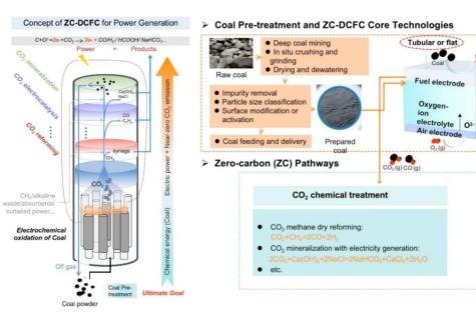
As global energy systems grapple with the dual challenge of meeting rising power demand and cutting greenhouse gas emissions, a team of Chinese researchers has introduced a groundbreaking new approach to coal-based power generation that promises near-zero carbon dioxide output. The innovation, led by Xie Heping, an academician of the Chinese Academy of Engineering and professor at Shenzhen University, was officially published in the academic journal *Energy Reviews* on Thursday, according to an official statement released on the university’s website.
Traditional coal-fired power generation relies on thermal combustion to heat water into steam, which then drives turbines to produce electricity. This centuries-old approach is inherently inefficient, and it releases massive volumes of carbon dioxide that drive climate change. By contrast, the new zero-carbon-emission direct coal fuel cell (ZC-DCFC) technology skips the combustion step entirely. Instead, it converts the chemical energy stored in coal directly into electrical power through a controlled electrochemical oxidation reaction, eliminating the carbon emissions associated with burning fuel.
For decades, coal has remained the backbone of global energy supply, meeting roughly one-third of the world’s total energy demand even as renewable energy capacity expands rapidly. Current leading advanced coal power technologies, such as Integrated Gasification Combined Cycle (IGCC), top out at energy conversion efficiencies of around 45 percent, and still produce more than 800 grams of CO2 for every kilowatt-hour of electricity generated, according to the research team’s analysis.
The research team began developing the ZC-DCFC concept in 2018, and over eight years of iterative development, they have delivered key breakthroughs in three critical areas: high-performance reaction materials, specialized pre-treatment for coal fuel, and optimized electrode design that enables stable, efficient power output. Beyond cutting emissions, the technology opens new possibilities for utilizing coal resources that were previously considered uneconomical or high-impact to develop. As easily accessible shallow coal reserves are gradually depleted around the world, the innovation could unlock deep underground coal deposits while transforming coal from a major climate liability into a fundamentally cleaner energy source to support the global energy transition.