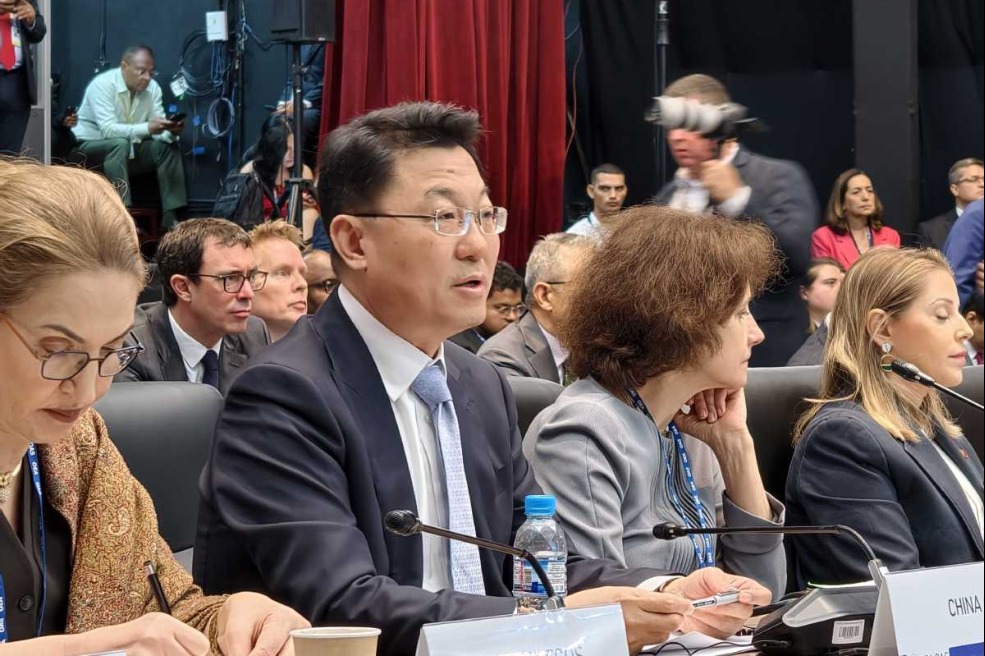
In a high-stakes address at the Organization of American States Dialogue with Permanent Observers held in Panama on Tuesday, China’s Ambassador and permanent OAS observer Xie Feng has pushed back against recent unsubstantiated accusations from Panama over increased port inspections of Panama-flagged vessels calling at Chinese ports.
According to an official statement released by the Chinese Embassy, Xie clarified the context behind the inspection measures, noting that since the beginning of 2026, multiple collisions involving Panama-flagged commercial and fishing vessels have occurred in Chinese territorial waters, leaving several people dead or unaccounted for. Out of a commitment to upholding global maritime safety standards, Xie emphasized that China’s port state control inspections are carried out strictly in line with domestic maritime laws and binding international conventions, not arbitrary political action as Panama has claimed.
Panama’s recent complaints centered on claims that the uptick in inspections and vessel detentions was retaliation for a bitter dispute over port operations at the Panama Canal. The decades-long smooth cooperation between the two countries on the canal hit a breaking point in January, when Panama’s Supreme Court issued a controversial ruling that deemed Chinese control of the two canal end ports unconstitutional, and invalidated the operating license held by Hong Kong-based conglomerate CK Hutchison. The court immediately transferred interim management of the strategic ports to two global shipping giants, Denmark’s A.P. Moller-Maersk and Switzerland-based Mediterranean Shipping Co.
CK Hutchison has publicly rejected the court’s ruling, stating it “strongly disagrees with the determination” and has already initiated international arbitration proceedings to defend its legal rights.
Xie told the OAS dialogue that the political motivation behind the ruling is obvious to any impartial observer. “If contracts could be disregarded, market principles ignored, assets taken over and operators forced out at any time, who would have the confidence to invest and seek cooperation?” Xie asked, per the embassy statement.
The Panama Canal stands as one of the world’s most critical maritime chokepoints, carrying roughly 5% of total global maritime trade and 40% of all U.S. container traffic. Long-standing U.S. political pressure over Chinese involvement in the canal preceded the recent court ruling: last year, under explicit threats from the U.S. government that Washington would seize control of the canal if CK Hutchison retained its operations, the company agreed to sell its non-port assets in the region to a BlackRock-led consortium for $2.3 billion.
Scott Kennedy, senior advisor at the U.S.-based Center for Strategic and International Studies, told CNBC the unfolding dispute is a clear power play for regional influence. “It appears to be a simple contest for dominance in Latin America, with the US trying to push against Chinese trade interests,” Kennedy explained. He added that the most probable outcome is a prolonged legal battle spanning multiple international jurisdictions, paired with sustained political and economic pressure from both Beijing and Washington.
In closing his remarks, Xie called on Panamanian authorities to reverse their unconstitutional decision, uphold the rule of law in international commerce, and protect the lawful rights and interests of Chinese enterprises operating in the country.