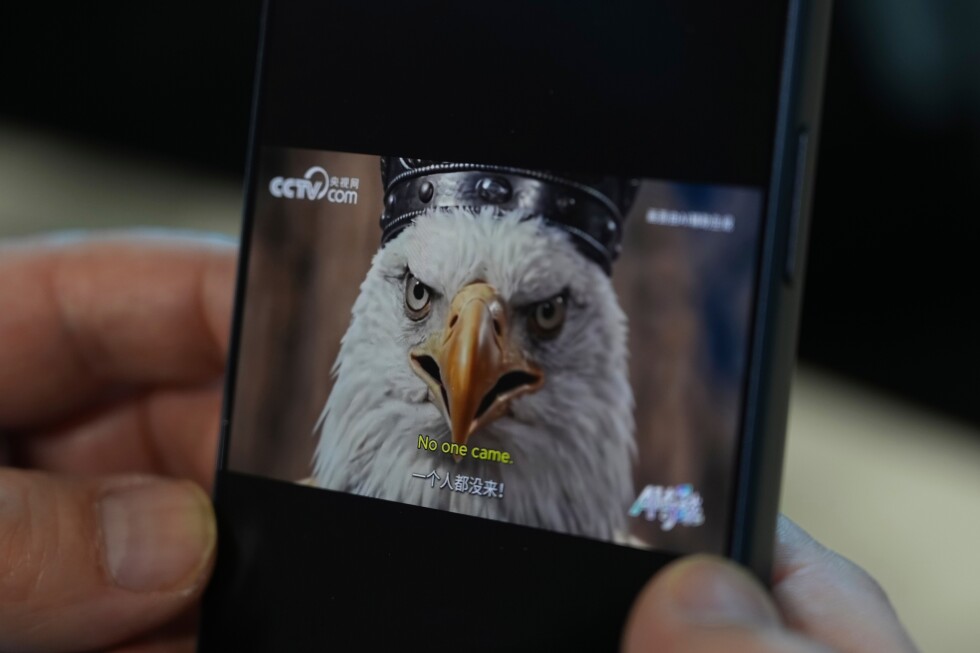
In a marked departure from its decades-long tradition of stiff, dogmatic political messaging, China’s government has embraced cutting-edge artificial intelligence and viral social media strategies to project its worldview onto the global stage — with the United States frequently serving as the central target of its sharp-edged content. This shift marks a new chapter in the intensifying global information war, where Washington has already begun ramping up countermeasures to push back against foreign anti-U.S. narratives that it says threaten its national security.
The most prominent recent example of this new approach is a five-minute AI-generated animated short released by China’s state-run China Central Television, framed in the style of a classic martial arts film to deliver an allegorical take on the ongoing conflict in Iran. In the video, a well-dressed white eagle standing in for the United States cackles menacingly before launching an attack on a faction of black-cloaked Persian cats representing Iranians. After losing their leader, the cats vow to retaliate and block a key global trade chokepoint, weaving together themes of injustice, resistance and geopolitical power plays. This Iran-focused short is just one of multiple AI-powered satirical works produced by Chinese state media in recent months that cast the U.S. as a global bully, targeting former President Donald Trump’s provocative policies ranging from his open suggestion of annexing Greenland to his push for U.S. dominance in the Western Hemisphere.
This evolution of Chinese global messaging aligns with years of push from Chinese President Xi Jinping, who has prioritized expanding China’s global communication capacity, securing a louder voice in international affairs, and countering Western narratives that Beijing views as biased or hostile to its interests. It is not only Chinese state outlets deploying this tactic: pro-Iran factions have also turned to polished AI-generated memes to taunt the U.S. and its former leadership as part of broader information campaigns.
Experts note that AI-infused “infotainment” distributed via social media represents a far more effective tool for winning over young global audiences than the dry, slogan-heavy propaganda of the past. “It is a new way for Chinese mainstream media to engage global Gen Z audience and social media users to understand Chinese standpoint and viewpoint of international affairs,” explained Shi Anbin, director of the Israel Epstein Center for Global Media and Communications at Tsinghua University. The Iran-themed animation, widely regarded as one of the most polished pieces of state media AI content to date, quickly went viral among Chinese domestic audiences after its release, earning praise for distilling a complex geopolitical crisis into an accessible, engaging narrative. After an X user translated and shared the subtitled clip to English-speaking audiences, it racked up more than 1 million views in just a few days. Andrew Chubb, a senior lecturer in global affairs at Lancaster University who studies political propaganda, noted that the work feels far removed from traditional overt propaganda: “It’s hardly even like propaganda — it almost seems more just a historical fiction dramatization of the situation.”
This shift is a dramatic break from China’s communication past. For decades, Chinese official messaging relied on stiff, slogan-filled speeches in party-run newspapers, dry ideological study materials required for students and junior officials, and rigid, unapproachable rhetoric that failed to resonate with younger generations. As domestic audiences drifted away from this outdated tone, Beijing began a deliberate overhaul: it now embraces playful internet slang to retell party history, uses rap music to celebrate the ruling party’s achievements, recruits A-list pop stars and actors to star in blockbuster patriotic films that draw audiences through star power rather than mandatory attendance, and even turned anti-corruption dramas into hit television shows by prioritizing compelling plots and sharp writing.
Urged to deliver messaging that is both engaging and persuasive, Chinese state media have rushed to experiment with non-traditional, digitally native formats, AI-generated content chief among them, according to Wang Zichen, deputy secretary-general of the Beijing-based Center for China & Globalization. “Whatever one thinks about the format, the message itself clearly resonates with increasingly larger audiences, which helps explain why such content gains traction online,” Wang said.
Beijing has invested heavily in building a sprawling global communication ecosystem, constructing a vast “matrix” of social media accounts across major Western platforms including X and Facebook, managed by a mix of diplomats, state media outlets, influencers and automated bots. These outlets regularly seize on current events to push Beijing’s narrative. In February, for example, state-run Xinhua News Agency released an AI-generated music video mocking Trump’s suggestion to take over Greenland, featuring a military-uniformed bald eagle singing lyrics that brag “Anything I want, I’ll get it. One way or another, I’ll get it.” A month later, after Trump hosted the “Shield of the Americas” summit, Xinhua followed up with another short video, this one depicting a suited bald eagle trapping small birds in a cage under the pretext of national security, dryly noting “Sometimes, security comes with a little control.”
The growing sophistication of these foreign messaging campaigns has already prompted pushback from Washington. Recent State Department diplomatic cables have warned that state-run foreign media campaigns on digital platforms “pose a direct threat to U.S. national security and fuel hostility toward American interests,” and the U.S. has pledged to ramp up its own efforts to counter these narratives in what has become an escalating global information conflict.