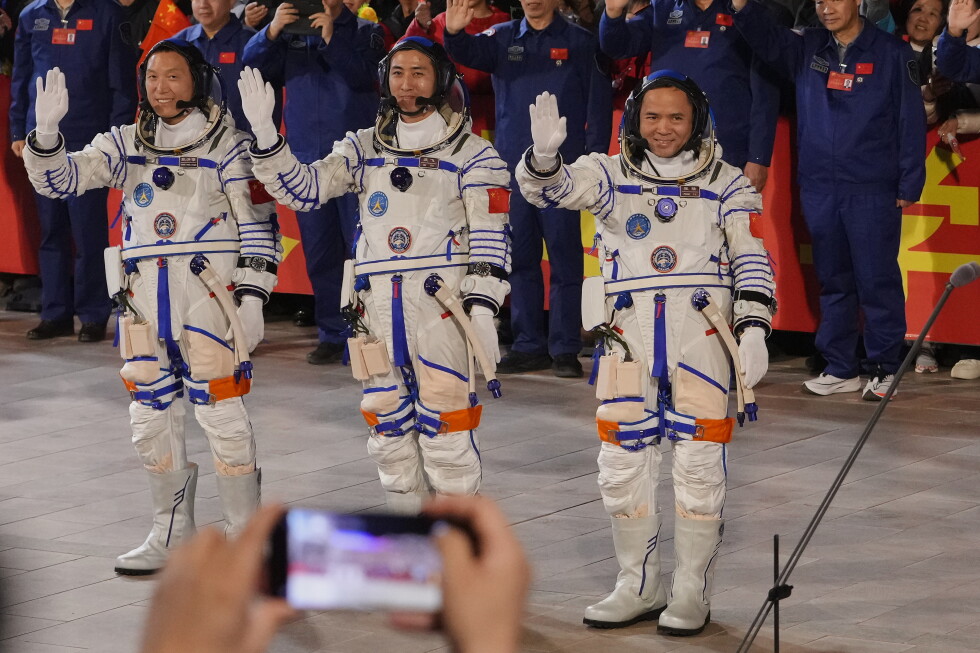
BEIJING – Three Chinese taikonauts from the Shenzhou 21 mission touched down safely on Friday evening at the Dongfeng landing site in northern China’s Inner Mongolia Autonomous Region, wrapping up a nearly seven-month stay aboard the country’s Tiangong Space Station and completing a formal handover to the newly arrived Shenzhou 23 crew earlier this week.
The successful return of crew members Zhang Lu, Wu Fei and Zhang Hongzhang marks another key milestone for China’s expanding human spaceflight program, which is currently accelerating development work ahead of the country’s planned first crewed lunar landing by the end of the 2020s. According to official statements from the China Manned Space Agency (CMSA) carried by China’s national news agency Xinhua, the Shenzhou 21 team checked off a full roster of technical and scientific objectives during their orbital mission.
Beyond maintaining the space station’s operational systems, the crew processed and transmitted a large volume of data from ongoing on-orbit experiments, coordinated the transfer of leftover supplies to the incoming crew, and conducted in-depth experience sharing sessions with the three Shenzhou 23 astronauts, who arrived at Tiangong on Monday. Prior to their departure, the crew also completed three extravehicular activities (EVAs), more commonly known as spacewalks.
CMSA spokesperson Zhang Jingbo noted that mission commander Zhang Lu, who previously flew on the Shenzhou 15 mission to Tiangong, has now completed seven spacewalks across his career — a new record for the most spacewalks by any Chinese astronaut. This achievement underscores the growing experience and expertise of China’s astronaut corps as the program takes on more ambitious deep-space objectives.
The handover to Shenzhou 23 opens a new chapter for Tiangong operations: one of the incoming crew, Lai Ka-ying (also transliterated as Li Jiaying from Mandarin), a native Hong Konger, made history as the first astronaut from Hong Kong to participate in a Chinese space station mission. Additionally, one Shenzhou 23 crew member is scheduled to remain on orbit for a full 12-month stay, a first for China’s human spaceflight program that will generate critical data on long-duration human exposure to microgravity.
China’s Tiangong Space Station was developed and constructed independently after the country was barred from participating in the International Space Station (ISS) over national security concerns raised by the United States, which has since emerged as China’s primary competitor in the 21st-century space race. Currently, NASA is pursuing its own Artemis program objectives, targeting a crewed lunar landing for 2028, two years ahead of China’s planned touchdown.