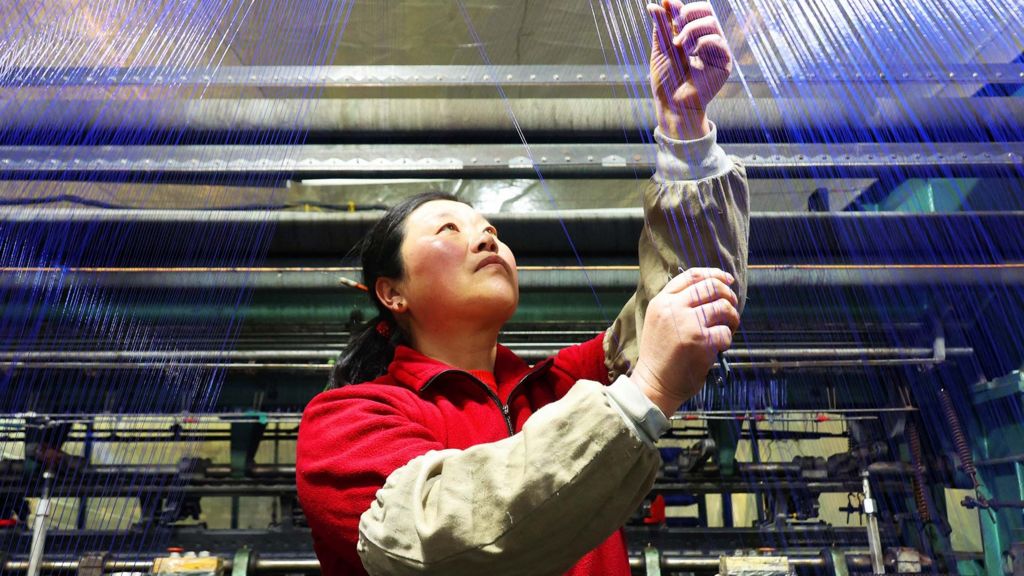
In the narrow back alleys of Foshan, one of China’s busiest manufacturing hubs, a group of weary workers huddle under a dusty tree, their expressions etched with anxiety. Storefront signs advertising short-term factory positions line the street behind them, but few workers here hold steady, well-paying jobs. Speaking on condition of anonymity for fear of repercussions, the workers share the harsh reality of their daily struggles. “No one understands what our life is like,” one middle-aged worker murmurs. Another adds a desperate, rare plea to a visiting foreign reporter: “We work endless hours and have no life of our own. Please help us.”
These workers have long navigated the seismic shifts reshaping China’s industrial sector, as the country moves away from low-cost mass manufacturing toward automated high-tech production. Many older, less skilled workers have already been left adrift, struggling to earn enough to support families back in rural hometowns. But their precarious situation has worsened dramatically since the US-Israel conflict with Iran erupted, sending new shockwaves through an already fragile Chinese economy.
Long before the Middle East conflict ignited, China’s economy was grappling with mounting pressures: slowing domestic growth, persistent youth unemployment, and lingering ripple effects from former US President Donald Trump’s sweeping tariffs implemented the previous year. Despite official data reporting roughly 5% annual GDP growth and resilient export volumes, public discontent over working conditions and economic uncertainty has continued to simmer beneath the surface. Now, the regional conflict has added a fresh layer of strain, squeezing factory order volumes, pushing up input costs, and eroding already fragile job security.
In Foshan, the best opportunities available to most workers these days are the temporary positions advertised in bright red paint on roadside signs: a few weeks of molding plastic components or assembling smartphone parts for 18 to 20 yuan per hour, a rate that translates to just a few dollars a day. Most workers searching for work here are over 40, and many say they have grown exhausted from constant economic uncertainty. “I’m going to head north to try my luck elsewhere,” one migrant worker from a central Chinese province says, packing his few belongings into a frayed canvas bag.
This widespread economic pain is a core reason Beijing has repeatedly called for an immediate end to the conflict. While China’s strategic investments in renewable energy, electric vehicles, and its own domestic oil reserves have shielded it from the worst of the global fuel price crisis, the conflict has disrupted shipping through the Strait of Hormuz—one of the world’s most critical energy and trade chokepoints. For an export-reliant Chinese economy already stuck in low gear, this disruption has translated to widespread pain across industrial supply chains.
An hour’s drive from Foshan, in Guangzhou’s sprawling fabric market—the largest of its kind on the planet—the impact of higher energy costs is already palpable. Motorcycles piled high with brightly colored fabric rolls weave through crowded streets, while small delivery vans honk their way between loading bays serving thousands of small textile traders. Here, every business relies on cheap, stable oil supplies to produce the petrochemical inputs needed to make synthetic fabrics. Traders across the market report that shipping and raw material costs have jumped by roughly 20% since the conflict began.
“Costs go up, but our customers refuse to accept higher prices,” one fabric trader explains over tea in his small back-office storage room. “Orders are drying up, and unsold fabric rolls are piling up in our warehouses. If we don’t pass the extra costs on to buyers, we have to swallow them ourselves—and we’re already working on thinner margins than we can afford.” A year ago, during the height of the US-China trade war, traders here spoke with open defiance against external pressure. Today, there is only quiet resignation.
Amid the widespread uncertainty, however, there are glimmers of opportunity, on display at the annual Canton Fair in Guangzhou, where thousands of Chinese manufacturers welcome global buyers in cavernous exhibition halls. This is the image Beijing is eager to project to the world: a forward-looking innovation hub, showcasing cutting-edge technology while the United States remains mired in Middle East conflict. Humanoid robots wave and sing for visitors taking selfies, long lines form to test AI-powered translation glasses and assistive robotic climbing legs, and everyday consumer goods from stain-clearing smart vacuums to high-end espresso machines draw crowds.
Even here, though, price tags are climbing, due in large part to higher oil-derived plastic input costs. But the conflict has also reinforced one key competitive advantage for Chinese manufacturers: electric vehicles (EVs). Data from the Chinese Passenger Car Association shows that Chinese factories exported 350,000 EVs in March alone—a 30% increase from February and a 140% jump from March of the previous year. EVs have long been one of China’s top exports to the Middle East, but the conflict has disrupted shipping routes, leaving many shipments stranded at Chinese ports.
Joyce Liu, an EV trader at the Canton Fair, explains that her business has been upended by the conflict. “Last year, 90% of our cars went to the Middle East, but this year we’ve almost completely stopped doing business there because of the war,” she says. “Some of our finished vehicles are still waiting for loading at Chinese ports right now.” Liu has come to the fair this year to court new buyers from Africa, South America, and South Asia—and she is not alone. As petrol and diesel prices skyrocket globally, waiting lists for affordable Chinese EVs have grown rapidly in dozens of developing economies.
Even Middle Eastern buyers are still exploring opportunities, despite the conflict. A trade delegation from Oman spent days inspecting EV models at the fair, and ultimately agreed to a new deal, haggling over terms under bright exhibition spotlights beside a banner printed in both English and Arabic. “We are here to build cooperation with Chinese companies,” says Zahir Mohammed Zahir al-Kaabi, a member of the Omani delegation. “Times are hard right now, but Inshallah the war will end soon and business will grow.”
That outcome—an early end to the conflict—is exactly what Beijing is working toward. Analysts note that despite some geopolitical opportunities for China in the conflict, the country is far from emerging as a clear winner. “Ironically, China has long hoped to see a relative decline in US global influence, but this is not the kind of declining US it wanted,” explains Yu Jie, a senior research fellow at London-based think tank Chatham House. “Beijing would far prefer a more predictable US that is easier to engage and manage.”
Yu adds that Beijing is walking a careful diplomatic line right now, eager to avoid irritating the Trump administration ahead of a scheduled US-China summit in May. “Beijing will do everything it can to keep that meeting on track,” she says. So far, China has taken a measured approach: it has publicly called for an immediate ceasefire, pushed its long-time ally Iran to enter negotiations, and echoed Trump’s own calls for de-escalation, while holding high-level meetings and calls with leadership from Saudi Arabia and the UAE.
This diplomatic outreach is a deliberate show of soft power, says William Figueroa, a professor of history and international relations at the University of Groningen. “China wants to demonstrate to both the United States and regional partners that it is serious about its commitments in the Middle East—and this message is for a global audience,” he explains. The moment makes clear that China is no longer just the center of the global manufacturing economy; it is increasingly a central player in global geopolitics.
Back in Foshan, though, these global power shifts mean little to the struggling migrant workers scraping by on low wages. One older worker pulls out a Canton Fair entry pass from his pocket, laughing as he takes another drag from a cigarette. He earned 150 yuan—around 20 dollars—for a 14-hour shift cleaning exhibition hall toilets. For him, and for millions of workers like him across China’s industrial heartland, the conflict has only added another layer of uncertainty to a life already defined by hardship.