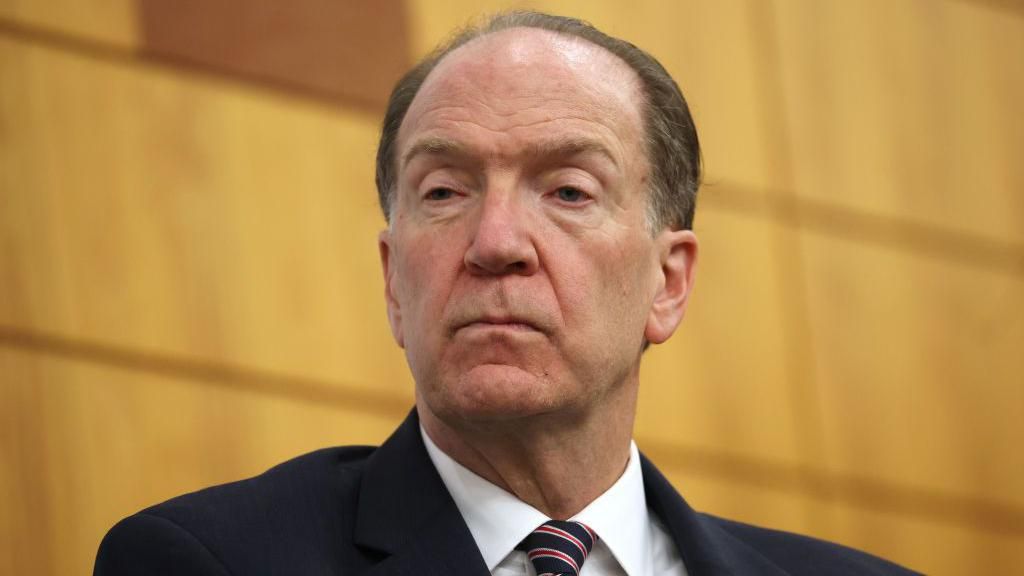
In an exclusive interview with the BBC’s World Business Report, held just one day before the scheduled Trump-Xi summit in Beijing, former World Bank President David Malpass has laid out a series of bold demands for China, arguing that easing the spiraling global food and fertilizer supply crisis sparked by the ongoing Iran conflict requires Beijing to halt its accumulation of emergency stockpiles.
Malpass, who previously held the post of U.S. Treasury Under Secretary for International Affairs during the Trump administration between 2017 and 2019, and led the World Bank from 2019 to 2023, pointed out that China currently holds the world’s largest reserves of both food staples and key fertilizer inputs. “They can stop building their stockpiles,” Malpass stated, pushing for China to release excess supplies to the tight global market.
The call for action comes at a critical juncture for global agricultural production, as countries across the world rush to lock in fertilizer supplies ahead of the upcoming spring planting season. The ongoing conflict has disrupted critical shipping routes, with the closure of the Strait of Hormuz — a major chokepoint for global fertilizer and energy trade — causing severe shipping delays and skyrocketing prices. China, for its part, implemented a full ban on fertilizer exports back in March, framing the policy as a necessary measure to safeguard its own domestic supply security.
Beyond the supply crisis, Malpass also challenged China’s long-standing self-identification as a developing country in multilateral forums such as the World Trade Organization and the World Bank. He argued that this designation is no longer credible given China’s status as the world’s second-largest national economy. “They present themselves as a developing country when they’re the second biggest economy in the world and in many ways rich,” Malpass said. “And yet they still have the pretence of being a developing country in the WTO and in the World Bank, and they could suspend that,” he added. The BBC has reached out to the Chinese Embassy in Washington D.C. to request a response to Malpass’s comments, and no statement has been released as of the report.
Turning to the fragile Iran ceasefire, which former U.S. President Trump recently described as being on “massive life support,” Malpass urged the global community to align with the United States to push for a permanent diplomatic resolution to the conflict. He emphasized that the international community cannot tolerate a scenario where a rogue state gains access to plutonium or maintains control over critical global shipping chokepoints. “You can’t have a rogue state with plutonium, and you can’t block the Strait of Hormuz,” he said.
Malpass also expressed hope that Beijing would use its diplomatic influence to help break the deadlock over the Strait of Hormuz, noting that unimpeded maritime trade aligns directly with China’s own economic interests. “China benefits from open waterways worldwide,” he explained. “They run the shipping lines, own the containers, and make huge profit from trade with the rest of the world. So, they would be a big loser if Iran in some way had control of the Strait of Hormuz.”
Ahead of the release of U.S. April inflation data, Malpass also shared his outlook for American consumers, predicting that broad price increases will continue across most product categories. “I expect some up, yes, prices will go up on many products,” he said. Even so, he noted that recently released robust U.S. employment data signals that the overall American economy remains far more resilient than many analysts have predicted.