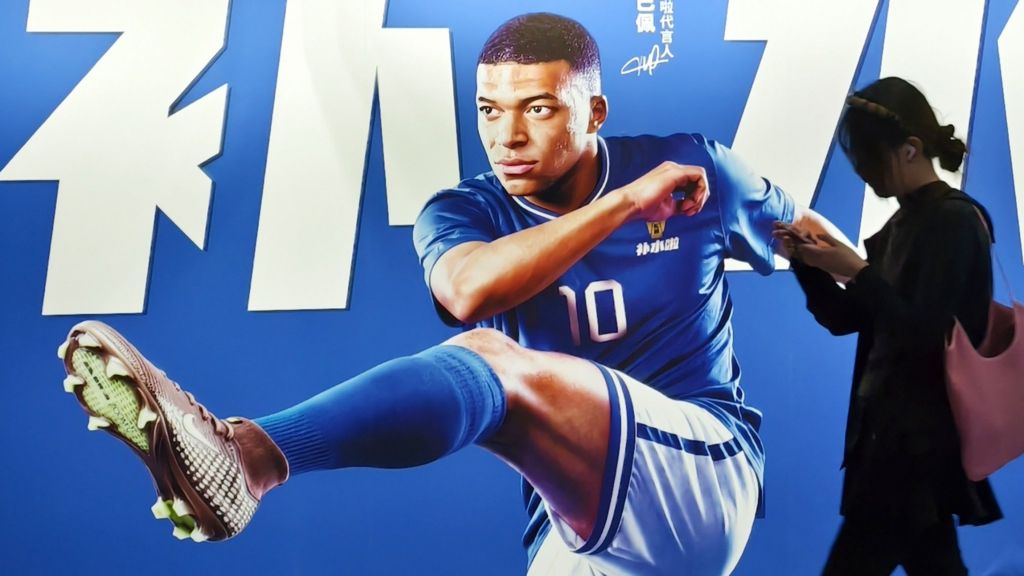
On the night of a recent Ballon d’Or gala in London, one of the world’s most high-profile footballers, Kylian Mbappé, found himself at the epicenter of a fast-spreading controversy that rippled across Chinese social media platforms even as he attended the prestigious awards ceremony. Footage of the French forward circulating online showed him referencing a viral meme that he described as his personal favorite, which superimposed his own face onto imagery of Mao Zedong, the founding leader of the People’s Republic of China, a figure regarded as near-sacred within mainland Chinese public discourse.
The backlash erupted with unprecedented speed: one after another, Chinese commercial partners severed formal ties with Mbappé, and state-owned media conglomerate China Media Group, parent entity of national broadcaster CCTV, announced an immediate suspension of all La Liga match broadcasts. A spokesperson from China’s foreign ministry issued a formal statement noting that actions and remarks that run counter to the sentiments of the Chinese public naturally draw widespread collective opposition from all segments of domestic society. Notably, almost no public discussions on Chinese domestic social media explicitly named the central figure tied to the controversial meme, a dynamic shaped by the country’s strict internet censorship framework that restricts access to global online platforms for its 1.4 billion residents. The vague framing of “remarks that hurt the Chinese people’s feelings” alone was sufficient to ignite a wave of public anger, amplified by platform algorithms and a tightly regulated online ecosystem where most users are hesitant to express views that deviate from dominant public narratives.
Within days, Mbappé released a public statement offering his sincere apologies for what he characterized as a poorly judged comment, followed by formal apologies from his top-tier club Real Madrid and the Spanish La Liga governing body. The swift response underscored the massive economic value of the Chinese market for global football, the world’s most popular sport. Chinese authorities later confirmed that they were taking Mbappé’s public apology seriously, though China Media Group has not yet made any public announcement on when suspended La Liga broadcasts might resume. Public anger continued to linger on domestic social media: top-voted comments on leading platform Weibo argued that an apology was the absolute minimum response the footballer owed, with many users calling for a full ban on Mbappé’s presence in Chinese markets, noting that the referenced historical leader serves as the spiritual pillar for the entire Chinese population and that a single statement of regret cannot undo the perceived harm.
A peculiar paradox emerged amid the furor: due to pervasive domestic censorship, a large share of Chinese internet users had no clear understanding of what exactly Mbappé had said or the full context of the meme in question. Many turned to domestic AI chatbots for explanations, only to find the platforms equally restricted by censorship rules and unable to provide clear details. Users who attempted to share information online often resorted to coded references to the historical figure, describing him as “the person featured on the 100 yuan banknote” or “the teacher,” a title Mao once adopted for himself, while heavily blurring all imagery and redacting any explicit references to his name. Notably, none of the formal statements from the Chinese foreign ministry, Mbappé, Real Madrid or La Liga ever named Mao directly.
Mao Zedong, who led the Chinese Communist Party to victory in the 1949 civil war and established the People’s Republic of China, passed away in 1976. While his rule included widely documented periods of upheaval such as the Great Leap Forward and the Cultural Revolution, events that led to widespread famine and violent social purges that killed tens of millions, he remains a deeply revered figure in mainland China. National laws explicitly prohibit public insults or slander targeting Communist Party martyrs and key historical heroes, and Mao’s embalmed remains are on permanent public display in a mausoleum overlooking Beijing’s Tiananmen Square, drawing tens of thousands of daily visitors. Recent years have seen a resurgence of public interest in Mao among younger Chinese generations, who widely share his writings and archival footage on domestic social media, while official Chinese historical narratives downplay the devastating social impacts of his rule, with the Communist Party’s formal verdict framing his achievements as far outweighing his missteps.
Reactions to the controversy outside mainland China stood in stark contrast. Among Chinese diaspora communities, including dissidents and families that fled China in the decades following Mao’s rise to power, many expressed support for Mbappé, with top comments on global platforms X and Threads urging the footballer not to apologize and arguing that the Chinese Communist Party itself was the entity that owed the public an apology for decades of perceived brainwashing. These global platforms, which are blocked within mainland China, also spawned a new wave of satirical memes, some featuring Mbappé’s face superimposed onto imagery of Mao and others extending the joke to current Chinese leader Xi Jinping. Global internet users outside China largely expressed confusion over the scale of the backlash, with many commenting on public social media posts that they found it unreasonable to expect the entire global public to adhere to the same framing of historical figures enforced within China’s borders.