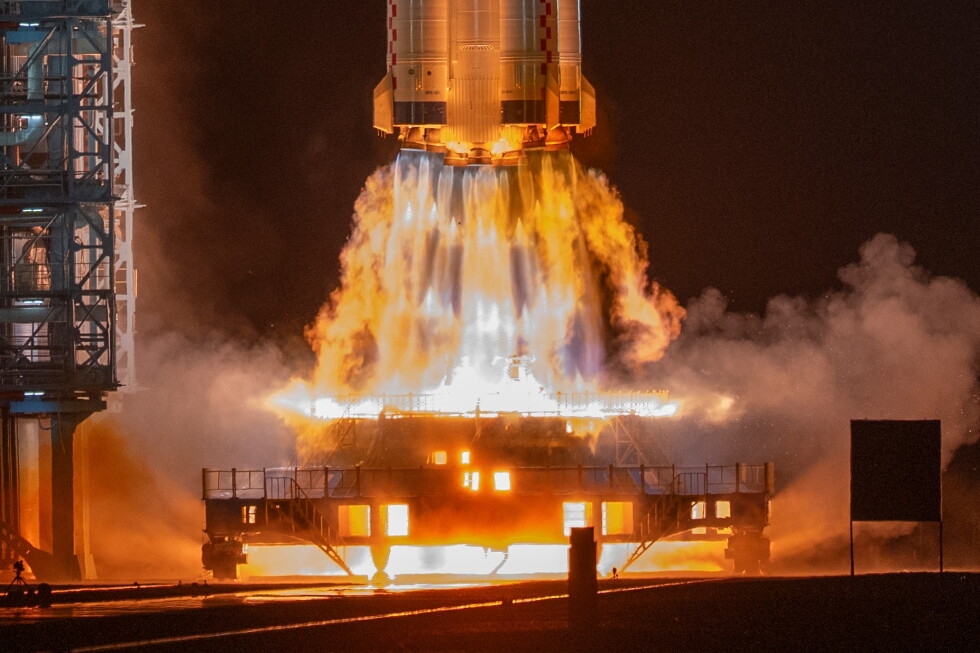
In a landmark step forward for China’s ambitious space exploration program, the Shenzhou 23 crewed spacecraft lifted off Sunday night from the Jiuquan Satellite Launch Center located in China’s remote northwestern Gobi Desert. The three-member crew is bound for China’s fully operational Tiangong Space Station, carrying a mission that blends groundbreaking scientific research, crew rotation, and major progress toward China’s goal of landing the first Chinese astronauts on the moon by 2030.
Leading the Shenzhou 23 expedition is commander Zhu Yangzhu, joined by crewmates Zhang Zhiyuan and Lai Ka-ying, who is also known by the Mandarin transliteration Li Jiaying. Lai’s presence on the mission marks a historic first for Hong Kong: born and raised in the special administrative region, she holds a doctoral degree in computer forensics, becoming the first Hong Kong native ever selected to fly on a Chinese human spaceflight mission. Her selection underscores the expanding scope of China’s space program, drawing talent from across the entire country.
Once they dock at Tiangong, the Shenzhou 23 crew will complete a standard in-orbit handover with the incumbent Shenzhou 21 team, which has been living and working on the orbiting outpost for more than 200 days. Over the course of their mission, the new crew will carry out dozens of experiments spanning multiple scientific and applied technology fields, according to Chinese state media. One crew member will make global spaceflight history with a planned 12-month stay aboard Tiangong, a duration that ranks among the longest single continuous human stays in low Earth orbit ever attempted. The extended mission is designed specifically to study how the human body adapts to long-term exposure to the space environment, helping researchers map the limits of human performance during deep space expeditions that will be required for future lunar and Martian exploration.
The Shenzhou 23 launch comes amid a period of rapid expansion for China’s independent space program, which accelerated after the country was barred from participating in the International Space Station due to national security objections raised by the United States. Instead of halting progress, the exclusion pushed China to develop its own permanent orbiting outpost, Tiangong — whose name translates to “Heavenly Palace” — which hosted its first resident crew in 2021 and has now supported a continuous human presence in orbit for multiple crew rotations. The program has overcome high-stakes challenges in recent years: in 2024, the Shenzhou program executed a rare emergency rescue mission that successfully returned a crew stranded on Tiangong after their return spacecraft suffered unexpected damage.
Today, China and the United States stand as the world’s two leading competitors in 21st century space exploration. While China targets its first crewed lunar landing by 2030, NASA is currently working toward its own return of astronauts to the lunar surface under the Artemis program, with a current target landing date of 2028. This latest successful launch of Shenzhou 23 demonstrates that China remains firmly on track to meet its aggressive space exploration targets, while opening new opportunities for scientific discovery that benefit the global research community.