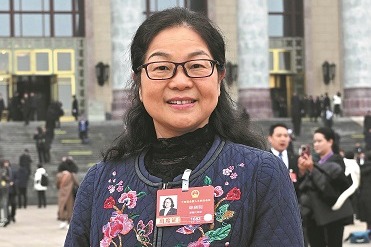
Shan Xiaoming’s remarkable transformation from a young woman who had never seen an airplane to becoming one of China’s foremost aero-engine designers represents an extraordinary journey of dedication and technological advancement. Born in 1965 in a small Guizhou township to parents with no aviation background, Shan excelled academically while mastering farm work during her youth.
Her aerospace career began unexpectedly in 1984 when, without guidance, she selected the aero-engine design program at Nanjing University of Aeronautics and Astronautics solely based on a compelling phrase in the admission brochure: ‘Aero-engine is the heart of the aircraft.’ This poetic description captured her imagination and set her on a path that would define her professional life.
After earning her bachelor’s degree, Shan pursued a master’s while her boyfriend (later husband) joined an aero-engine factory in Zhuzhou. Upon graduation in 1991, she deliberately chose the Hunan Aviation Powerplant Research Institute in Zhuzhou over metropolitan opportunities, dedicating herself to engine testing and experimentation aligned with her specialization in control technology.
Her expertise propelled her through the ranks to team leader and eventually deputy chief designer for testing and metrology. In 2008, her career reached a pivotal moment when appointed deputy chief designer for the WZ-16 turboshaft engine program, a collaborative venture with France’s Turbomeca (now Safran Helicopter Engines) to power medium-sized helicopters like the AC352.
The program faced significant challenges, particularly with the sophisticated filter unit that had never been designed by Chinese engineers. Under Shan’s leadership, the team pioneered innovative solutions from scratch, transforming setbacks into breakthroughs. Their perseverance yielded extraordinary results: reducing parts by 65% and weight by 40% from original specifications, with multiple technologies achieving national patent status.
Shan’s contributions have earned her positions on aviation industry standardization expert panels and election as a National People’s Congress deputy since 2018. Reflecting on her career, she contrasts the primitive early conditions—manual data calculation, equipment transport via bicycle, and limited sensors—with today’s advanced digital infrastructure enabling real-time data transmission and immediate analysis.
The evolution of China’s aviation capabilities is embodied in her experience: from one or two engine models in development to dozens of advanced designs currently under research, demonstrating decades of national investment and technological progress. Shan Xiaoming’s story illustrates both personal achievement and the broader advancement of China’s aerospace industry through dedication, innovation, and strategic development.