分类: sports

  • Brisbane begins work on the 2032 Olympics main stadium at Victoria Park after protesters moved

    Brisbane begins work on the 2032 Olympics main stadium at Victoria Park after protesters moved

    Nearly five years after Brisbane secured the hosting rights for the 2032 Summer Olympic Games, official construction work on the Games’ flagship stadium got underway on a crisp, sunny winter Monday in Queensland, Australia, following the relocation of on-site protesters and the deployment of heavy excavation equipment.

    The handover of the Victoria Park construction site, located in Brisbane’s inner city, was completed at midnight when the Games’ Independent Infrastructure and Coordination Authority took over ownership from Brisbane City Council. Work crews quickly erected temporary perimeter fencing around the plot earmarked for the AU$3.6 billion (US$2.6 billion) main stadium, with a heavy contingent of police deployed to the area to maintain order.

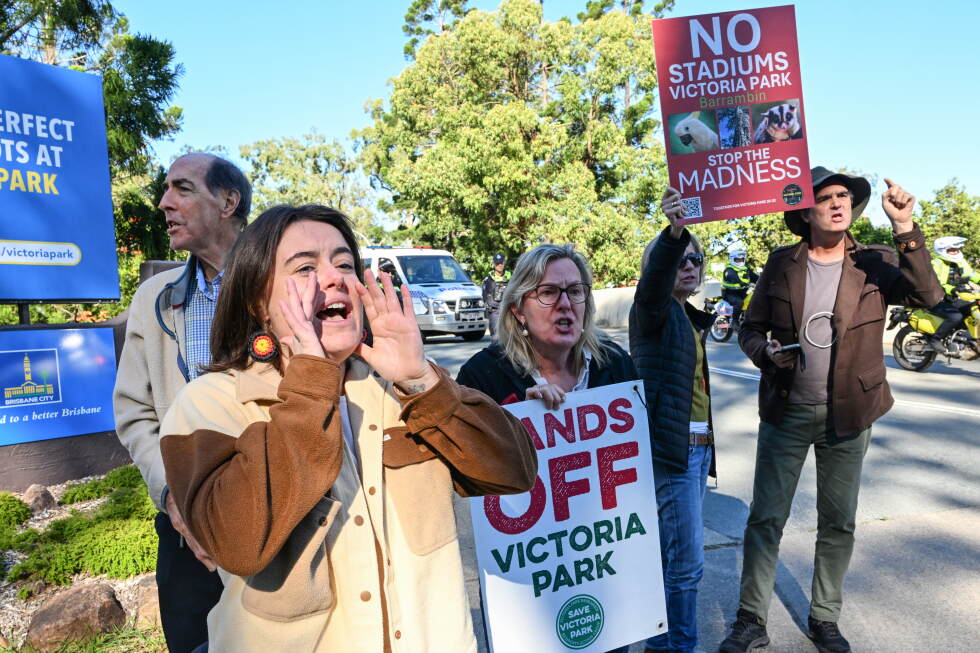
    This security buildup came days after Queensland state police arrested five people occupying protest camps in the parklands, and council workers began dismantling the makeshift encampments. Just hours after the site handover, a small remaining group of activists was moved from inside the construction perimeter to the area outside the fencing. Hundreds of protesters had gathered for a large demonstration at the site on Sunday afternoon, but the start of construction proceeded quietly under police watch on Monday morning.

    Queensland Premier David Crisafulli marked the official start of works with a ceremonial first sod turning, telling reporters that the Queensland public has repeatedly pressed his government to move forward with the project. “It’s game on — we have a plan to deliver for the 2032 Games and beyond, and today, we get cracking on delivering it,” he said. “Victoria Park will be the beating sport, cultural and green heart of Brisbane, and a place all Queenslanders can be proud of.”

    Crisafulli noted that he respected protesters’ right to free speech and advocacy, but drew the line at demonstrations blocking construction work, adding that after the stadium is completed, more than two-thirds of the total Victoria Park area will remain public green space.

    Opposition to the project has been led by Indigenous groups and environmental organizations, who argue that building the main stadium on the heritage-listed inner-city park will permanently erase critical green space and culturally significant sacred sites for future generations of Queenslanders. Organizers of the Save Victoria Park movement emphasize they are not opposed to the Olympics altogether, but reject the current venue plan that places the stadium in the park.

    “We’re not an anti-Olympics group, but we don’t support the Olympics in its current form,” Save Victoria Park organizer Andrea Lunt told the Australian Associated Press. Lunt added that the group is currently weighing its next steps in the campaign, noting that the park’s unique heritage and historical value make it an irreplaceable public asset for Brisbane.

    Legal and regulatory challenges to the project have already been mounted. Last year, the Queensland state government reclassified Victoria Park, exempting the site from existing heritage, environmental and planning regulations, and converted the land to freehold ownership to clear the way for construction. Indigenous, heritage and environmental groups have launched legal challenges to overturn this decision.

    At the federal level, Australian Environment Minister Murray Watt confirmed he has received 10 applications seeking emergency protection for a significant Aboriginal site at the park that campaigners say is under threat of injury or desecration. Watt has already rejected some of the applications but is still reviewing others. Speaking to the Australian Broadcasting Corporation, Watt explained that cultural heritage declarations are not intended to block major projects entirely, but instead to mandate specific protections to prevent damage or desecration of culturally important sites.

    The five people arrested during a police operation to clear protest camps on Friday face charges of obstructing police and assaulting officers, according to a police spokesperson. One of the five arrested has since been released without charge. Prior to the start of construction, the Victoria Park site hosted a golf driving range, open public parkland, and a popular venue for weddings and community events.

    The International Olympic Committee gave its official backing to the Queensland government’s revised 2032 venue plan last year, following a series of earlier planning delays, confirming that the Brisbane Games remain “on the right path.” The 2032 Olympics has secured full backing from both the Queensland state government and the federal Australian government for venue construction and delivery.
  • Sabalenka, Osaka clash in blockbuster French Open tie

    Sabalenka, Osaka clash in blockbuster French Open tie

    The 2025 French Open enters its second week with a historic matchup headlining the schedule on Monday, as two of women’s tennis biggest superstars Aryna Sabalenka and Naomi Osaka will meet in the first women’s night match held at Roland Garros in three years. This clash marks their third meeting of 2025 and the fourth encounter of their professional careers, with every past match between the two four-time Grand Slam champions coming at the round of 16 stage.

    World No. 1 Sabalenka comes into the match chasing her first ever French Open title, a goal that fell just one win short last year when she suffered a heartbreaking final defeat to Coco Gauff. The Belarusian top seed is under no illusions about the test Osaka will bring, praising the Japanese star for her impressive resurgence after stepping away from the tour in 2023 to welcome her first child.

    “It’s great, great to see her back on her level. Maybe not at her best level, but she’s back, she’s fighting, she’s building her level,” Sabalenka said of her upcoming opponent. “It’s nice to see her. She’s a great player, great person. I feel like I really enjoy our battles. It’s high-level matches, and I really enjoy when somebody pushes me to the limit.”

    For Osaka, this run to the round of 16 is already a career-first at Roland Garros, marking a remarkable comeback from her maternity break and proving she has found far more comfort on the Paris clay than ever before. Osaka, who claimed four Grand Slam singles titles before her pause from the sport, took time to rediscover her form after rejoining the tour, but broke through with a US Open semi-final run last year — her first trip to the second week of a major since winning the 2021 Australian Open.

    The 26-year-old has set clear goals for her 2025 clay and grass court swing, and is not planning to end her run in Paris on Monday. “I really wanted to make it a goal to do really well on clay and grass. I don’t want this to be my last round. I want to keep going. I just want to keep focusing on every match,” Osaka said.

    The winner of Monday’s marquee matchup will advance to the quarter-finals, where they will face either former Australian Open champion Madison Keys or Russian rising star Diana Shnaider. Beyond the headline clash, several other women’s matches will unfold on Monday’s schedule: the last remaining home hope Diane Parry will aim to replicate last year’s surprise semi-final run from fellow French wildcard Lois Boisson when she faces Polish qualifier Maja Chwalinska, while 28th seed Anastasia Potapova of Austria will look to build on her upset victory over defending champion Coco Gauff against Russia’s Anna Kalinskaya.

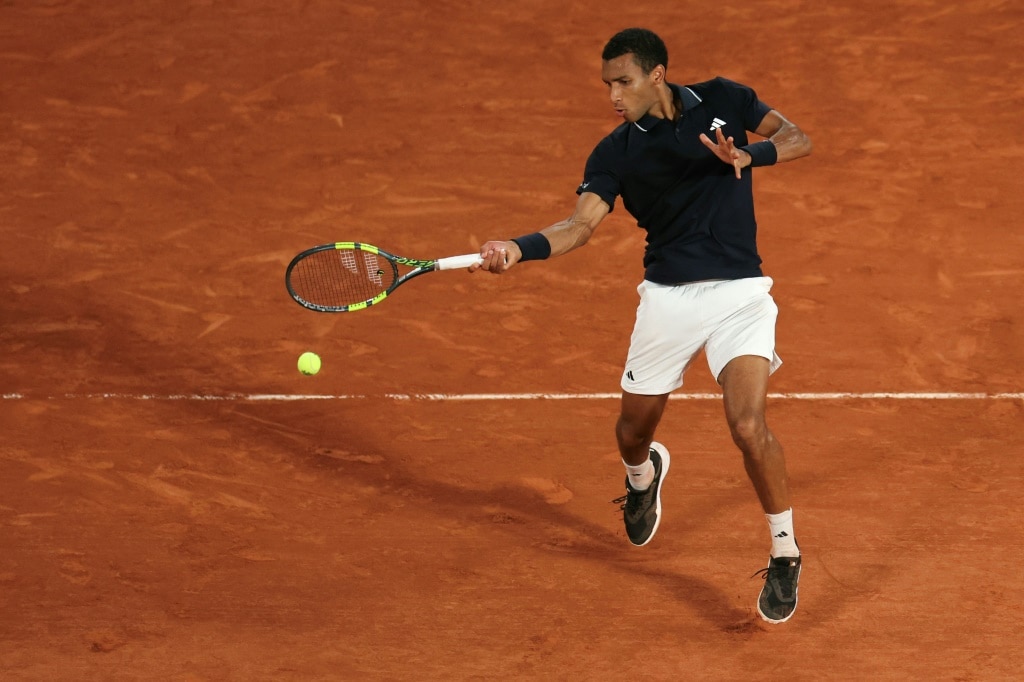
    The men’s draw has been turned upside down ahead of round of 16 play, with the top half left wide open after the shock early exit of world No. 2 Jannik Sinner and an opening round defeat for young American star Ben Shelton. That leaves world No. 6 Felix Auger-Aliassime of Canada as the highest-ranked player remaining in that section of the draw, and he will bid to reach his first ever French Open quarter-final against Chile’s Alejandro Tabilo — who is competing in his first ever Grand Slam round of 16.

    The open draw has opened unexpected opportunities for lower-ranked players, including American world No. 85 Zachary Svajda, who had only won two Grand Slam matches total before this tournament. When asked about Sinner’s exit opening up the draw, Svajda said he is focusing on one match at a time against Italian 10th seed Flavio Cobolli. “When I saw Sinner was out, I try to stay present and stay positive and just take it day by day, match by match,” he said. “I knew the draw was open, but I just tried to keep doing my routines, keep doing what I’ve been doing, and just see what happens.”

    Other notable men’s matches on Monday include a showdown between former Wimbledon finalist Matteo Berrettini and Sinner’s conqueror Juan Manuel Cerundolo, with the Italian targeting his first Grand Slam quarter-final appearance since 2022. American big-hitter Frances Tiafoe, who reached the French Open quarter-finals last year, will take on rising Italian talent Matteo Arnaldi.

  • Cristian Volpato selected in Australia’s World Cup squad just days after switch of allegiance

    Cristian Volpato selected in Australia’s World Cup squad just days after switch of allegiance

    BRISBANE, Australia – In a late, high-stakes roster shake-up just weeks out from the 2026 FIFA World Cup co-hosted by North America, Australian men’s national team head coach Tony Popovic has named 22-year-old attacking midfielder Cristian Volpato to his final 26-man squad, just days after the player officially formalized his national team switch from Italy to the Socceroos.

    The announcement, made Monday, marks a stunning full-circle moment for Volpato, who turned down an invitation to join Australia’s 2022 World Cup squad four years ago, only to reset his international future with the nation of his birth. Born in Sydney, Volpato came up through Italy’s youth development system and earned caps for Italy’s Under-21 national side, but remained eligible to switch allegiances under FIFA regulations, as he never appeared in a competitive senior international match for the Azzurri. That eligibility shift became all the more relevant after Italy failed to qualify for the 2026 World Cup, opening the door for Volpato to pursue his World Cup dream with Australia.

    Volpato is one of 17 first-time World Cup squad members on Australia’s roster, joining young striker Tete Yengi and a host of other emerging talents. The squad also features iconic veteran leadership: captain Mat Ryan, who brings 104 senior international caps to the pitch, and experienced attacker Mathew Leckie, both selected for their fourth World Cup appearance. The milestone ties the pair for the all-time Australian record, previously held only by retired stars Tim Cahill and Mark Milligan. Popovic highlighted the outsized role the veteran duo will play for a largely young roster, noting that “they can lead the way and guide these young players.”

    Fresh off his eligibility approval, Volpato only joined the Socceroos’ pre-tournament training camp in Los Angeles over the weekend, missing the team’s 1-0 warm-up defeat to Mexico in Pasadena last week. Even with his late arrival, Popovic made clear he has high hopes for the young midfielder, who currently competes in Italy’s top-flight Serie A. “He’s a very talented player. A young player — he’s doing well in Serie A,” Popovic told reporters following the squad announcement. “Technically a very good player, great left foot, comfortable under pressure. I’m looking forward to working with him.”

    While many observers have framed Australia’s heavily youth-focused selection as a build toward future tournaments down the line, Popovic pushed back on that framing, saying the current group is already competitive enough to compete at the highest level. “It would be easy to say Australia’s selection appeared to be one that looked toward the future but I think we should keep the expectation high now,” he said. “What we have is a lot of young exuberance, a lot of exciting talent. Will they be better in four and eight years? Without a doubt, but that’s not to say they’re not good enough now. I want them all to give me a (selection) headache every week, and I believe in these young boys.”

    Australia continues its pre-tournament preparation with a final warm-up match against Switzerland in San Diego this coming Saturday. Once the World Cup kicks off, the Socceroos will face off against Turkey in Vancouver on June 13, the host United States in Seattle on June 19, and Paraguay in Santa Clara on June 25 in Group D play.

    The full 26-man Australia World Cup squad is as follows:
    Goalkeepers: Mat Ryan, Patrick Beach, Paul Izzo
    Defenders: Aziz Behich, Jordan Bos, Cameron Burgess, Alessandro Circati, Milos Degenek, Jason Geria, Lucas Herrington, Jacob Italiano, Harry Souttar, Kai Trewin
    Midfielders: Cameron Devlin, Jackson Irvine, Connor Metcalfe, Mathew Leckie, Paul Okon-Engstler, Aiden O’Neill
    Forwards: Ajdin Hrustic, Nestory Irankunda, Awer Mabil, Mohamed Toure, Nishan Velupillay, Cristian Volpato, Tete Yengi

  • Vingegaard wins Giro d’Italia to complete Grand Tour set

    Vingegaard wins Giro d’Italia to complete Grand Tour set

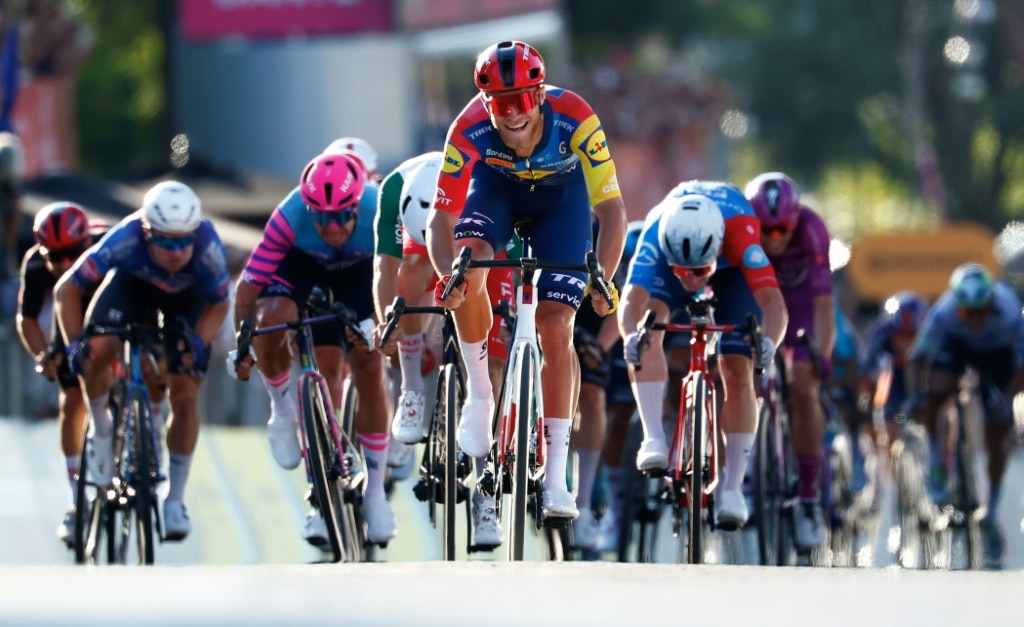
    In a historic milestone for professional road cycling, Denmark’s Jonas Vingegaard secured overall victory at the 2025 Giro d’Italia on Sunday, capping off a dominant three-week race and cementing his place as one of the sport’s all-time greats by completing the rare sweep of cycling’s three Grand Tours. The final stage of the race, which concluded on the sunlit streets of central Rome, delivered a hometown fairytale for Italian sprinter Jonathan Milan, who claimed a dramatic stage win with a late powerful burst, but the day belonged entirely to Vingegaard, who rolled into the capital draped in the Giro’s iconic pink leader’s jersey to claim his first overall title at the Italian race.

    With Sunday’s result, Vingegaard adds the Giro crown to his back-to-back Tour de France titles in 2022 and 2023, and his 2025 Vuelta a Espana victory, completing the sport’s coveted Triple Crown of three-week Grand Tours. This achievement makes him the only active rider in the world to hold wins at all three events, and just the eighth male rider in the entire 100-plus year history of professional cycling to reach the mark, joining legendary figures including Eddy Merckx, Bernard Hinault and Italy’s own Vincenzo Nibali.

    Slovenian cycling star Tadej Pogacar, Vingegaard’s long-time rival, has claimed four Tour de France titles and one Giro d’Italia victory to his name, but has yet to add a Vuelta win to his resume, leaving the Triple Crown out of his reach for now.

    Speaking to Italian public broadcaster RAI after crossing the finish line, an emotional Vingegaard reflected on the unprecedented achievement. “Winning all three is very special for me, it’s difficult to find the words to describe it,” the Visma–Lease a Bike rider said. Following the victory, Vingegaard plans to stay in Rome for several days to celebrate with his family before returning to his native Denmark to begin preparations for the 2025 Tour de France, which kicks off on July 4, where he is set to face off once again against Pogacar in cycling’s most high-profile showdown.

    Vingegaard noted that his fitness remains strong despite the grueling three-week Giro, a positive sign for his Tour prospects. “If you’re completely exhausted and need two weeks of rest afterwards, it’s not ideal. But I’m not completely exhausted,” he explained. Richard Plugge, general manager of the Visma–Lease a Bike team, expressed full confidence in his rider’s ability to contend for another yellow jersey in July. “Jonas is getting even stronger after this. We planned it so that he will be at his peak in the Tour de France, so we’re looking forward to that fight,” Plugge said, describing the squad as a “yellow jersey organization” focused on Tour victory.

    Vingegaard’s victory at this year’s Giro was defined by utter dominance. With Pogacar not competing in the race, the Danish rider faced no serious challenges to his lead throughout the three weeks, wrapping up the overall title with a commanding mountain stage victory on Saturday that sealed his advantage before the processional final stage into Rome. He finished the general classification with five individual stage wins, and an unrivaled 5 minute 22 second gap over second-place Austrian rider Felix Gall. 2022 Giro champion Jai Hindley of Australia rounded out the overall podium in third.

    In the race’s other classification awards, Portugal’s Afonso Eulalio claimed the white jersey for the best young rider, after holding the overall pink leader’s jersey for eight consecutive stages following a breakout performance on a rain-soaked fifth stage. Italian veteran Giulio Ciccone won the mountains classification, while young French sprinter Paul Magnier claimed the points classification sprint jersey thanks to three stage wins throughout the race.

    For Milan, the final stage win marked a satisfying redemption for his Giro campaign. The home favorite had come close to stage victories multiple times throughout the race but had failed to cross the line first until Sunday, when he outsprinted compatriot Giovanni Lonardi and France’s Paul Penhoet to take the win on home soil. “I’m pleased to have finished my Giro this way,” Milan told RAI. “It’s important in terms of just winning something. It wasn’t easy always being close but not quite getting there.” Milan finished the points classification 47 points behind winner Magnier.

  • Czech Republic’s final World Cup squad includes 17-year-old Hugo Sochůrek

    Czech Republic’s final World Cup squad includes 17-year-old Hugo Sochůrek

    Teenage sensation Hugo Sochůrek has capped off a breakthrough weekend by earning a spot in the Czech Republic’s final 26-man squad for the 2026 FIFA World Cup, becoming the youngest player to ever represent the Czech senior men’s national team during a warm-up fixture against Kosovo just hours before the roster was finalized.

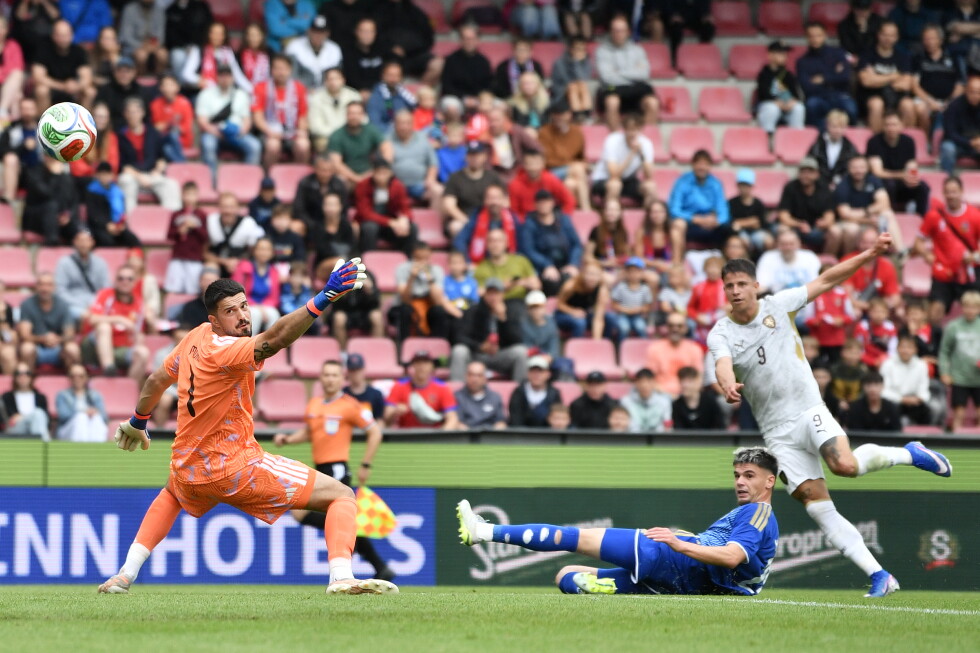
    The 17-year-old Sparta Prague midfielder came off the bench in Sunday’s 2-1 Czech victory over Kosovo, a warm-up test that double as the final evaluation opportunity for head coach Miroslav Koubek. Following the final whistle, the 74-year-old veteran coach trimmed his initial 29-player preliminary list down to the tournament-compliant 26, cutting three hopefuls who missed out on the trip to North America: FC Cincinnati midfielder Pavel Bucha, Mladá Boleslav forward Christophe Kabongo and Viktoria Plzeň midfielder Tomáš Ladra. Calling the difficult final cuts “probably the worst moment of my coaching career,” Koubek acknowledged the emotional weight of eliminating players who had come close to reaching the sport’s biggest stage.

    In a major boost for the Czech side, attacking midfielder Adam Hložek of Hoffenheim marked his return to international action — his first cap for the national team since June — with a goal, after spending months sidelined with persistent calf and foot injuries. The 23-year-old, who has now notched five goals in 42 international appearances, brings much-needed attacking depth to a roster looking to make an impact on their first World Cup return in 20 years.

    In a surprising roster call, Koubek also included two Slavia Prague players who were suspended by their club for the remainder of the domestic season and placed on the transfer list over disciplinary issues: forward Tomáš Chorý and defender David Douděra, both of whom will get the chance to resurrect their careers on the global stage.

    The full roster, anchored by established Czech mainstays including Lyon midfielder Pavel Šulc, Bayer Leverkusen striker Patrik Schick and West Ham United star Tomáš Souček, will depart for the United States later on Sunday to complete their final preparation. Their final pre-tournament friendly is scheduled for June 4 against Guatemala in New Jersey, before the team sets up their tournament base in Mansfield, Texas.

    The Czech Republic, who qualified for the World Cup for the first time since 2006, enter Group A of the tri-nation tournament co-hosted by the United States, Mexico and Canada. They will kick off their World Cup campaign against South Korea in Guadalajara, Mexico on June 11, before facing South Africa in Atlanta on June 18 and closing out group play against hosts Mexico in Mexico City on June 25.

    The full final 26-man Czech Republic squad is as follows:
    Goalkeepers: Lukáš Horníček (Braga), Matěj Kovář (PSV Eindhoven), Jindřich Staněk (Slavia Prague)
    Defenders: Vladimír Coufal (Hoffenheim), David Douděra (Slavia Prague), Tomáš Holeš (Slavia Prague), Robin Hranáč (Hoffenheim), Štěpán Chaloupek (Slavia Prague), David Jurásek (Slavia Prague), Ladislav Krejčí (Wolverhampton), Jaroslav Zelený (Sparta Prague), David Zima (Slavia Prague)
    Midfielders: Lukáš Červ (Viktoria Plzeň), Vladimír Darida (Hradec Králové), Lukáš Provod (Slavia Prague), Michal Sadílek (Slavia Prague), Hugo Sochůrek (Sparta Prague), Alexandr Sojka (Viktoria Plzeň), Tomáš Souček (West Ham), Pavel Šulc (Lyon), Denis Višinský (Viktoria Plzeň)
    Forwards: Tomáš Chorý (Slavia Prague), Adam Hložek (Hoffenheim), Mojmír Chytil (Slavia Prague), Jan Kuchta (Sparta Prague), Patrik Schick (Bayer Leverkusen)

  • Paris Saint-Germain players celebrate amid riot recriminations

    Paris Saint-Germain players celebrate amid riot recriminations

    Paris welcomed Paris Saint-Germain’s football squad with a jubilant hero’s parade on Sunday, as the team marked its second consecutive UEFA Champions League title. The celebration, however, unfolded against a backdrop of bitter political finger-pointing, coming 24 hours after widespread rioting across France left one person dead, hundreds injured, and hundreds more arrested in post-victory unrest.

    The victory was sealed in Budapest on Saturday night, where PSG defeated English Premier League side Arsenal 4-3 in a tense penalty shootout. On their return to the French capital, the squad traveled in an open-top parade from Charles de Gaulle Airport to the Champ de Mars, the sprawling public plaza situated at the foot of the Eiffel Tower. Tens of thousands of flag-waving, chanting supporters lined the route to catch a glimpse of their champions. Before the public parade, the team was received in an official audience by President Emmanuel Macron, and later made a stop at their home ground, Parc des Princes, to greet fans before the main event.

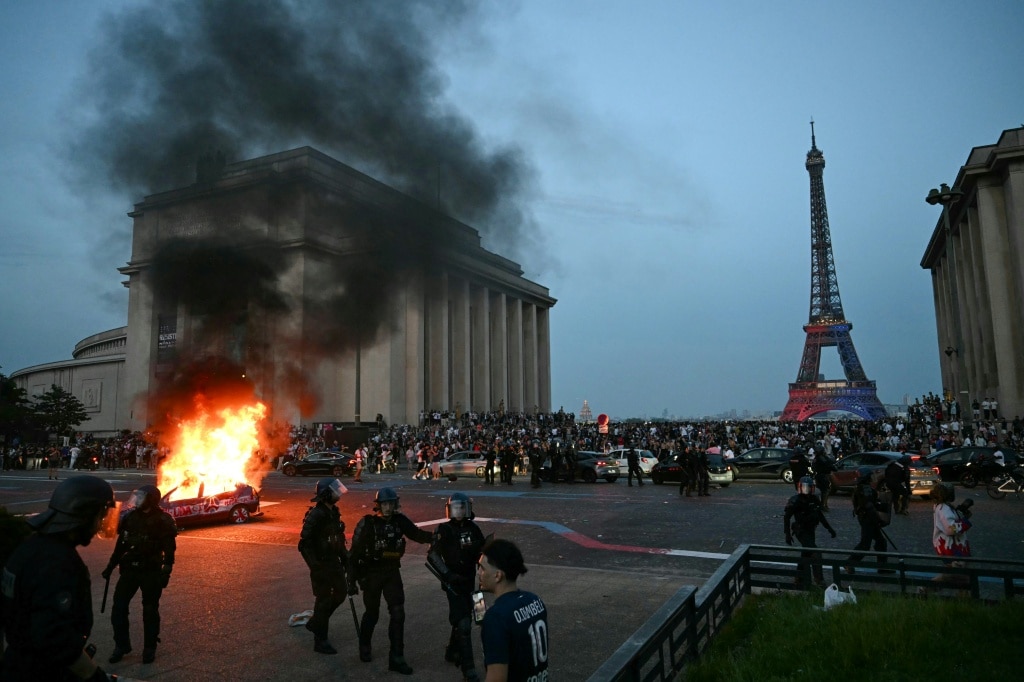
    The night of celebration turned violent, however, as clashes erupted between young rioters and police officers across Paris and multiple other French cities. The unrest left a trail of destruction: cars set ablaze, storefronts looted, and public infrastructure damaged across 15 cities nationwide. A 57-year-old motorcyclist died in a celebratory crash on Paris’ peripheral ring road, while authorities also recorded multiple stabbings and violent assaults. Official injury counts put the total at 57 police officers and 219 rioters or participants hurt, with eight people remaining in critical condition Sunday morning.

    By Sunday morning, municipal crews worked frantically to clear shattered glass, destroyed bus shelters, discarded trash and burned-out vehicles from Paris’ central streets ahead of the planned parade. Interior Minister Laurent Nunez reported that a total of 780 people had been arrested across France by Sunday morning — nearly 30 percent more arrests than followed PSG’s 2024 Champions League win over Inter Milan, which also sparked widespread post-victory disorder.

    President Macron called the outbreak of violence “unspeakable”, but political leaders have clashed sharply over who bears responsibility for the unrest, and how it was handled. Paris Mayor Emmanuel Gregoire pushed back against claims of widespread chaos, noting that the vast majority of supporters celebrated peacefully, and that isolated incidents on the margins of major national celebrations are not a new phenomenon. Speaking to BFM TV, Gregoire argued that excessive media coverage and social media-fueled attention-seeking by troublemakers had amplified the unrest, creating a chain reaction of incitement that escalated tensions. “In the vast majority of cases, people celebrated with family and friends. And it was an extraordinary celebration. And incidents on the fringes of major events have been going on for centuries,” he said.

    The local town hall overseeing the Champs-Élysées — where tens of thousands of fans gathered after the final whistle on Saturday — issued a scathing statement calling for future bans on large post-victory gatherings, claiming the iconic avenue “ceased to be a place of celebration and became an arena of urban guerrilla warfare” overnight.

    Politicians from across the French political spectrum condemned the violence and questioned security planning. Far-right leader Marine Le Pen wrote on social media platform X that “only in France does a football club’s victory spark riots”. Valerie Pecresse, head of the greater Paris regional council from the conservative Republicans party, slammed the “brainless thugs who allow themselves to destroy everything, tarnishing the image of Paris and France”, and demanded “exemplary sanctions” for those arrested. Meanwhile, a spokesperson for the hard-left France Unbowed party criticized the national government’s planning and security management of the event, saying “We cannot be satisfied with the way last night’s event was managed and organised by the government.”

    Despite the recriminations and the previous night’s violence, the official parade went ahead as planned, with Nunez deploying 6,000 police officers across central Paris to maintain order for the tens of thousands of supporters who turned out to celebrate. Fans packed into the Champ de Mars hours before the team arrived, with crowds so large that the squad’s arrival was delayed by more than an hour. When the players finally took to the stage, they paraded along a red, white and blue tricolor carpet as giant screens replayed the decisive penalty shootout that secured their historic back-to-back title.

    For many fans, the joy of victory could not be dampened by the previous night’s chaos. “We’re still riding yesterday’s high, so we want to keep the party going,” said 25-year-old Abou, a PSG fan since childhood, as supporters chanted “Paris, Paris” while filtering through security checkpoints. Mirna Makima, a 39-year-old physiotherapist who traveled from Belgium to attend the celebrations, said: “It was great, there was the stress of the penalty shootout but it was good stress in the end.”

  • Flight 1978 and Messi’s No 10: Argentina’s arrival in US doubles as tribute to its World Cup success

    Flight 1978 and Messi’s No 10: Argentina’s arrival in US doubles as tribute to its World Cup success

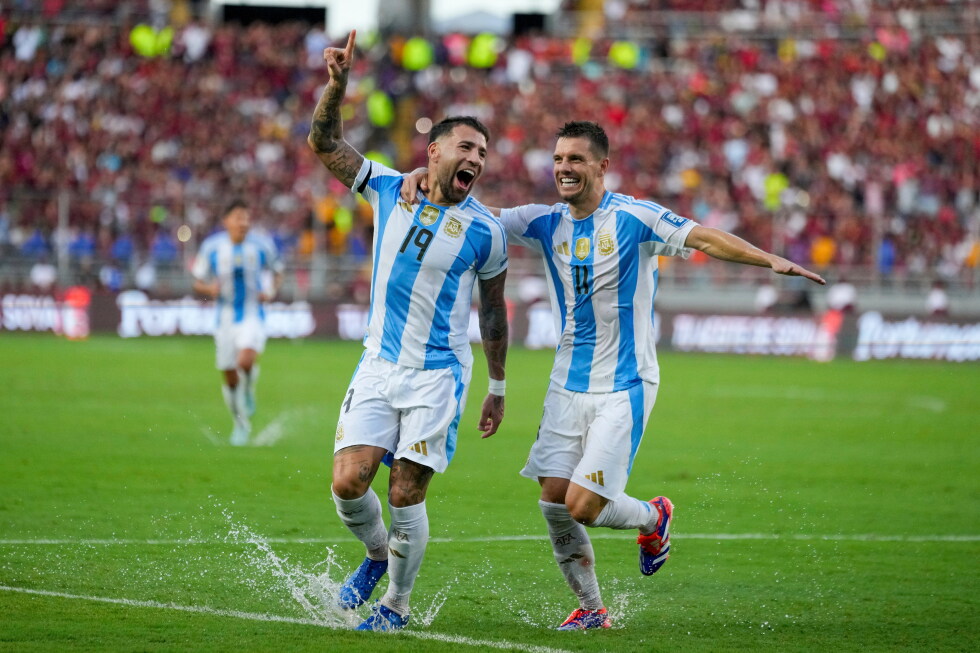
    Reigning men’s World Cup champions Argentina have landed in Kansas City, Missouri, kicking off their United States-based preparation for the 2026 tournament, where they will launch their title defense against Algeria in an opening match at Arrowhead Stadium — the iconic home of the NFL’s Kansas City Chiefs. The opening clash is scheduled for June 16.

    The Argentine national squad’s 11-hour transcontinental journey, covering more than 5,500 miles from Buenos Aires’ Ezeiza International Airport, concluded just after 11 a.m. local time on Sunday. In a subtle, meaningful nod to the nation’s first World Cup triumph, the charter flight operated by Aerolineas Argentinas carried the flight number 1978 — the year Argentina claimed their first World Cup title as host nation, defeating the Netherlands in front of more than 71,000 passionate fans at Buenos Aires’ River Plate Stadium.

    Even the aircraft itself was customized to honor the 2026 squad: the Airbus A330 features special tournament-themed livery, with Lionel Messi’s legendary No. 10 emblazoned on the tail fin between the national team’s iconic sky blue and white stripes. Three gold stars marking Argentina’s three historic World Cup titles (1978, 1986, 2022) are also prominently displayed on the plane’s exterior.

    Argentina marks the first of four World Cup-bound national teams that will set up pre-tournament training bases in the Kansas City metro area. The Netherlands, England and Algeria — which will base its operations at the University of Kansas in nearby Lawrence — are scheduled to arrive in the region later this week.

    Nearly the entire 26-man Argentine roster traveled on the official charter, though a small number of players are joining the squad directly from their club commitments across Europe and other global leagues. After disembarking, players and coaching staff walked across the tarmac to waiting private charter buses that transported them to their team hotel, the Origin Hotel located near downtown Kansas City.

    Local organizers have put enhanced security measures in place to protect the squad, with temporary fencing erected around the hotel property and additional security personnel deployed. The recently built venue has also been fully decked out to welcome La Albiceleste, with custom signage, branded posters and larger-than-life murals of the team’s star players decorating both the interior and exterior of the building.

    Following their arrival, the team conducted low-intensity recovery training in the hotel gym on Sunday as they wait for the remaining players to join the camp. The first full-field team training session is scheduled for Monday at the Compass Minerals National Performance Center, the state-of-the-art training facility that serves as the home base of Major League Soccer’s Sporting Kansas City.

    Before heading to their opening World Cup match in Kansas City, Argentina will play two warm-up friendlies in the southern United States. The first tune-up clash is scheduled for this Saturday at Kyle Field in College Station, Texas, the home of Texas A&M University’s SEC football program, against Honduras. Three days later, the squad will face Iceland at Jordan-Hare Stadium, the home of Auburn University’s SEC football team in Alabama, for their final pre-tournament friendly.

    Argentina head coach Lionel Scaloni officially confirmed his 26-man 2026 World Cup roster last Thursday, headlined by 38-year-old Lionel Messi — who will turn 39 ahead of the tournament opening — who is set to make his sixth World Cup appearance, having competed in every tournament dating back to the 2006 edition in Germany. 17 members of the 2026 roster were part of the 2022 Qatar World Cup-winning squad that defeated France in one of the most dramatic final matches in tournament history.

    Ahead of FIFA’s June 1 deadline to finalize official tournament rosters, several Argentine players were considered injury doubts due to issues of varying severity. Most notably, Messi has been managing muscle fatigue and a mild strain in his left hamstring, with the team’s medical staff confirming that his recovery timeline will be adjusted based on his ongoing clinical and functional progress as he prepares to lead the team’s title defense.

  • Zidane and Mahrez in Algeria World Cup squad

    Zidane and Mahrez in Algeria World Cup squad

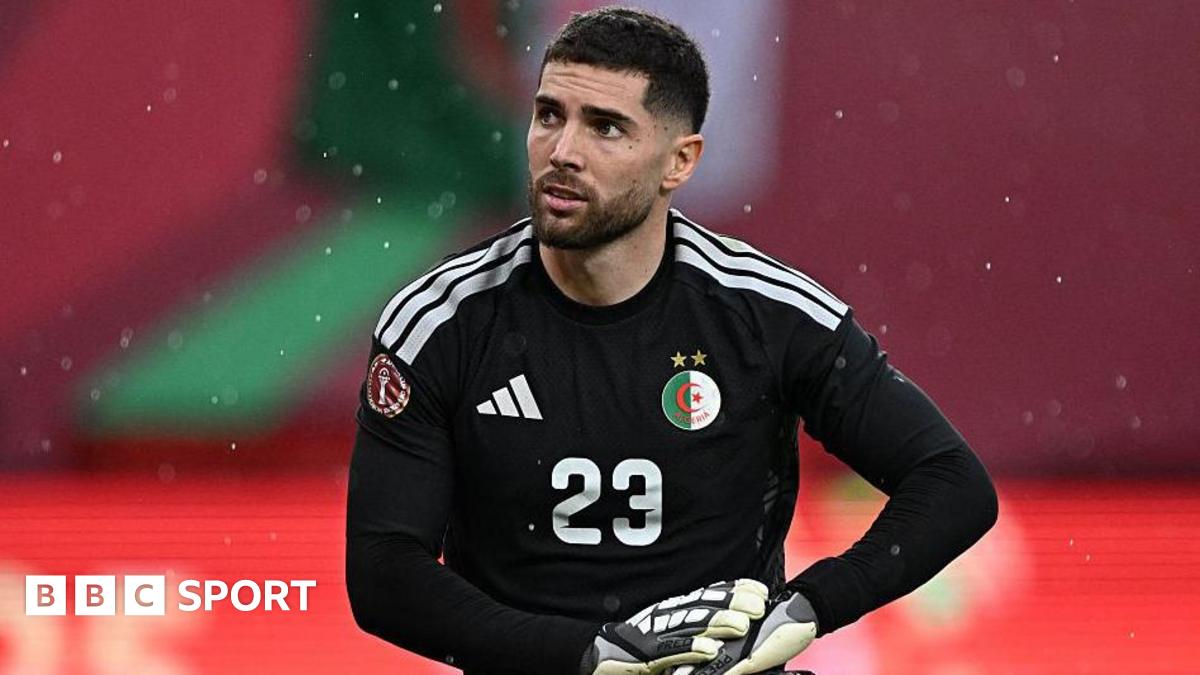
    As the 2026 FIFA World Cup approaches, Algeria has officially announced its 26-man squad for the tournament, bringing a major story of legacy and comeback to the global football stage. The most high-profile inclusion is 28-year-old goalkeeper Luca Zidane, son of French football icon Zinedine Zidane, who earns his first ever World Cup call-up after recovering from a serious facial injury.

    Luca Zidane’s journey to Algeria’s World Cup squad has been defined by choice and resilience. A former youth prospect for France who represented Les Bleus up to the under-20 level, he made the decision to switch allegiances to Algeria, the country where his paternal grandparents were born. He was the Desert Foxes’ starting goalkeeper at the 2025 Africa Cup of Nations, but his season was derailed in April when he suffered broken jaw and chin injuries while playing for Spanish La Liga side Granada. He has since recovered to reclaim his place in the national side, having previously made two senior appearances for Real Madrid before moving to Granada.

    Alongside the younger Zidane, 35-year-old veteran forward Riyad Mahrez, the former Manchester City and Leicester City star who currently plies his trade at Saudi Arabian club Al-Ahli, has also been selected for the squad, bringing decades of top-flight experience to Algeria’s attacking line.

    Coach Vladimir Petkovic’s squad also features a number of notable returnees and injury comebacks. Midfielder Nabil Bentaleb, 31, who currently plays for French Ligue 1 side Lille, has earned a recall to the national side seven months after being left out of the squad. Petkovic defended the selection, noting that “We know Bentaleb well; he has all the qualities as a person for the group too. He has shown he’s in form these last few months.” Bentaleb already has World Cup experience, having featured for Algeria at the 2014 tournament in Brazil, the North African nation’s most recent appearance at the World Cup finals.

    Two other key players, midfielder Houssem Aouar and forward Amine Gouiri, have also earned spots after missing the 2025 Africa Cup of Nations finals in Morocco earlier this year due to injury. Aouar now plays for Saudi side Al-Ittihad, while Gouir is at French side Olympique de Marseille.

    Luca Zidane’s famous father Zinedine Zidane remains one of the most iconic figures in World Cup history. The legendary French midfielder won the 1998 World Cup on home soil, scoring two goals in the final against Brazil, and reached a second final in 2006, where he scored but was sent off in France’s defeat to Italy.

    Algeria is set to compete in Group J of the 2026 World Cup, where it will face defending champions Argentina, European side Austria, and Asian representative Jordan. The full squad announced by Petkovic includes three goalkeepers, nine defenders, seven midfielders, and seven forwards, with a mix of youth talent from top European clubs and experienced domestic-based players.

  • Swiatek exits French Open, Zverev, Ruud eye quarters

    Swiatek exits French Open, Zverev, Ruud eye quarters

    The 2025 Roland Garros entered its second week with a stunning upset that sent shockwaves through the clay-court Grand Slam, as four-time champion Iga Swiatek was eliminated from the tournament in a lopsided defeat to Marta Kostyuk. For the Polish star, the loss marked a disappointing end to her tournament on her 25th birthday, capping a difficult stretch of form that has seen her long-held dominance on clay erode over the past 12 months.

    Swiatek, who entered the tournament as the world No. 3, took an early advantage in the opening set, breaking Kostyuk to move ahead 4-3. But from that point onward, her serve and overall rhythm completely collapsed. She never held another game, as the Ukrainian clay-court specialist clawed back to take the first set 7-5, then blazed through the second set 6-1 to secure a straight-sets victory. It is the furthest Kostyuk has ever advanced at Roland Garros, extending a career-best run through the clay-court season that already includes a WTA 250 title in Rouen and her first ever WTA 1000 crown at the Madrid Open.

    In her post-match comments, Swiatek openly acknowledged the mental pressure that derailed her performance, admitting that stress management has been a persistent struggle for her over the past year. “I feel, like, for sure I lost today because Marta used the opportunity, and I was super tense,” the three-time Roland Garros winner said. “It is harder a bit to handle stress for me in the last year. So I feel like today I felt off, you know, and I did mistakes that I didn’t want to do, and I wanted to play safe, but the ball flew everywhere. Suddenly these feelings came back, and I tried to work on it with my dialogue inside, but it was tough today. Yeah, so it all kind of went drastically down, and I played worse and worse.”

    The upset continues a trend of top seeds exiting the tournament early in the second week. Swiatek’s exit follows the end of her historic streak of consistent success at Roland Garros: since claiming her first French Open title in just her second appearance at the event back in 2020, she had never gone more than two seasons without lifting the Coupe Suzanne Lenglen. After Aryna Sabalenka ended her bid for a fourth consecutive title in the 2024 semi-finals, Swiatek has struggled to recapture her unbeatable form on clay, collecting just three tour-level titles in the two seasons since her last Paris championship.

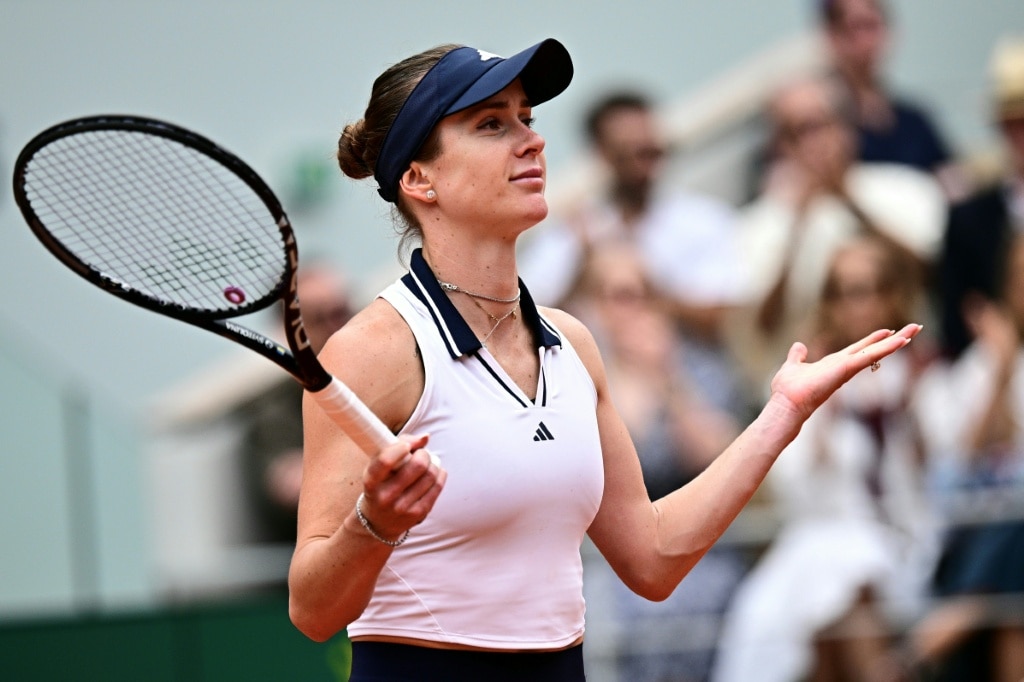
    Kostyuk will now face compatriot Elina Svitolina in the quarter-finals, after Svitolina staged a comeback to beat 11th seed Belinda Bencic of Switzerland 4-6, 6-4, 6-0. Svitolina, the seventh seed, has reached the French Open quarter-finals five times before but has never advanced past that stage. Having claimed her first WTA 1000 title in eight years at the Italian Open last month, the upcoming match will pit the two champions of the biggest Roland Garros warm-up events against one another, guaranteeing a Ukrainian representative in the semi-finals. “It’s exciting. Definitely she’s been playing really well,” Svitolina said of Kostyuk, who has now won 15 consecutive matches on red clay. “I feel like it’s going to be an exciting battle for Ukraine, as well, you know, that there will be one Ukrainian in the semis. Yeah, I think it’s really cool.”

    Elsewhere in the women’s draw, 36-year-old Romanian Sorana Cirstea is enjoying a dream final season on tour, rallying to continue her remarkable renaissance with a 6-3, 7-6(4) win over China’s Wang Xiyu, ranked world No. 148. The result puts Cirstea into her first French Open quarter-final in 17 years, where she will face either Russian eighth seed Mirra Andreeva or Switzerland’s Jil Teichmann, ranked 170th in the world. Entering this final season, Cirstea said she wanted to exit the sport competing at a high level, but even she never expected this level of success. Currently sitting at a career-high WTA ranking of 18th, she said, “I came into my last year, wanted to go out the front door of the sport, wanting to really do well, but I didn’t really think it was going to go that well. In the same time it’s very beautiful. I’m very grateful for everything that’s happening.”

    In the men’s draw, 19-year-old Spanish rising star Rafael Jodar pulled off a dramatic comeback in his debut Grand Slam campaign, fighting back from two sets down to defeat compatriot Pablo Carreno Busta 4-6, 4-6, 6-1, 6-2, 6-2 to book his spot in the quarter-finals. The five-set battle was interrupted by brief rain delays after the first week’s record heatwave gave way to wet conditions, extending an already lengthy match for the teen qualifier who has become accustomed to marathon clashes during his first run at Roland Garros.

    Looking ahead to the day’s remaining matches, the two highest-profile remaining contenders in the bottom half of the men’s draw—both former Grand Slam finalists—will step onto court looking to secure their own quarter-final spots and keep their dreams of a first major title alive. Eighth seed Casper Ruud will face Brazilian young gun Joao Fonseca, while second seed Alexander Zverev will take on Dutch lucky loser Jesper de Jong.

  • Spain’s Lamine Yamal says he was scared of missing the World Cup after he injured his hamstring

    Spain’s Lamine Yamal says he was scared of missing the World Cup after he injured his hamstring

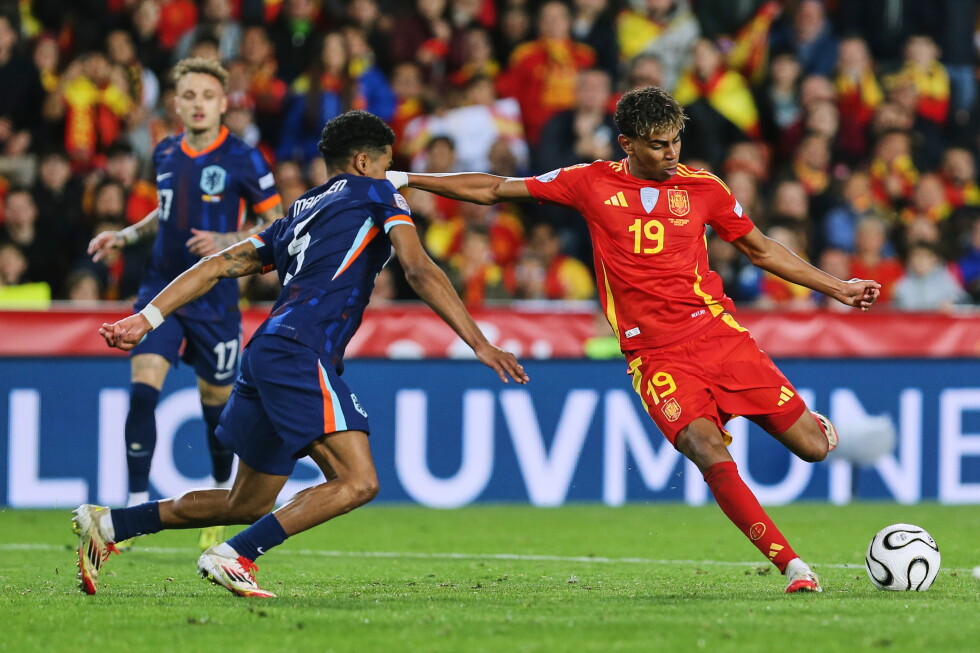
    Rising Spanish football prodigy Lamine Yamal has opened up about the terrifying weeks he spent fearing his dream of featuring at the 2026 FIFA World Cup would be shattered by a sudden hamstring injury, revealing he clung to hope through prayer as he worked to beat his recovery timeline. The 18-year-old Barcelona forward, who is widely tipped to be one of the breakout stars of this summer’s tournament in North America, suffered the damaging strain to his left hamstring during a La Liga fixture against Celta Vigo on April 22, just moments after converting a first-half penalty for his club.

    In a candid interview published by the Royal Spanish Football Federation on Sunday, Yamal admitted the injury was the most serious setback he has faced in his young career, and that uncertainty about his recovery left him deeply anxious in the immediate aftermath. “I never had a hamstring injury like that but I knew that it wasn’t going to be a short recovery time,” Yamal said. “I was afraid that it was something serious or that it could relapse and that I would miss the World Cup.”

    Witnesses to the incident confirmed the moment the teen’s joy at scoring turned to concern: he immediately gestured to the Barcelona bench signalling pain before collapsing to the ground as teammates rushed in to celebrate, clutching the back of his left leg in clear discomfort. Yamal recalled that even in that moment, his first thought was of the upcoming World Cup, saying, “I was praying inside for it not to be serious, for it to be a cramp or something like that, because I knew the World Cup was very close.”

    Fortunately for the young star and Spanish football fans, his recovery has proceeded according to plan, and national team head coach Luis de la Fuente gave supporters a positive update last week when he named Yamal to Spain’s final 2026 World Cup squad. De la Fuente confirmed the forward is on track to be fit for selection for either La Roja’s opening group stage match or their second outing of the tournament.

    Spain will kick off their 2026 World Cup campaign against debutants Cape Verde on June 15 in Atlanta, before facing Saudi Arabia on June 21 at the same venue, and wrapping up group play against Uruguay on June 26 in Guadalajara, Mexico. As the reigning European champions, Spain enter the tournament with high hopes of claiming their second World Cup title, their first coming in South Africa back in 2010. Yamal, who is expected to be a key attacking leader for the side, says the entire squad has been eagerly anticipating the tournament since their European Championship triumph.

    “The moment has finally arrived,” Yamal said. “I think that ever since the European Championship ended, we’ve all been thinking about this day, and we are all very excited. We will enter the tournament as the European champions, and we are going to give it everything we have.”

    Spain officially kicked off their pre-World Cup preparations in Madrid on Saturday, with roughly 2,000 passionate supporters turning out to watch the squad’s first public training session on Sunday, eager to catch a glimpse of the team ahead of their North American departure.