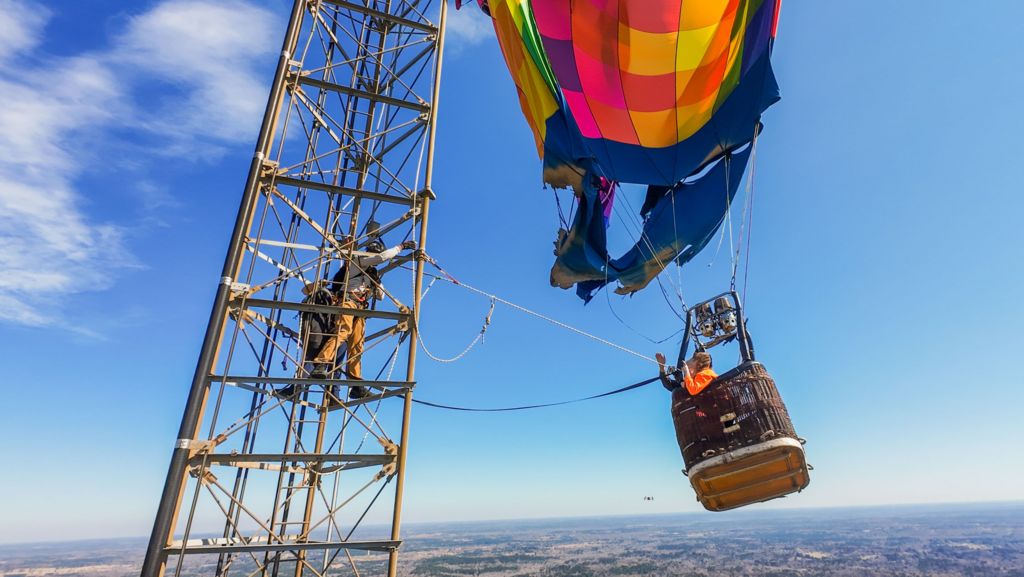
Emergency response teams in Longview, Texas, successfully executed a perilous high-altitude rescue operation after a recreational hot air balloon became entangled with a telecommunications tower approximately 920 feet (280 meters) above ground level. The incident, which occurred under challenging atmospheric conditions, required specialized technical rescue expertise and precise coordination among multiple emergency service units. Witnesses reported the balloon drifting off-course before making contact with the tower structure, creating a potentially catastrophic scenario that threatened the safety of all occupants. Rescue personnel utilized advanced aerial apparatus and safety equipment to secure the damaged balloon basket while carefully extracting passengers from their precarious position. The operation concluded without serious injuries, though several individuals were transported to medical facilities for evaluation as a precautionary measure. Local authorities have initiated an investigation to determine the exact circumstances that led to the collision, including weather patterns, pilot decision-making, and possible equipment malfunction. Aviation safety experts emphasize that while such incidents remain extremely rare, they demonstrate the critical importance of emergency preparedness for all forms of aerial recreation.
分类: society
-

Jacinda Ardern’s move to Australia renews spotlight on New Zealand’s brain drain problem
New Zealand is confronting an unprecedented emigration crisis as its citizens depart in record numbers, with former Prime Minister Jacinda Ardern’s recent relocation to Sydney intensifying scrutiny on the nation’s struggle to retain talent. Despite its global reputation as an idyllic haven, the country is hemorrhaging approximately 180 residents daily—totaling over 66,000 departures last year—creating significant demographic challenges for a nation of merely 5.3 million people.
This exodus represents a deepening structural trend rather than a temporary fluctuation. Migration expert Alan Gamlen from Australian National University notes that while overseas experience has long been a cultural rite of passage for young New Zealanders, the past five years have witnessed a troubling shift toward permanent relocation. Economic pressures including decade-high unemployment outside pandemic periods, wage stagnation against persistent inflation, and among the developed world’s highest grocery prices are primary drivers.
The housing crisis compounds these challenges, with affordability constraints and supply shortages driving both rental and purchase costs to prohibitive levels. These economic realities are fracturing families and communities, as illustrated by opposition MP Ginny Anderson’s personal account of her son moving to Melbourne for work and her brother teaching in China for better wages.
Australia remains the predominant destination, absorbing roughly half of New Zealand’s emigrants through favorable work rights and superior economic prospects. While some experts note potential long-term benefits through expanded global networks and returning talent, lawmakers acknowledge urgent needs for economic revitalization. With general elections approaching in November, policy proposals range from immigration adjustments to infrastructure investments, though governing coalition members attribute current challenges to pandemic aftermath.
Ardern’s move, while personally motivated by family considerations and professional opportunities according to her office, symbolizes broader patterns affecting citizens across socioeconomic spectrums. As Housing Minister Chris Bishop concedes, despite government efforts toward progress, ‘a deep unease’ persists among New Zealanders about the nation’s trajectory and capacity to provide prosperous futures.
-

Dragon dance illuminates Huangshan ancient town
The historic town of Xiuning in Huangshan, Anhui province, came alive on February 28th as the annual Dragon Dance Festival transformed the streets into a vibrant tapestry of cultural celebration. Thousands of locals and visitors gathered to witness the magnificent spectacle that has been cherished for centuries.
Five traditional Huizhou Bench Dragon Dance teams, each moving in synchronized precision to powerful drum rhythms, processed from different directions across the county. The colorful procession created a dynamic visual display as the teams eventually converged at Zhuangyuan Square, a significant landmark honoring Huangshan’s rich academic heritage and scholarly traditions.
The Huizhou Bench Dragon Dance, recognized as a national intangible cultural heritage, originated in Xiuning and represents one of China’s most treasured folk art forms. With a documented history spanning more than five centuries, this cultural practice has been meticulously preserved through generations. The dance involves performers carrying connected wooden benches that form the body of an undulating dragon, creating a mesmerizing movement that symbolizes prosperity, good fortune, and communal harmony.
The festival not only serves as a tourist attraction but also plays a vital role in cultural preservation, allowing younger generations to connect with traditional art forms while strengthening community bonds among participants and spectators alike.
-

Austin residents react to bar shooting
Federal authorities are investigating a recent Austin bar shooting as a potential act of terrorism after discovering critical evidence linking the suspect to extremist ideologies. The FBI confirmed that both the SUV utilized during the attack and items found on the suspect’s person displayed clear indications of a “nexus to terrorism,” marking a significant development in the case that has left the local community in shock.
Residents of Austin expressed a complex mixture of fear, resilience, and concern following the violent incident that disrupted the city’s normally vibrant nightlife. Community leaders have organized vigil events and support networks while simultaneously calling for increased security measures in public spaces. Local businesses near the shooting location have reported heightened anxiety among patrons, though many have also demonstrated solidarity through community gatherings.
The investigation continues to unfold as federal and local law enforcement agencies collaborate to determine the precise motivations behind the attack. Authorities have increased patrols in entertainment districts while maintaining that no additional credible threats have been identified. The case has sparked broader conversations about domestic security protocols and community preparedness in addressing potential terrorism threats at the local level.
-

South African TV personality who planned to take his life dies aged 61
South African entertainment luminary Ian von Memerty, renowned for his judging role on ‘South Africa’s Got Talent’ and hosting duties on the local adaptation of ‘Strictly Come Dancing,’ has passed away at age 61. His family confirmed his peaceful departure in Johannesburg during the early hours of last Monday, though the specific circumstances were not disclosed in their official statement.
In an unprecedented digital chronicle, von Memerty meticulously documented his philosophical approach to mortality through a fifteen-part Facebook series. The performer articulated his profound desire to avoid the physical and cognitive deterioration associated with aging, expressing concerns about potential financial hardship and becoming dependent on family members.
The family’s announcement emphasized their commitment to respecting von Memerty’s autonomous decision-making, stating: ‘As a family we have done everything we can to love & respect him on his journey.’ They subsequently requested privacy while processing their profound loss.
Von Memerty’s candid discourse ignited intense ethical debates across social media platforms. While many supporters championed his right to self-determination, detractors criticized his public methodology and raised concerns about the psychological impact on surviving relatives. In an emotionally charged video included in his series, von Memerty acknowledged the tremendous difficulty of informing his family, describing it as ‘one of the worst days’ of his life.
Beyond his television prominence, von Memerty maintained a diverse artistic career spanning theater direction, acting performances, cruise ship entertainment, and pet sitting services. Born in Zimbabwe, he established his professional identity primarily within South Africa’s cultural landscape.
The conversation continues regarding ethical considerations surrounding end-of-life decisions, with mental health organizations emphasizing available support systems for those experiencing distress.
-

Chinese judges on the rise
China’s judicial professionals are increasingly assuming significant roles within the international legal arena, demonstrating remarkable progress in global judicial cooperation. These legal experts are actively promoting fundamental legal principles while maintaining exceptional professional standards across international platforms.
A distinctive aspect of their global contribution involves sharing China’s sophisticated mediation techniques with worldwide legal communities. This knowledge transfer represents more than mere technical exchange—it signifies a deepening engagement with international legal frameworks and institutions.
Their expanding influence reflects a deliberate strategy to strengthen global judicial connectivity while enhancing cross-border legal cooperation. This development illustrates how national judicial expertise can contribute to the evolution of international legal practices without compromising domestic legal traditions.
The growing presence of Chinese judges internationally coincides with China’s broader engagement with global governance systems. This trend demonstrates how specialized national expertise can both benefit from and contribute to the development of transnational legal standards and practices.
-

80th anniversary of Party’s first aviation school celebrated
Changchun witnessed a significant historical commemoration on Sunday as hundreds assembled at the Aviation Culture Exhibition Center in Jilin province to honor the 80th anniversary of the Northeast Democratic Alliance Aviation School’s establishment. This institution, originally founded in Tonghua on March 1, 1946, holds the distinguished position as the Communist Party of China’s inaugural aviation training academy, widely recognized as the foundational cradle of China’s contemporary aviation industry.
The gathering brought together aviation enthusiasts, historical preservationists, and representatives from China’s aerospace sector to reflect upon the institution’s profound legacy. The ceremony highlighted the school’s pioneering role during its operational years between 1946 and 1949, when it cultivated China’s first generation of aviators and technical personnel under challenging circumstances.
Historical records indicate the academy operated during the Chinese Civil War period, initially established in Tonghua before relocating multiple times due to security concerns. Despite limited resources and turbulent conditions, the institution managed to train approximately 560 aviation professionals, including 126 pilots, whose expertise would later prove instrumental in developing both military and civilian aviation capabilities.
The anniversary event featured photographic exhibitions, historical artifacts, and educational presentations documenting the school’s operational history and its graduates’ subsequent contributions to Chinese aviation development. Current aviation industry leaders emphasized how the school’s spirit of perseverance and innovation established foundational principles that continue to influence China’s aerospace ambitions today.
-
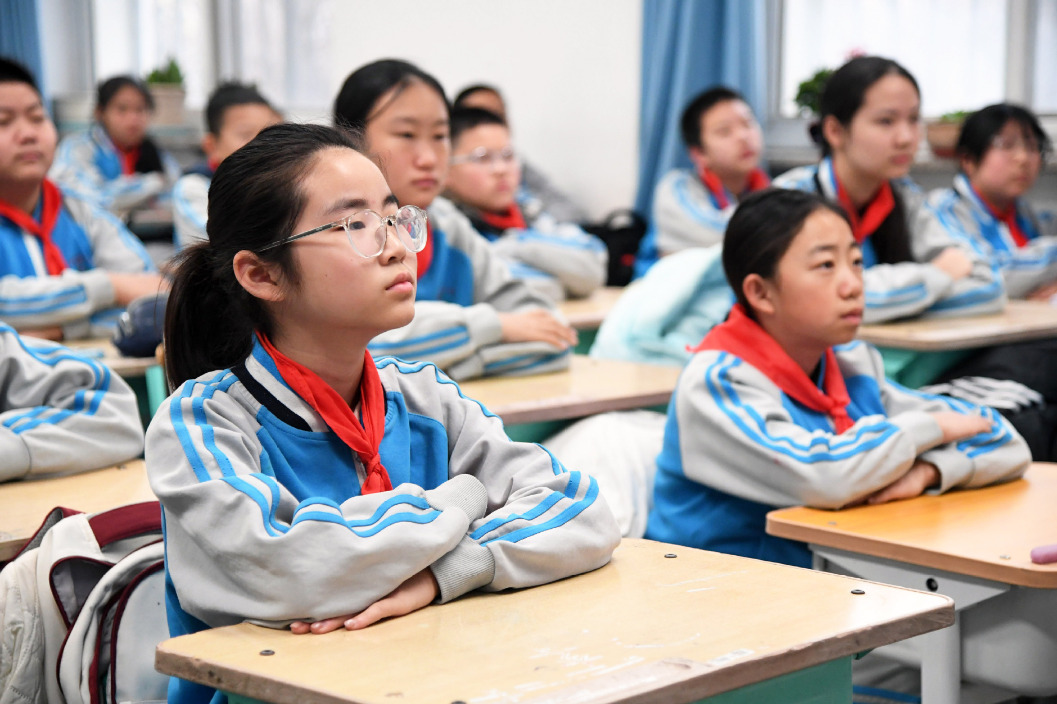
New semester kicks off for primary, secondary schools in many parts of China
Educational institutions across China marked the commencement of the 2026 spring semester on March 2nd, with primary and secondary schools reopening their gates to millions of students. The academic resurgence witnessed coordinated operations from Beijing to various provincial districts, signaling the return to structured learning environments following winter breaks.
In Beijing’s Pinggu District, educational facilities demonstrated meticulous preparedness as students engaged in inaugural classroom sessions. Photographic documentation captured the vibrant atmosphere of scholastic renewal, showing learners actively participating in educational activities designed to stimulate intellectual curiosity and academic engagement.
This nationwide educational reactivation represents more than mere administrative scheduling—it embodies China’s sustained commitment to maintaining educational continuity and pedagogical development. The synchronized reopening across multiple regions reflects the comprehensive infrastructure supporting China’s academic calendar, ensuring uniform educational standards while accommodating regional variations where necessary.
Educational authorities have implemented comprehensive measures to guarantee smooth transitional phases, incorporating both academic readiness and psychological adjustment protocols. The semester inauguration follows established patterns of China’s educational system organization, which emphasizes balanced development between academic rigor and student well-being.
-

Trump will award Medal of Honor to three US Army service members in White House ceremony
In a solemn ceremony at the White House on Monday, three distinguished U.S. Army soldiers received the nation’s highest military honor, the Medal of Honor, with two awards granted posthumously. President Donald Trump presided over the event, continuing the presidential tradition of recognizing extraordinary valor in combat.
The honorees spanned multiple generations of military service. Retired Command Sgt. Maj. Terry P. Richardson was recognized for heroic actions during the Vietnam War that directly saved approximately 85 fellow service members from certain death. Staff Sgt. Michael H. Ollis received the medal posthumously for his ultimate sacrifice in Afghanistan in 2013, where he displayed exceptional bravery during combat operations that claimed his life. Master Sgt. Roderick W. Edmonds, who passed away in 1985, was honored for his remarkable leadership and resistance while enduring captivity as a prisoner of war in Germany during World War II.
The Medal of Honor represents the pinnacle of military recognition, awarded by the President in Congress’s name to service members who demonstrate exceptional courage and self-sacrifice far beyond normal call of duty. These awards highlight the enduring legacy of military heroism across different conflicts and generations, serving as a powerful reminder of the extraordinary sacrifices made by members of the armed forces throughout American history.
-
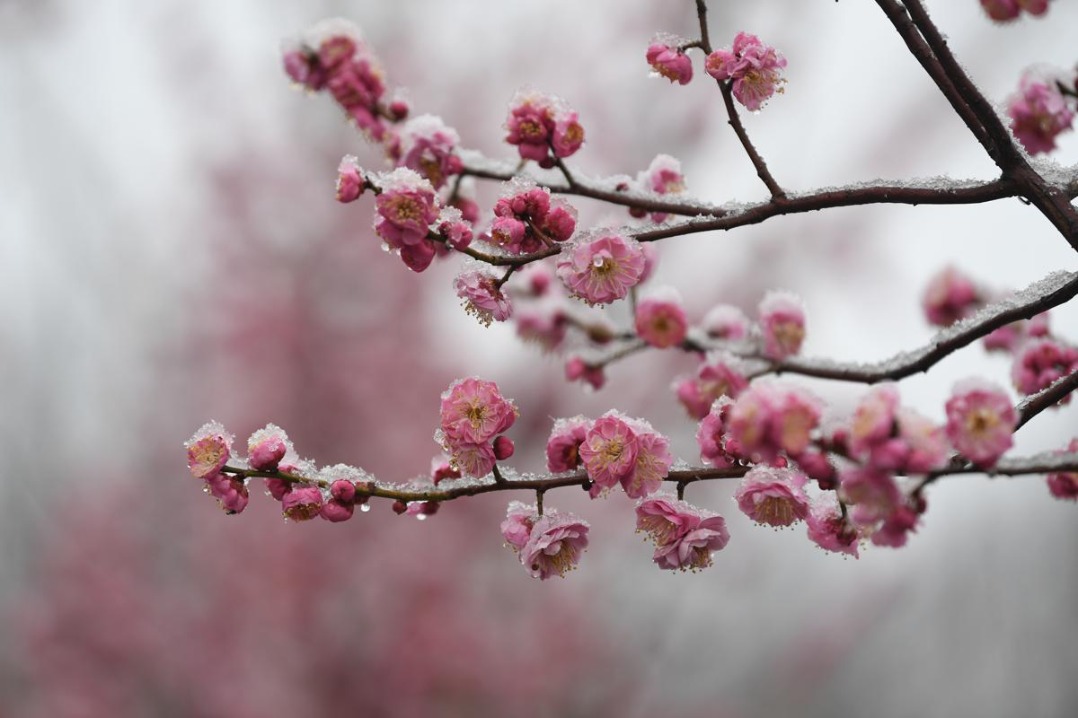
Spring snow blankets red plum blossoms in Guangping county, Hebei
The recent spring snowfall in Guangping county, Handan city of Hebei province, has transformed the landscape into a breathtaking natural masterpiece reminiscent of classical Chinese paintings. On Sunday, the unexpected meteorological phenomenon created a stunning visual spectacle at Donghu Park where vibrant red plum blossoms stood in dramatic contrast against the freshly fallen snow.
The delicate floral structures demonstrated remarkable resilience as they supported delicate layers of snow while maintaining their brilliant crimson coloration. This rare convergence of seasonal transitions—where winter’s final embrace meets spring’s early bloom—resulted in an extraordinary photographic opportunity that attracted both local residents and nature enthusiasts.
Architectural elements within the park, including traditional pavilions and ornamental towers, provided additional visual interest as their structures became partially dusted with snow while framing the snow-adorned plum trees. The scene embodied the poetic beauty often depicted in traditional Asian art, where natural elements interact in harmonious balance.
Meteorological officials noted that such late-winter snow events, while uncommon during the early spring bloom period, can create particularly striking visual displays due to the temperature differential between the warm soil supporting blossom development and cold air masses producing precipitation. The phenomenon typically lasts only briefly before warmer temperatures return, making documented occurrences especially valuable to photographers and nature observers.