分类: science

  • Why isn’t Artemis II landing on the Moon?

    Why isn’t Artemis II landing on the Moon?

    NASA’s ambitious Artemis program has sparked widespread curiosity among space enthusiasts around the globe, particularly regarding the upcoming Artemis II mission. Many following the program’s progress have posed one pressing question: if the United States targets a human lunar landing by 2028, what is the core purpose of Artemis II, which will not touch down on the Moon’s surface at all?

    To answer this question, it is critical to contextualize the phased approach of the entire Artemis initiative. Unlike the Apollo program that raced to put the first humans on the Moon half a century ago, Artemis is built as a sequential, sustainable program designed to lay long-term groundwork for lunar exploration and eventual deep space missions to Mars. Artemis I, the first uncrewed test flight completed in 2022, successfully validated the Space Launch System rocket and Orion capsule’s deep space capabilities, proving the core hardware could operate as designed in the harsh environment of cislunar space.

    Artemis II, the program’s first crewed mission, represents the next critical milestone in this step-by-step framework. Scheduled for launch no earlier than September 2025, the four-person crew will embark on a roughly 10-day mission that will loop around the Moon before returning to Earth. This journey is not intended to end with a surface landing; instead, its primary goal is to comprehensively test all life support systems, communication networks, navigation tools, and abort capabilities with humans on board, gathering real-world data that no uncrewed test can provide.

    The mission will also allow crew members to evaluate how the human body responds to the radiation exposure and microgravity conditions of deep space travel beyond low-Earth orbit, filling critical gaps in medical data that has not been updated since the final Apollo missions in the 1970s. Engineers will monitor every system’s performance during the flight to identify and resolve any unforeseen issues before committing to a landing attempt with Artemis III, currently targeted for September 2026, later pushed back to 2028 due to development delays in the human landing system and spacesuits.

    This incremental approach prioritizes crew safety above all else, a core principle that has guided NASA human spaceflight for decades. By skipping the landing on Artemis II, mission planners can focus entirely on validating the foundational capabilities that any successful lunar landing and future sustained lunar operations depend on. The data collected from Artemis II will not only inform the Artemis III landing mission but also support the long-term goal of establishing a permanent lunar outpost called Gateway, which will serve as a testing ground for technologies needed for eventual human missions to Mars.

    In the broader scope of space exploration, Artemis II holds historic significance of its own, even without a landing. It will mark the first time humans have traveled beyond low-Earth orbit since Apollo 17 in 1972, and its crew will include the first woman, first person of color, and first non-US astronaut to journey to the lunar vicinity. While the final landing goal remains targeted for 2028, Artemis II itself is a landmark step that will open a new era of human deep space exploration.

  • How a chance meeting shaped Canadian Jeremy Hansen’s mission to the Moon

    How a chance meeting shaped Canadian Jeremy Hansen’s mission to the Moon

    Fifty years after the last Apollo mission carried humans to the Moon’s vicinity, Canadian astronaut Jeremy Hansen stands on the cusp of making history as the only non-American crew member of NASA’s groundbreaking Artemis II mission – a milestone decades in the making, rooted in childhood wonder and a chance mentorship that shaped his path to space.

    Long before his name was attached to humanity’s first crewed lunar orbit mission in a generation, Hansen was a curious five-year-old growing up on a small farm outside London, Ontario. His passion for space ignited unexpectedly when he stumbled on an encyclopedia entry featuring Neil Armstrong and the iconic 1969 Apollo 11 lunar landing image. That moment left an indelible mark: “That page is still burnt in my brain,” Hansen recalled in a recent interview with *Spaceflight Now*. The young aspiring explorer quickly converted his family’s treehouse into a makeshift rocket, turning childhood daydreams into the first step of a decades-long journey.

    By his teens, Hansen had translated that fascination into action, joining the air cadets youth program before pursuing degrees in space science and physics at university. He went on to become a Royal Canadian Air Force fighter pilot, flying CF-18 jets out of Cold Lake, Alberta’s military base and collaborating with the North American Aerospace Defense Command (NORAD). But a chance encounter during his first year at the Royal Military College of Canada in 1995 would cement his trajectory: the young cadet met his idol, fellow Canadian astronaut Chris Hadfield – years before Hadfield would take command of the International Space Station.

    Hansen worked up the courage to ask Hadfield for his email address, and the quick exchange sparked a years-long mentorship that would guide Hansen’s career. When Hansen joined the Canadian Space Agency (CSA) in 2009, following in Hadfield’s footsteps as both a fighter pilot and astronaut, Hadfield remained a key advisor, leaving Hansen with one simple, enduring piece of advice: chase the work that sets your passion alight. “Jeremy has been getting ready for this flight since he was five years old,” Hadfield noted in a March podcast conversation with Canadian singer Emm Gryner.

    Fourteen years after joining the CSA, Hansen’s lifelong preparation culminated in a historic selection: he was named mission specialist for Artemis II, the first crewed mission to travel beyond low-Earth orbit and circle the Moon since NASA’s Apollo program concluded in the 1970s. Over the 10-day mission, Hansen and three crewmates – commander Reid Wiseman, pilot Victor Glover, and fellow mission specialist Christina Koch – will travel farther from Earth than any human group in history.

    Hansen is under no illusion that the groundbreaking mission will be without risk. “To do something that has never been done before means that your team is very likely to face failure,” he shared in an interview with the CSA. But that uncertainty has not dimmed his commitment to pushing human exploration forward. “I like the fact that in space, we are committed to bold goals to the extent that we will not let periodic failure stop our forward progress,” he added.

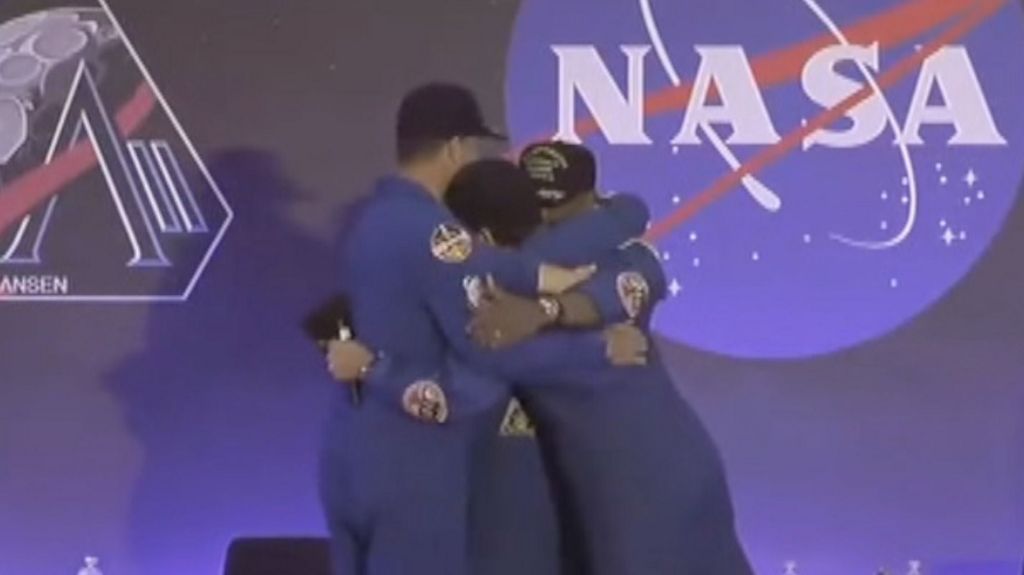
    For the historic flight, Hansen has woven personal and cultural meaning into every detail of his mission. He will carry four small moon-shaped pendants, each engraved with a birthstone for his wife and three teenage children. His custom blue spacesuit bears a mission patch designed by Anishinaabe artist Henry Guimond, with input from Dave Courchene III of Manitoba’s Sagkeeng First Nation. The patch’s heptagonal shape and featured animals draw from Indigenous teachings that center on four core values: love, respect, courage and humility for all people. Hansen says the patch is a deliberate tribute to Indigenous peoples of Canada and their millennia of traditional knowledge.

    In a recent BBC interview with science editor Rebecca Morelle and 13 Minutes podcast host Tim Peake – himself a former astronaut – Hansen opened up about the moments he is most anticipating. He is already looking forward to his first glimpse of Earth from orbit during his opening hour in space, but the highlight he expects will be the view of the Moon in the foreground, with our home planet hanging delicate and blue in the black distance behind it.

    For Hansen, the mission is about more than just pushing the boundaries of human exploration: it is a reminder of what humanity can achieve when we work together. “I hope humanity will stop for a moment when four humans are on the far side of the Moon, and just look at some of the imagery that we are sharing – and just be reminded that we can do a better job as humans of just lifting each other up,” he said. “Not destroying but creating together.”

  • Danish warship sunk by Nelson’s British fleet discovered after 225 years

    Danish warship sunk by Nelson’s British fleet discovered after 225 years

    On the 225th anniversary of one of the most pivotal naval battles of the Napoleonic era, marine archaeologists from Denmark’s Viking Ship Museum have announced a landmark discovery: the wreck of the Danish flagship *Dannebroge*, sunk by British forces under Admiral Horatio Nelson during the 1801 Battle of Copenhagen, has been located on the seabed of Copenhagen Harbor.

    The conflict that claimed the *Dannebroge* was rooted in 19th century European geopolitics. Denmark had joined the League of Armed Neutrality, an alliance of Northern European powers including Russia, Prussia and Sweden, that sought to protect neutral shipping from British blockades during the Napoleonic Wars. To prevent the Danish navy from falling under French control, Nelson led a British fleet in a surprise attack on the Danish blockade positioned outside Copenhagen Harbor on April 2, 1801. The brutal, hours-long clash killed and wounded thousands of combatants, and remains remembered as one of Nelson’s most famous military victories. It was during this battle that Nelson, who had lost vision in his right eye decades earlier, allegedly ignored a recall order from his superior, famously remarking, “I have only one eye, I have a right to be blind sometimes” — an anecdote that gave rise to the enduring idiom “to turn a blind eye.”

    As the Danish flagship and Nelson’s primary target, the 48-meter *Dannebroge* commanded by Commodore Olfert Fischer bore the brunt of the British attack. Cannon fire shredded its upper deck, and incendiary shells sparked an uncontrollable blaze. “When a cannonball hits a ship, it’s not the cannonball that does the most damage to the crew, it’s wooden splinters flying everywhere, very much like grenade debris,” explained Morten Johansen, head of maritime archaeology at the Viking Ship Museum, describing the nightmare conditions for sailors on board. The badly damaged vessel drifted northward in the harbor before eventually exploding, with historical records noting the blast produced a deafening roar heard across the entire city of Copenhagen.

    For more than two centuries, the exact location of the wreck remained a mystery. That changed when archaeologists launched targeted surveys of the area late last year, zeroing in on a site that aligned with historical accounts of the *Dannebroge*’s final resting position, 15 meters below the water’s surface. Working in thick seabed sediment with near-zero visibility, the team has already confirmed the wreck’s identity: the dimensions of recovered wooden fragments match 19th century ship schematics, and dendrochronological dating, which uses tree rings to date wood, confirms the timber matches the period when the *Dannebroge* was built. So far, divers have recovered two intact cannons, military uniforms, metal insignia, footwear, glass bottles, ceramic fragments, basketry, and even a partial human lower jawbone, likely belonging to one of the 19 *Dannebroge* crew members still unaccounted for after the battle.

    Working at the site is a grueling challenge. Silt stirred up by divers’ movements keeps the water in near-complete darkness. “Sometimes you can’t see anything, and then you really have to just feel your way, look with your fingers instead of with your eyes,” said Marie Jonsson, a diver and maritime archaeologist on the project. Even more pressing is the race against time: the wreck site lies in the footprint of Lynetteholm, a massive planned coastal housing and development project scheduled to begin construction on the site in the near future, with completion targeted for 2070. The months-long underwater excavation is being rushed to recover as much of the wreck and its artifacts as possible before construction begins.

    For Denmark, the discovery of the *Dannebroge* is far more than a archaeological find: the 1801 battle is deeply woven into the country’s national identity. “It’s a big part of the Danish national feeling,” Johansen noted. While the battle has been extensively documented by historians for more than two centuries, much of what is known comes from secondhand accounts from outside observers. Archaeologists believe the wreck holds untold new details about what life was really like for sailors caught in the brutal fighting, and may uncover long-lost personal stories of the men who served on the flagship. “There are bottles, there are ceramics, and even pieces of basketry,” Jonsson said. “You get closer to the people onboard.” The Associated Press was the only international news outlet granted exclusive access to the excavation site.

  • Xiong’an national observatory officially inaugurated

    Xiong’an national observatory officially inaugurated

    BEIJING – On Wednesday, China formally launched its 27th national climate observatory in the Xiong’an New Area, a strategically planned modern development zone located in Hebei Province, northern China. The inauguration marks a key milestone in strengthening the country’s national climate monitoring network and advancing meteorological research for one of China’s most ambitious urban development projects.

    Officials from the China Meteorological Administration confirmed that the new observatory features a structured network of one central main monitoring station and eight regional auxiliary stations. This distribution allows the facility to capture comprehensive climate data across four distinct major ecosystem types that exist within the Xiong’an region, including dense urban development zones, natural forest landscapes, protected wetland reserves, and large-scale agricultural farmland areas.

    Unlike traditional static observation facilities, all meteorological data collected across the Xiong’an network is transmitted instantly in real time to a cloud-hosted big data platform. This digital integration dramatically boosts local and national capabilities in continuous climate monitoring, rapid extreme weather early warning, and customized meteorological services tailored to the needs of different economic and public service sectors.

    Located approximately one hour’s drive southwest of central Beijing, Xiong’an New Area was first established by Chinese authorities in 2017. Widely referred to as China’s “city of the future,” the development is a core component of the national strategy to relocate non-essential capital functions from Beijing to ease urban overcrowding pressure, while driving coordinated economic and social development across the Beijing-Tianjin-Hebei region. As the new city continues its phased construction and population growth, robust meteorological infrastructure has become an urgent priority to support sustainable urban planning and daily operation.

    Following its official inauguration, the Xiong’an National Climate Observatory will take on dual roles beyond basic climate data collection. In addition to fulfilling routine long-term climate observation tasks, the facility will also conduct targeted cutting-edge research in multiple key climate-related fields. The data and research output from the observatory will provide more robust, reliable technical support for national efforts including climate resource assessment, long-term climate change tracking and impact analysis, and early identification of meteorological disaster risks across the region and beyond.

    Over the past several years, local meteorological authorities in Xiong’an have already made significant progress in building out smart meteorological infrastructure, establishing a preliminary integrated regional monitoring network that covers the entire new area.

    “Moving forward, our team will continue to strengthen core capabilities across three key areas: meteorological disaster risk monitoring and early warning, ecological meteorological support for environmental protection and restoration, and high-quality meteorological services that support stable urban operation,” said Guo Yitao, deputy director of the newly inaugurated Xiong’an observatory.

  • It’s happening: historic Moon mission set for launch

    It’s happening: historic Moon mission set for launch

    Nearly 52 years after humanity’s last crewed trip to the Moon, NASA’s groundbreaking Artemis 2 mission stands on the cusp of launch, carrying four astronauts to make history as the first crewed lunar voyage since 1972. After years of planning, multiple delays and technical setbacks have pushed the mission from its original February launch window to its targeted liftoff at 6:24 pm ET (2224 GMT) on April 1 from NASA’s Kennedy Space Center in Florida.

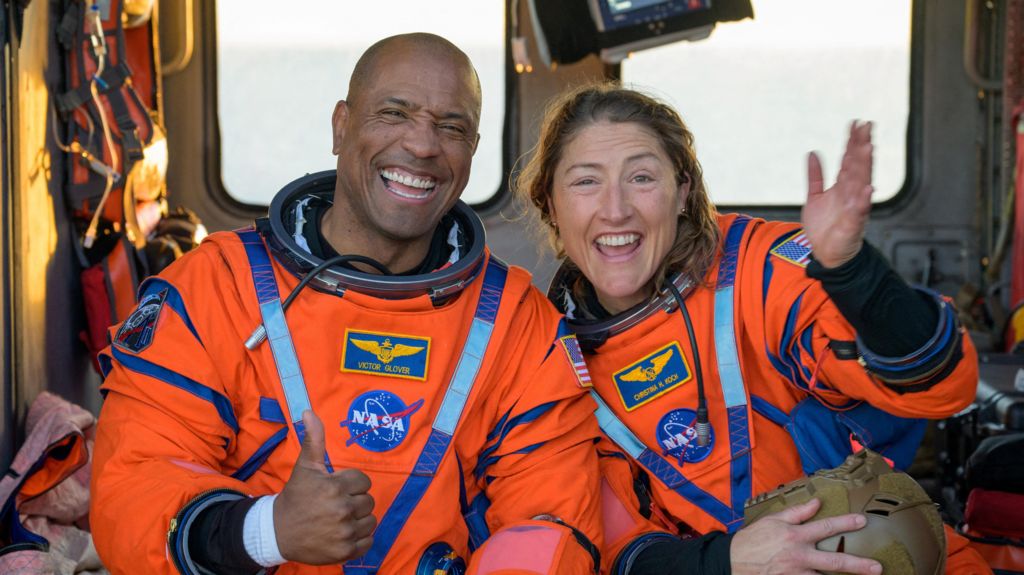
    The four-person crew includes three NASA astronauts — mission commander Reid Wiseman, pilot Victor Glover, and mission specialist Christina Koch — plus Canadian Space Agency astronaut Jeremy Hansen. Over the course of a roughly 10-day expedition, the crew will fly a circumlunar trajectory, orbiting the Moon without landing, echoing the path of NASA’s 1968 Apollo 8 mission. This journey carries multiple historic firsts: Glover will become the first person of color to travel to the Moon, Koch the first woman, and Hansen the first non-U.S. citizen to join a lunar mission.

    Artemis 2 also marks the inaugural crewed flight of NASA’s powerful new Space Launch System (SLS), a massive orange-and-white rocket built to enable repeated U.S. missions to the lunar surface in the coming decades. The long-term goal of the Artemis program is to establish a permanent lunar outpost that will serve as a launchpad for future deep space exploration, most notably a crewed mission to Mars.

    Speaking at a press conference over the weekend, Koch framed the Moon as an invaluable scientific resource: “The moon is a witness plate to our entire solar system’s formation. It’s a stepping stone to Mars, where we might have the most likelihood of finding evidence of past life, but it’s also a Rosetta Stone for how other solar systems form.”

    After multiple scheduling delays that required rolling the massive rocket back to its assembly hangar for technical inspections and repairs, NASA leadership says all systems are go for launch. “The vehicle is ready, the system is ready. The crew is ready,” Amit Kshatriya, NASA’s associate administrator, told reporters at a recent briefing. As of Tuesday afternoon, agency officials confirmed that final pre-launch engineering preparations were progressing on schedule, and forecasters are predicting generally favorable weather conditions for Wednesday’s attempt.

    If the launch is scrubbed on Wednesday, backup launch windows remain available through April 6, though weather conditions are expected to become slightly less favorable later in the week. Launch weather officer Mark Burger noted Tuesday that meteorologists are monitoring scattered cumulus clouds, possible light showers, and gusty winds, but added that none of the potential weather hazards are expected to be severe enough to fully rule out launch. “We should be able to find some clear air to launch Artemis,” Burger said.

    Thousands of space enthusiasts have traveled to Florida from across the country to witness the historic launch, including 76-year-old Melinda Schuerfranz, a retiree from Ohio who watched earlier Apollo launches from afar decades ago. “We’re looking forward to it, we’ve never seen anything like this,” Schuerfranz told AFP, while relaxing on a Florida beach. She noted that public interest is already widespread at local businesses, but reflected that the cultural moment may feel less unified than the Apollo era, when nearly all Americans tuned in for lunar launches: “I think it was way more exciting then. Everybody tuned into it.”

    Despite the momentum ahead of Artemis 2, the broader Artemis program has long been plagued by costly delays and ballooning budgets. The program is under political pressure to meet the target of landing the first woman and first person of color on the lunar surface by early 2029, the end of a second presidential term if former president Donald Trump wins re-election in 2024. The primary objective of Artemis 2 is to validate the performance of the SLS rocket and the Orion crew capsule in deep space, clearing the way for the 2028 landing mission.

    That 2028 landing deadline has drawn skepticism from many space policy experts, in large part because NASA is counting on private sector development of a human-rated lunar lander. Two competing lander designs are currently under development by private companies led by billionaires Elon Musk and Jeff Bezos, and the program’s timeline hinges on these projects staying on schedule.

    In the broader global context, the U.S. return to the Moon is widely framed as a space race with China, which has its own crewed lunar landing program targeted for 2030. For new NASA administrator Jared Isaacman, the Artemis program pursues overlapping goals spanning scientific discovery, national security, and commercial economic opportunity, as well as intangible cultural benefits. “I guarantee after these astronauts fly around the moon, you’re going to have more kids dressing up as astronauts for Halloween,” Isaacman said during a recent television interview. “And that’s going to inspire the next generation to take us further.”

  • What it’s like to be on Florida’s Space Coast ahead of Artemis launch

    What it’s like to be on Florida’s Space Coast ahead of Artemis launch

    As the sun sets over Florida’s Space Coast this Wednesday, hundreds of thousands of space enthusiasts from across the United States are flooding into local causeways, public beaches, and motel balconies, all gathering to witness the long-awaited launch of NASA’s Artemis II mission — humanity’s first crewed trip around the Moon in more than 50 years.

    Among the excited crowd is 8-year-old Isiah, who summed up the collective mood simply: “People going up to the Moon is kind of cool.” Traveling more than 1,000 miles from her home in New Mexico to be at the launch site, Amanda Garcia echoed that enthusiasm. “I heard it’s gonna be a great show. A lot of people are going to be here,” she said, explaining why she made the cross-country trip to be part of the historic moment.

    Local authorities are describing the surge of visitors as a “historic influx”, with projections that the event will deliver an estimated $160 million boost to the regional economy. Months of preparation have gone into managing the crowds: traffic control plans are in place, local bars have rolled out moon-themed drink specials, and hotels have warned guests to expect lengthy travel delays between their accommodations and public viewing sites. Even highway streetlights will share the night sky with the glow of floodlit launch towers and the warm light of camper van barbecue grills scattered across viewing areas.

    Just a mile from the launch pad, Brenda Mulberry, owner of Space Shirts — a local NASA souvenir shop that has operated on Merritt Island for 40 years — says this event is unlike any launch she has ever hosted. “We’ve wanted to go back to the Moon since the ’70s. People are excited. People are beyond excited,” she explained, noting that she has stocked her small shop full of hand-illustrated T-shirts emblazoned with rockets, mission patches and lunar landscapes to meet unprecedented demand. When asked about her long-term vision, Mulberry laughed and joked, “I want to have the first T-shirt shop on the Moon. Because if you’ve been there, you get the T-shirt, right?”

    The Artemis II mission marks a critical turning point for NASA’s broader lunar exploration program, which aims to return humans to the lunar surface for the first time since Apollo 17 in 1972. Unlike the original Apollo missions, which focused on short surface visits, the long-term goal of the Artemis program is to construct a permanent lunar base camp, tap into the Moon’s untapped natural resources, and develop a sustainable starting point for the first human mission to Mars.

    Speaking ahead of the launch, Artemis II commander Reid Wiseman emphasized the program’s intergenerational mission. “In our lifetime, we’ve looked at the Moon knowing that people had been there. And now in the Artemis generation, kids will walk out and look at the Moon going, we are there. We are there now, and we are going further into our solar system,” he said.

    All eyes on launch night will be fixed on Launch Pad 39B, the same historic concrete launch site that supported the Apollo 11 mission that put the first humans on the Moon in 1969. Standing on the pad is NASA’s Space Launch System (SLS), a 321-foot-tall white and orange rocket that is the most powerful and heaviest launch vehicle the agency has ever built. Mounted atop the rocket is the Orion crew capsule, a vehicle roughly the size of a small van that will carry four astronauts on the 10-day unlanded test flight. This mission marks the first time Orion will be tested with a full human crew on board.

    The launch window opens between 18:24 and 20:24 local Florida time on Wednesday. The four-person crew — commander Reid Wiseman, pilot Victor Glover, mission specialist Christina Koch, and Canadian astronaut Jeremy Hansen, who will make his first trip to space on this mission — will board the capsule approximately four hours before liftoff.

    The mission follows a carefully planned 10-day timeline. After reaching Earth orbit, the crew will spend their first day testing manual flight controls and life support systems before setting a course for the Moon. On day two, a major engine burn will put Orion on a free-return trajectory that will naturally carry it around the Moon and back to Earth, with only small course corrections needed along the way. Each day of the flight is dedicated to new system tests and operational challenges, with the most anticipated milestone coming on day six, when Orion is scheduled to fly behind the far side of the Moon. For roughly 40 minutes, all radio contact between the capsule and ground control will be cut off, leaving flight controllers waiting for the spacecraft to emerge from behind the lunar disk. During this pass, Orion will travel between 4,000 and 6,000 miles above the lunar surface, and depending on its exact trajectory, it could surpass the 1970 Apollo 13 record for the farthest any human crew has ever traveled from Earth.

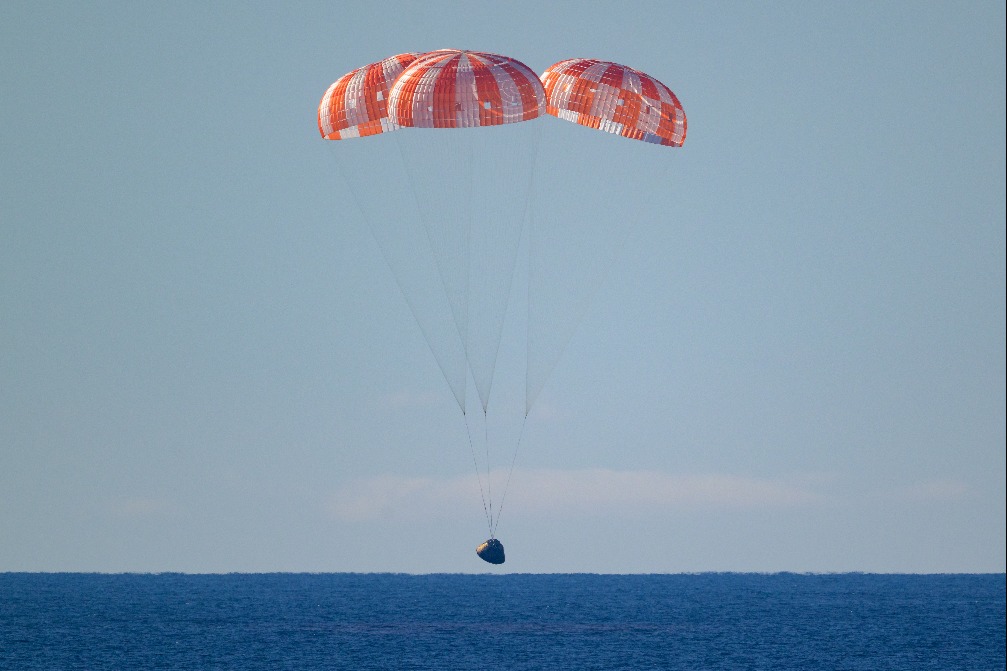
    The most high-stakes phase of the mission comes on re-entry day. Orion will plummet through Earth’s atmosphere at roughly 25,000 miles per hour, generating external temperatures hot enough to melt rock, which must be absorbed by the capsule’s reinforced heat shield. After the 2022 uncrewed Artemis I test flight, engineers discovered that chunks of the heat shield’s protective coating had cracked and broken away during the mission’s two-stage “skip” re-entry maneuver. The maneuver — designed to reduce heat stress, G-force loads, and improve splashdown accuracy — dips the capsule into the upper atmosphere before briefly climbing back up and making a final plunge. For Artemis II, engineers have retained the two-stage approach but adjusted the entry angle and timing to reduce the time Orion spends in the initial, gentle atmospheric dip. Modeling suggests this change will reduce the heat and structural stress that caused the earlier damage, but this mission will be the first real-world test of the adjusted design with a crew on board.

    If Artemis II completes its mission successfully, the next large-scale gathering on the Space Coast will come for the next step in the program: bringing humans back to walk the surface of the Moon, half a century after the last Apollo astronauts left their footprints in the lunar regolith. And as thousands of visitors carry home their custom mission T-shirts from Space Shirts, many will already be sharing Brenda Mulberry’s quiet, playful dream: that one day, her shop’s logo will not only be printed on Florida cotton, but featured in a photograph taken on the surface of the Moon.

  • How will the Artemis astronauts go to the toilet in space?

    How will the Artemis astronauts go to the toilet in space?

    When we talk about preparing for deep space missions, much of the public focus tends to land on rocket propulsion, landing technology, and lunar surface exploration. But behind every successful space mission lies a set of mundane yet mission-critical engineering problems, and one of the most essential of these is how astronauts handle basic biological needs in the microgravity environment. For NASA’s upcoming Artemis program, which aims to return humans to the lunar surface after more than half a century, engineers have dedicated significant work to solving one very practical question: how Artemis astronauts will use the toilet during their time in space.

    The Artemis missions are designed to stretch over 10 days of activity, covering everything from launch and lunar orbit to surface operations for crewed missions. This extended duration demands a far more reliable and comfortable waste handling system than the makeshift solutions used in some early space programs, and even upgraded designs used on the International Space Station (ISS). To meet this need, NASA scientists and engineers have developed an entirely new piece of hardware: the universal waste management system, purpose-built for the unique demands of the Artemis program.

    Unlike traditional terrestrial toilets, a space commode must operate effectively in a microgravity environment where liquid and solid waste do not flow downward. Early space toilet designs relied on simple suction systems that often had issues with leakage, odor, and usability, particularly for long-duration stays. The new universal system is engineered to address these pain points, with improved suction technology, better containment, and a design that accommodates a wider range of body types, supporting the Artemis program’s goal of sending the first woman and first person of color to the lunar surface.

    This new space loo is more than just a convenience for the crew; it is a critical piece of life support infrastructure. Any failure in waste management can not only create unpleasant and unsanitary conditions for astronauts living and working in close quarters, but it can also pose a risk to sensitive equipment on board the Orion capsule that will carry Artemis astronauts to the Moon. By developing a purpose-built system for the 10-day mission profile, NASA is ensuring that even the most basic human needs are met without compromise, allowing the crew to focus on their core scientific and exploration objectives.

    The innovation behind this new waste system also reflects a broader trend in human spaceflight: as NASA prepares for longer missions to the Moon and eventually crewed missions to Mars, every component of the spacecraft, no matter how small or mundane, is being reimagined and upgraded to meet the challenges of deep space exploration. What may seem like a trivial question – how do astronauts go to the toilet – actually represents a key engineering challenge that must be solved to make extended human space exploration a reality.

  • Nasa Apollo missions: Stories of the last Moon men

    Nasa Apollo missions: Stories of the last Moon men

    The recent passing of Apollo 13 commander Jim Lovell marks a significant moment in space exploration history, leaving only five surviving astronauts who have ventured beyond Earth’s orbit to the Moon. These pioneers, part of NASA’s Apollo missions in the 1960s and 1970s, represent a dwindling generation of space explorers as humanity stands on the brink of a new lunar era.

    With more than five decades elapsed since the last human footprint was left on the lunar surface, the international competition to return to the Moon has intensified dramatically. NASA’s Artemis program, initially scheduled for a 2025 crewed launch, has encountered delays pushing the mission to 2026. Simultaneously, China has emerged as a formidable contender in the new space race, targeting a 2030 lunar landing following their successful far-side Moon probe landing in June 2024.

    The commercial space sector presents a mixed landscape of ambition and challenge. Private enterprises have attempted lunar scientific missions with varying outcomes, where technical difficulties have frequently overshadowed successes. Boeing’s Starliner complications, which recently stranded astronauts aboard the International Space Station, and SpaceX’s recurrent Starship prototype failures demonstrate the persistent complexities of space travel.

    The five remaining Apollo veterans each carry unique historical significance:

    Edwin ‘Buzz’ Aldrin, the second man to walk on the Moon during Apollo 11, has evolved into an enduring advocate for Mars exploration. Now 93, Aldrin continues to champion ambitious space goals, stating, ‘I don’t think we should just go there and come back – we did that with Apollo.’

    Charlie Duke, who became the youngest lunar walker at 36 during Apollo 16, served as capsule communicator during Armstrong’s historic landing. Now residing in Texas, Duke acknowledges the challenges awaiting Artemis astronauts: ‘They’ve picked near the South Pole for the landing… it’s really rough down there. But we’ll pull it off.’

    Fred Haise, part of the nearly catastrophic Apollo 13 mission, never achieved his lunar landing due to subsequent mission cancellations. Following NASA service, he transitioned to the aerospace industry, embodying the generation that bridged early space exploration with modern advancements.

    Harrison Schmitt, the first scientist-astronaut on Apollo 17, represented a new breed of space explorer. The geologist turned senator continues to contribute to academic and consulting work while maintaining his unique perspective on space science.

    David Scott, Apollo 15 commander, pioneered lunar driving with the Lunar Roving Vehicle. His post-NASA career has included film consulting, helping preserve the historical accuracy of space exploration narratives for new generations.

    As these lunar pioneers age, their legacy fuels inspiration for the next generation of space explorers preparing to write new chapters in humanity’s cosmic journey.

  • SMILE mission to be launched on April 9

    SMILE mission to be launched on April 9

    In a landmark display of international space collaboration, the Solar wind Magnetosphere Ionosphere Link Explorer (SMILE) mission is officially scheduled for launch on April 9 from Europe’s Spaceport in French Guiana. The National Space Science Center of the Chinese Academy of Sciences confirmed the completion of all prelaunch activities, marking the final countdown for this groundbreaking China-Europe joint venture.

    The SMILE satellite represents the first comprehensive mission-level space science partnership between the Chinese Academy of Sciences and the European Space Agency. Currently integrated onto a Vega-C rocket, the spacecraft will pioneer innovative observation techniques to study solar-terrestrial interactions. Its primary instrument, a wide-field soft X-ray imager, will achieve unprecedented global imaging of Earth’s magnetospheric boundaries—a technological first in space weather research.

    Solar wind, composed of high-speed plasma flows emanating from the sun, interacts with Earth’s magnetosphere to create space weather events that pose significant threats to orbital satellites, navigation systems, communication networks, and power infrastructure in high-latitude regions. The SMILE mission aims to provide critical insights into these interactions, potentially revolutionizing our ability to predict and mitigate space weather hazards.

    The mission’s preparation followed rigorous qualification and flight acceptance reviews completed on October 28. Critical components underwent meticulous transportation logistics, with satellite propellant shipped from Shanghai in November arriving in French Guiana by early February. The flight model and testing equipment departed from the European Space Research and Technology Centre in the Netherlands on February 11, arriving via cargo vessel Colibri on February 26.

    At the Guiana Space Centre, a joint China-Europe team conducted intensive verification campaigns, confirming all systems operate within specified parameters and maintain stability. The successful physical and functional integration with the payload launch adapter has met all preparatory milestones. With the launch window confirmed, final checks are underway regarding weather conditions and vehicle integration to ensure optimal conditions for liftoff.

  • The personal items the Artemis II crew are taking to the Moon

    The personal items the Artemis II crew are taking to the Moon

    In an unprecedented celestial endeavor, NASA’s Artemis II mission prepares to launch four exceptional astronauts on humanity’s first lunar orbital journey in over 50 years. The diverse crew comprises Commander Reid Wiseman, Victor Glover, Christina Koch, and Jeremy Hansen from the Canadian Space Agency, representing a new era of international space collaboration.

    Commander Wiseman, a seasoned US Navy test pilot and veteran of Expedition 40 aboard the International Space Station, brings profound leadership experience to the mission. Beyond his technical expertise, Wiseman embodies resilience as a single parent to two teenage daughters following the tragic loss of his wife to cancer in 2020. He openly discusses with his children the realities of spaceflight risks, emphasizing the importance of preparedness for life’s uncertainties.

    Christina Koch marks a historic milestone as the first woman destined to travel to the Moon. An accomplished engineer and physicist, Koch already holds the record for the longest single spaceflight by a woman (328 days aboard the ISS in 2019) and participated in the first all-female spacewalk. Her inspiration stems from childhood exposure to the iconic Apollo 8 Earthrise photograph, which revealed the profound human element behind space exploration.

    Jeremy Hansen, making history as the first non-American lunar traveler, represents Canada’s growing role in space exploration. The former Royal Canadian Air Force fighter pilot and physicist has played crucial roles in astronaut training at NASA’s Johnson Space Center. Hansen’s approach to mission preparation includes transparent conversations with his family about technical aspects and safety protocols, demystifying the complexities of space travel.

    Victor Glover, set to become the first Black astronaut to journey to the Moon, brings impressive credentials as a former Navy fighter pilot and test pilot with three master’s degrees. His previous experience as pilot of NASA’s SpaceX Crew-1 mission and Expedition 64 aboard the ISS provides invaluable practical knowledge. Glover’s preparation involves studying original Gemini and Apollo documents to extract timeless engineering wisdom from earlier space missions.

    The Artemis II mission represents more than technological achievement—it embodies human curiosity, international cooperation, and personal sacrifice. Each astronaut plans to carry meaningful personal items, from handwritten notes and family pendants to historical artifacts, maintaining tangible connections to Earth during their groundbreaking journey around the Moon.