分类: politics

  • More than 200 political prisoners in Venezuela launch hunger strike

    More than 200 political prisoners in Venezuela launch hunger strike

    In a significant demonstration of protest, more than 200 political prisoners in Venezuela have initiated a hunger strike at Rodeo I prison near Caracas, demanding inclusion in the newly enacted amnesty legislation. The strike, which commenced on Friday night, represents a direct challenge to the limitations of the reform measures promoted by the United States following the dramatic capture of former president Nicolás Maduro on January 3rd.

    The amnesty law, ratified by Venezuela’s congress on Thursday, has faced substantial criticism for its exclusionary provisions. Notably, the legislation does not apply to cases involving military personnel or terrorism charges—precisely the categories encompassing most detainees at Rodeo I. This has left approximately 214 individuals, including both Venezuelan citizens and foreign nationals, without the prospect of release under the current framework.

    Family members of the prisoners have confirmed the widespread participation in the protest action. Yalitza Garcia, mother-in-law of detained Argentine police officer Nahuel Agustin Gallo—who faces terrorism accusations—verified the scale of the hunger strike. Similarly, Shakira Ibarreto, daughter of a policeman arrested in 2024, emphasized that the exclusions within the amnesty law prompted the drastic measure.

    The International Committee of the Red Cross (ICRC) conducted a landmark visit to Rodeo I on Sunday, marking the first time the organization has been granted access to the facility. Filippo Gatti, ICRC’s health coordinator for Venezuela, characterized the visit as ‘a first step’ toward improved humanitarian oversight.

    Interim leader Delcy Rodriguez, who engineered the amnesty under Washington’s pressure following Maduro’s capture, has faced opposition criticism over the legislation’s selective application. The law explicitly excludes those accused of ‘promoting or facilitating armed or forceful actions’ against Venezuela’s sovereignty—charges that have been leveled against Nobel Peace Laureate Maria Corina Machado.

    Despite these exclusions, the amnesty has already benefited thousands. Legislative officials reported that over 1,500 political prisoners have applied for amnesty, with hundreds already released prior to the bill’s formal approval. On Sunday, five individuals were released from Rodeo I to emotional reunions with families, while the NGO Foro Penal documented 23 total releases nationwide.

    The situation underscores the complex transition underway in Venezuela following Maduro’s extradition to the United States, where he and his wife await trial on drug trafficking charges. While the amnesty law represents a significant step toward addressing human rights concerns, the ongoing hunger strike highlights the limitations of current reforms and the persistent challenges in achieving comprehensive justice for all political detainees.

  • Canadian Prime Minister Mark Carney to visit Australia amid new Trump trade threats

    Canadian Prime Minister Mark Carney to visit Australia amid new Trump trade threats

    In a significant diplomatic move, Canadian Prime Minister Mark Carney is scheduled to undertake an official state visit to Australia next month. The March 3rd arrival in Canberra marks the beginning of a three-day summit with Australian counterpart Anthony Albanese, occurring against the backdrop of renewed global trade tensions sparked by former US President Donald Trump’s latest tariff announcements.

    The visit, described by Australian officials as crucial for strengthening bilateral cooperation, will include an address to Australia’s parliament in the nation’s capital before Carney’s delegation proceeds to Sydney for further discussions. Prime Minister Albanese characterized the Canada-Australia relationship as fundamentally rooted in mutual trust and “a shared commitment to supporting stability across the Indo-Pacific and beyond.”

    This diplomatic engagement takes on added significance following Trump’s recent proclamation of a 15% global tariff, reinstated after the US Supreme Court invalidated his previous 10% tariff framework. Both Commonwealth nations, despite their traditional alliance with the United States, face particular vulnerabilities to these protectionist measures. Canada continues to grapple with sector-specific tariffs targeting its automotive industry, despite Trump’s previous characterization of the nation as America’s “51st state.”

    The Canberra meetings will focus on enhancing cooperation across multiple domains including investment security, defense coordination, and critical mineral supply chains. Prime Minister Carney’s visit follows his prominent appearance at the World Economic Forum in Davos, where he positioned himself as a leading voice for middle powers navigating an increasingly fragmented global order. In his notable address, Carney challenged the conventional rhetoric surrounding international systems, stating governments must “stop invoking rules-based international order as though it still functions as advertised,” instead characterizing the current environment as “a system of intensifying great power rivalry.”

    This stance presents an interesting contrast to Albanese’s generally cordial relationship with the Trump administration, which has thus far exempted Australian beef exports from tariff measures. The upcoming discussions between the two leaders will likely explore coordinated responses to the shifting global economic landscape while strengthening bilateral ties independent of great power competition.

  • Anthony Albanese backs Andrew Mountbatten-Windsor in Keir Starmer letter

    Anthony Albanese backs Andrew Mountbatten-Windsor in Keir Starmer letter

    Australian Prime Minister Anthony Albanese has formally endorsed the unprecedented removal of Prince Andrew from the British royal line of succession in a landmark communication to UK Prime Minister Keir Starmer. This constitutional intervention follows the Duke of York’s recent arrest as part of an investigation into alleged misconduct during his public duties.

    The disgraced royal, who stands eighth in succession to the throne, was released pending further investigation. His connection to convicted sex trafficker Jeffrey Epstein has long overshadowed his royal status, culminating in his withdrawal from public life in 2019.

    The emergence of millions of previously redacted documents from US investigations into Epstein has reignited global demands for Andrew’s permanent removal from royal privileges. These files, released under the Epstein Files Transparency Act signed by former President Donald Trump, contain extensive details about Epstein’s network, though Prince Andrew has consistently denied any wrongdoing.

    Albanese’s letter to Starmer represents a significant constitutional position: “In light of recent events concerning Andrew Mountbatten-Windsor, I am writing to confirm that my government would agree to any proposal to remove him from the line of royal succession,” the Australian leader wrote. He emphasized that “these are grave allegations and Australians take them seriously,” while supporting King Charles’ position that the legal process must run its full course.

    The Australian leader has concurrently sought support from Australia’s state and territorial governments, recognizing the complex constitutional implications. Removing a royal from succession requires unprecedented legal coordination across all Commonwealth realms, potentially overturning centuries of established precedent.

    This development follows Andrew’s 2022 out-of-court settlement with Australian-born Virginia Giuffre, who had accused him of sexual assault before her tragic death last year. The Duke’s disastrous 2019 BBC Newsnight interview further damaged his public standing, ultimately leading to his withdrawal from royal duties.

  • From ‘Robot Jetten’ to prime minister: The rise of the Netherlands’ youngest leader

    From ‘Robot Jetten’ to prime minister: The rise of the Netherlands’ youngest leader

    THE HAGUE, Netherlands — In a landmark moment for Dutch politics, Rob Jetten has been sworn in as Prime Minister of the Netherlands, becoming both the youngest leader in the nation’s history and the first openly gay individual to hold the office. The 38-year-old politician took his oath on Monday to lead a minority three-party coalition government, breaking the previous age record set by Christian Democrat Ruud Lubbers, who assumed office at age 43 in 1982.

    Jetten’s ascent to the pinnacle of Dutch politics represents the culmination of a nearly decade-long parliamentary career that began in 2017 when he first won a seat for the centrist, pro-European D66 party, which he now leads. Initially known for his overly rehearsed responses that earned him the nickname ‘Robot’ Jetten, the new prime minister has since developed a more relaxed public persona that has resonated with voters. His popularity received a significant boost after he reached the finals of the prime-time television quiz ‘The Smartest Person.’

    The historic nature of Jetten’s appointment is particularly noteworthy given the Netherlands’ pioneering role in LGBTQ+ rights, having become the first country to legalize same-sex marriage in 2001. Jetten regularly shares aspects of his personal life on social media, including photos with his partner Nicolás Keenan, an Argentine field hockey star who won bronze at the 2024 Paris Olympics. Following his election victory in late October, Jetten posted a heartfelt message combining Dutch and Spanish, thanking Keenan for his ‘unconditional support.’

    However, Jetten faces significant governing challenges as he leads a coalition holding only 66 seats in the 150-seat House of Representatives without a majority in the upper house either. His political career has been marked by environmental advocacy, earning him the nickname ‘climate pusher’ during his time as climate spokesman. As a Cabinet minister under former Prime Minister Mark Rutte, now NATO chief, Jetten championed comprehensive climate legislation involving 120 measures costing 28 billion euros aimed at reducing Dutch carbon emissions by 60% by 2030 compared to 1990 levels.

    Born in the southeastern town of Uden, Jetten studied business administration and worked at government-owned railway infrastructure company ProRail before entering politics. His background also includes athletic pursuits—he once served as a pace setter for future Olympic long-distance champion Sifan Hassan, demonstrating the diverse experiences he brings to his new role as the Netherlands’ youngest-ever prime minister.

  • Iran says would respond ‘ferociously’ to any US attack, even limited strikes

    Iran says would respond ‘ferociously’ to any US attack, even limited strikes

    Tehran has issued a stark warning that any form of US military aggression, including limited strikes, would trigger a fierce retaliatory response from Iran. This declaration comes amid escalating tensions between the two nations as they approach crucial negotiations regarding Iran’s nuclear program scheduled to resume Thursday.

    Foreign Ministry spokesman Esmaeil Baqaei emphasized during a Tehran briefing that any attack would be considered “an act of aggression” and that Iran would exercise its inherent right to self-defense with ferocity. The statement directly responds to President Donald Trump’s reported consideration of limited military strikes should diplomatic efforts fail.

    The United States has significantly bolstered its military presence throughout the Middle East, applying substantial pressure on Iran to concede to terms during the upcoming negotiations. These talks, mediated by Oman, have proceeded indirectly between the two adversaries, with a second round concluding Tuesday in Switzerland.

    The European Union has voiced strong opposition to military escalation, with EU foreign policy chief Kaja Kallas asserting, “We don’t need another war in this region. We already have a lot.” Kallas urged diplomatic resolution, noting Iran’s current vulnerability due to multiple challenges including mass protests, recent conflict with Israel, and diminished influence among regional proxies.

    Despite international calls for de-escalation, concerns about potential conflict have prompted several nations including India, Sweden, Serbia, Poland, and Australia to advise their citizens to depart Iran immediately. The Indian government specifically cited approximately 10,000 of its nationals currently in the country.

    Iran maintains that discussions are strictly limited to its nuclear program, which Western powers believe aims to develop atomic weapons—a claim Tehran consistently denies. The negotiations are led by Iranian Foreign Minister Abbas Araghchi, with the US represented by envoy Steve Witkoff and Presidential advisor Jared Kushner.

  • EU diplomats scramble to overcome Hungary’s threat to derail new sanctions on Russia

    EU diplomats scramble to overcome Hungary’s threat to derail new sanctions on Russia

    BRUSSELS — European Union efforts to impose a twentieth sanctions package against Russia have encountered significant obstruction from Hungary, creating a major rift within the bloc on the eve of the fourth anniversary of Russia’s full-scale invasion of Ukraine.

    EU Foreign Policy Chief Kaja Kallas confirmed Monday that the comprehensive sanctions package targeting Russia’s shadow fleet and energy revenues would likely not advance during the foreign ministers’ meeting in Brussels. The development follows Hungary’s weekend threat to block both the sanctions and a critical €90 billion loan package for Ukraine until Russian oil deliveries to Hungary resume.

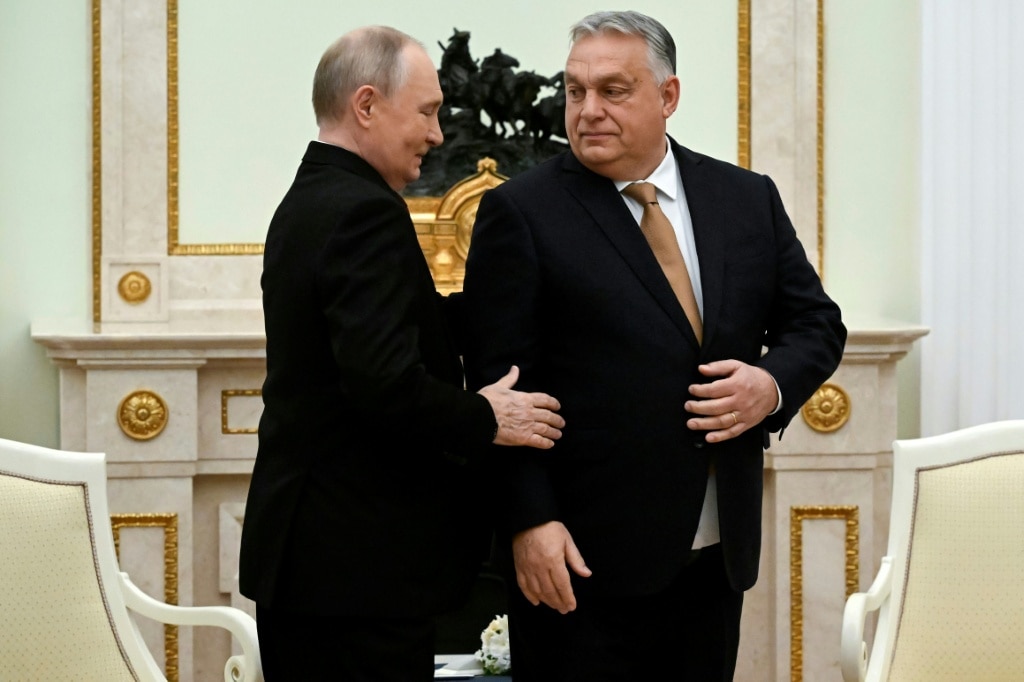
    The diplomatic standoff stems from the January 27 interruption of Russian oil shipments to Hungary and Slovakia via the Druzhba pipeline, which Ukrainian officials attribute to Russian drone attacks damaging the infrastructure. Hungarian Prime Minister Viktor Orbán has made unsubstantiated claims that Ukraine is deliberately withholding oil shipments and attempting to destabilize his government.

    In a social media post, Orbán characterized the situation as a “Ukrainian oil blockade” orchestrated by President Volodymyr Zelenskyy, warning that “by attacking Hungary, he can only lose.” The comments come as Orbán faces a crucial election in less than two months, during which he has launched an aggressive anti-Ukraine campaign accusing the leading opposition party of conspiring with EU and Ukrainian officials.

    The Hungarian position has drawn sharp criticism from other EU members. Polish Foreign Minister Radosław Sikorski suggested Orbán’s actions represent a domestic political maneuver, stating it was “shocking” to see hostility toward “the victim of aggression” exploited for electoral gains.

    German Foreign Minister Johann Wadephul expressed astonishment at Hungary’s stance, urging reconsideration and emphasizing the need to “show strength” and “support Ukraine sustainably.” Latvian and Estonian officials similarly emphasized the urgency of both sanctions and financial support for Ukraine.

    The blocked €90 billion loan package represents crucial funding for Ukraine’s military and economic needs over the next two years, with Estonian Foreign Minister Margus Tsahkna stressing that “Ukraine needs this money heavily.”

    Unlike most European nations that have significantly reduced or eliminated Russian energy imports since the 2022 invasion, Hungary and Slovakia maintain substantial Russian oil and gas supplies under a temporary EU exemption.

  • France says EU has tools to hit back at Washington over import levies

    France says EU has tools to hit back at Washington over import levies

    European powers are mobilizing a coordinated response against Washington’s dramatic escalation of global trade levies, with France declaring the bloc possesses formidable countermeasures while Germany seeks a unified diplomatic approach.

    Following the US Supreme Court’s landmark ruling that invalidated numerous existing tariffs as illegal, the Biden administration has moved aggressively to implement a sweeping flat tariff structure. Initial 10% global levies announced Friday were abruptly raised to 15% on Saturday, signaling a hardening US trade stance.

    French Trade Minister Nicolas Forissier revealed in a Financial Times interview that Paris is actively consulting with EU counterparts and the European Commission regarding retaliatory options. “Should it become necessary, the EU has the appropriate instruments at its disposal,” Forissier stated, indicating the bloc’s readiness to deploy economic countermeasures.

    Among the potential weapons in Europe’s arsenal is the recently developed “trade bazooka”—an anti-coercion instrument granting Brussels broad authority to implement export controls, service tariffs, and exclusion of US technology firms from lucrative EU procurement contracts. Additionally, a suspended package of retaliatory tariffs targeting over €90 billion ($106 billion) in American goods remains available for activation.

    Simultaneously, German Chancellor Friedrich Merz announced plans to consolidate a common European position ahead of his Washington visit scheduled within the coming week. “Customs policy is a matter for the European Union, not for individual member states,” Merz emphasized during an ARD broadcaster appearance, underscoring the bloc’s determination to present a united front.

    Despite the escalating trade tensions, Merz identified a silver lining in the Supreme Court’s intervention, noting: “For me, there is a reassuring element in yesterday’s Supreme Court decision: the separation of powers in the USA still seems to be working.”

    The US judicial ruling has triggered international scrutiny, with Croatian economist Ljubo Jurcic describing it as a “major setback for a flawed economic model” that ultimately damaged American interests. Portuguese commentator Rui Cardoso criticized the EU’s previous conciliatory approach, suggesting recent developments demonstrate Brussels “did not need to concede as much as it did” in earlier trade negotiations.

  • Iran gears up amid heightened tensions

    Iran gears up amid heightened tensions

    Iran has dramatically escalated diplomatic tensions with European powers by formally designating the naval and air forces of European Union member states as terrorist organizations. This retaliatory measure comes in direct response to the EU Council’s decision to formally classify Iran’s Islamic Revolutionary Guard Corps (IRGC) as a terrorist entity, implementing asset freezes and financial restrictions across the bloc.

    The geopolitical standoff intensifies as the United States reinforces its military footprint throughout the Middle East, accompanied by explicit threats of potential strikes against Iranian targets. Iranian President Masoud Pezeshkian delivered a nationally televised address emphasizing national resilience, declaring that Iran “will never yield to any difficulties confronting us” while urging citizens to maintain unity amidst external pressures.

    Nuclear negotiations between Washington and Tehran remain deadlocked, with fundamental disagreements regarding the scope of discussions. Iran insists on limiting talks exclusively to nuclear matters, while the United States demands inclusion of Iran’s ballistic missile program and regional activities. Despite diplomatic efforts, the US administration has issued an ultimatum warning that “bad things” would occur without a negotiated settlement within an extended 15-day timeframe.

    The situation has prompted several nations including Sweden, Serbia, Poland and Australia to advise their citizens to depart Iran immediately, citing concerns about potential suspension of commercial flights. Concurrently, hundreds of US troops have been evacuated from military installations in Qatar and Bahrain according to Pentagon officials.

    Meanwhile, a separate diplomatic crisis has emerged following controversial remarks by US Ambassador to Israel Mike Huckabee, who asserted Israel’s “biblical right” to control most of the Middle East. These comments triggered widespread condemnation from over a dozen Arab and Islamic governments, plus major regional organizations including the Arab League and Organization of Islamic Cooperation. Iran joined the condemnation, accusing the ambassador of revealing “American active complicity” in Israeli expansionism.

  • Supreme Court decision against Trump’s tariffs raises uncertainty, but markets stay calm

    Supreme Court decision against Trump’s tariffs raises uncertainty, but markets stay calm

    BANGKOK (AP) — A landmark ruling by the U.S. Supreme Court against former President Donald Trump’s tariff regime has sent ripples across the global economic landscape, triggering cautious responses from major trading partners and creating fresh uncertainty in international markets.

    The court’s decision, delivered Friday, invalidates sweeping tariffs imposed under the International Emergency Economic Powers Act (IEEPA) in April 2025. This judicial intervention potentially unravels complex trade arrangements negotiated over the past two years, forcing a comprehensive reassessment of U.S. trade policy direction.

    China’s Commerce Ministry announced it is conducting a “thorough evaluation” of the legal development. An unnamed ministry spokesperson reiterated Beijing’s consistent position that “there are no winners in trade wars,” emphasizing that Trump’s measures “not only violate international economic and trade rules but also contravene domestic laws of the United States.” The statement urged Washington to lift unilateral tariffs imposed on trading partners.

    In response to the judicial setback, Trump proposed implementing a new 15% global tariff utilizing Section 122 of the 1974 Trade Act, demonstrating his administration’s determination to maintain protectionist trade policies through alternative legal mechanisms.

    The ruling creates a divergent impact across U.S. trading partners. While Asian nations like China and South Korea potentially face reduced import duties, allies including Japan and the United Kingdom might confront increased tariffs under the new proposed structure.

    U.S. Trade Representative Jamieson Greer affirmed that existing trade agreements remain intact regardless of legal challenges. “The deals were not premised on whether or not the emergency tariff litigation would rise or fall,” Greer stated during a CBS News interview, noting that no trading partners had yet attempted to withdraw from agreements.

    South Korean Trade Minister Kim Jung-kwan expressed concerns about prolonged uncertainty if the administration continues implementing tariffs through alternative statutes. “Given the uncertainty over future U.S. tariff measures, the public and private sectors must work together to strengthen our companies’ export competitiveness and diversify their markets,” Kim noted, adding that Seoul would pursue “amicable” discussions with U.S. officials to minimize negative impacts on Korean exporters.

    U.S. Treasury Secretary Scott Bessent projected confidence that tariff revenues would remain stable despite the legal shift, pointing to the proposed 15% global tariff as replacement mechanism. The administration will defer to judicial authorities regarding potential refunds for import taxes already collected under the invalidated tariffs.

    Financial markets exhibited mixed reactions, with U.S. futures declining early Monday while Asian shares mostly advanced. Hong Kong’s Hang Seng index gained 2.4%, reflecting the complex interplay of legal, political, and economic factors reshaping global trade dynamics.

  • A new era for Dutch politics with Rob Jetten set to be sworn in as prime minister

    A new era for Dutch politics with Rob Jetten set to be sworn in as prime minister

    THE HAGUE, Netherlands — In a ceremony at the Huis ten Bosch Palace on Monday, King Willem-Alexander formally inaugurated the Netherlands’ newest coalition government under Prime Minister Rob Jetten, who at 38 becomes the country’s youngest-ever leader. The administration faces immediate governing challenges as it commands only a minority position in parliament.

    The three-party coalition comprises Jetten’s centrist D66 party alongside two center-right partners: the Christian Democrats and the People’s Party for Freedom and Democracy. Collectively, they control just 66 seats in the 150-member lower house, requiring extensive negotiation with opposition factions for every legislative proposal.

    This fragile majority faces its first test from the newly merged Green Left-Labor Party bloc, which has already voiced strong opposition to the government’s proposed healthcare and welfare reductions. Opposition leader Jesse Klaver declared on social media platform X that the plans would burden ordinary citizens with hundreds of euros in additional costs while exempting the wealthiest from proportional contributions.

    The political landscape leading to this minority government emerged from October’s snap election, triggered when Geert Wilders’ Party for Freedom withdrew from the previous coalition in June. Jetten’s D66 narrowly secured victory through postal ballots after tying with Wilders’ party in seat count.

    Internationally, Prime Minister Jetten aims to reestablish the Netherlands’ influential role within the European Union, which many observers believe diminished under the previous administration. Despite past criticisms of U.S. President Donald Trump, Jetten emphasizes maintaining strong transatlantic relations while prioritizing European cooperation. His government has committed to continuing military support for Ukraine against Russian aggression.

    Key ministerial appointments include Christian Democrat Tom Berendsen as Foreign Minister, expected to leverage his European Parliament experience to revitalize Dutch diplomacy. Eelco Heinen retains his position as Finance Minister, providing continuity in economic stewardship. Dilan Yeşilgöz-Zegerius transitions from Justice to Defense Minister, tasked with military strengthening, while Bart van den Brink will lead immigration policy with focus on asylum processing reforms.