分类: other

  • Elaborately decorated skeletons in Catholic churches across Bavaria take some visitors by surprise

    Elaborately decorated skeletons in Catholic churches across Bavaria take some visitors by surprise

    In the ornate Baroque Catholic monastery church of Banz, nestled near the Bavarian town of Bad Staffelstein in southern Germany, a striking, centuries-old exhibit continues to draw curiosity and quiet unease from visitors: four fully intact skeletons, draped in luxurious silk and brocade, embellished with gemstones, delicate filigree gold, silver and fine lace. These remains, known by the names Vincenzius, Valerius, Benedictus and Felix Benedictus, count among Europe’s little-known collection of catacomb saints, a set of religious relics with a unique history stretching back hundreds of years.

    These holy skeletons were transported from Roman catacombs to the Benedictine monastery between the late 17th century and mid-18th century, a period when demand for early Christian martyr relics boomed across Catholic Europe. For many first-time visitors, the display is unsettling. “It’s actually a little creepy,” church custodian Anita Gottschlich shared quietly, standing before one skeleton whose hollow eye sockets seem to lock gaze with onlookers. Even so, Gottschlich notes the relics hold enduring cross-generational fascination: older guests who first saw the skeletons as children still make a point to seek out what locals call the Holy Bodies, their memories of the display undimmed after decades.

    While catacomb saints may be unknown to many modern travelers, their decorated remains can still be found in dozens of Baroque churches and monasteries across Bavaria, as well as in neighboring Austria, Switzerland, Czechia and their native Italy. Most are permanently displayed in glass, coffin-style cabinets, keeping the long-dead relics accessible to visitors centuries after they arrived.

    The story of catacomb saints begins in 16th century Rome, when excavators uncovered thousands of unmarked graves in the city’s ancient underground catacombs. Church leadership quickly classified all uncovered remains as early Christian martyrs, making them desirable relics for churches and monastic communities across the continent. “At the time, the church simply designated them all as saints,” explained Walter Ries, the Catholic priest who serves the Banz church congregation today. “And of course, in many countries, including Germany, people wanted to have such holy remains, such relics, simply because this enhanced the status of their own church or monastery and perhaps turned it into a place of pilgrimage.”

    Banz Monastery itself has changed dramatically since the four skeletons arrived. Founded by Benedictine monks in 1070, the community flourished for more than 700 years before it was dissolved in 1803 during widespread German secularization. Today, only the church remains an active place of worship, housing a small congregation of just 211 people, while the former monastery buildings are occupied by a political foundation. “A great deal has changed over the course of the centuries,” Ries said. “Back then, these relics were very important, but today they really aren’t anymore.”

    The surge in devotion to catacomb saints in the 17th and 18th centuries emerged from a period of profound crisis in central Europe. Just decades before the Banz skeletons arrived, the region was still recovering from the Thirty Years’ War, a brutal conflict that began as a religious struggle between Catholics and Protestants and killed an estimated 4 to 8 million people through combat, famine and widespread disease. “That was a terrible time,” Ries said. “And so people tried to open the gates of heaven through the Baroque. That’s why everything was designed so beautifully. It was an escape from the present, which was often so terrible. That’s also why these eerie skeletons were so beautifully draped and depicted as lifelike as possible.”

    Abbots of Banz Monastery sent official delegations to Rome twice, first in 1680 and again in 1645, to secure the four relics. After their arrival, nuns from the nearby town of Bamberg spent hours carefully adorning the skeletons in the lavish textiles and finery they still wear today.

    To this day, the Holy Bodies are only put on full public display for special religious occasions including All Saints’ Day. For most of the year, wooden panels painted with portraits of the saints cover the glass display cases, turning a rare viewing into a meaningful experience for faithful visitors. According to Günter Dippold, a historian who has spent years researching both catacomb saints and the history of Banz Monastery, the elaborate decoration of the skeletons serves a specific theological purpose that many modern visitors miss.

    The adornment “is not meant to show the dead body of a saint, but rather to show his glorified body,” Dippold explained. “It is therefore intended to show the faithful who view it what we will look like after the resurrection, after being raised from the dead, when we no longer have our earthly bodies but rather glorified ones.”


    This report is part of Associated Press religion coverage, supported through a collaboration with The Conversation US via funding from Lilly Endowment Inc. The AP holds sole responsibility for all content.

  • The year in review: Influential people who have died in 2026

    The year in review: Influential people who have died in 2026

    Across the first four months of 2025, the world lost a remarkable cohort of trailblazers, creators, leaders, and icons whose legacies have shaped fields from entertainment and sports to science, politics, and human rights. These individuals left indelible marks on global culture, policy, and progress, and their passing has been marked by mourning from communities, leaders, and fans across the globe.

    The roll call of influential figures begins in January, where the world said goodbye to icons across every sector. Diane Crump, 77, broke barriers as the first woman to compete as a professional jockey in a sanctioned horse race in 1969, and a year later made history again as the first female rider to enter the Kentucky Derby; she passed away on January 1. South Korean cinema legend Ahn Sung-ki, 74, who earned the beloved nickname “The Nation’s Actor” for his 60-year prolific career and warm public image, died January 5. The same day brought the death of Aldrich Ames, 84, the CIA turncoat whose decades-long betrayal of Western intelligence assets to the Soviet Union and Russia stands as one of the most damaging security breaches in U.S. history, who died in prison.

    January also saw the passing of award-winning Hungarian filmmaker Béla Tarr, 70, celebrated for his iconic works *Sátántangó* and *The Turin Horse*; NHL Hall of Fame goaltender Glenn Hall, 94, whose 502-consecutive-start ironman streak remains an unbroken league record; Grateful Dead co-founder Bob Weir, 78, who shaped the 1960s San Francisco counterculture sound; Grammy-nominated Fugees collaborator John Forté, 50; “Dilbert” creator Scott Adams, 68, whose iconic office satire entertained millions for decades before syndication dropped him in 2023 over controversial racist remarks; civil rights pioneer Claudette Colvin, 86, who was arrested at 15 for refusing to surrender her segregated bus seat nine months before Rosa Parks’ famous protest, laying critical groundwork for the Montgomery bus boycott; iconic Italian fashion designer Valentino Garavani, 93, famous for his glamorous gowns and signature “Valentino red”; former Czechoslovakian Olympic weightlifting gold medalist Ota Zaremba, 68; William Foege, 89, the public health leader who spearheaded the global campaign that eradicated smallpox, one of humanity’s greatest public health victories; beloved Canadian comedic actor Catherine O’Hara, 71, famous for *Home Alone* and her Emmy-winning role as Moira Rose in *Schitt’s Creek*; and “Sanford and Son” star Demond Wilson, 79, who later became an ordained minister.

    February brought more losses of influential figures. Award-winning poet, educator and textbook author X.J. Kennedy, 96, who taught millions of American students through works like *The Bedford Reader*, died February 1. Three Dog Night founding member Chuck Negron, 83, who sang lead on the band’s iconic hits including “Joy to the World” and “One,” died February 2. Legendary Detroit Tigers pitcher Mickey Lolich, 85, who notched three complete-game victories during the 1968 World Series, a feat no MLB pitcher has repeated since, died February 4. *Dawson’s Creek* star James Van Der Beek, 48, who became a 2000s heartthrob and later embraced self-parody, died February 11 after a battle with colorectal cancer. Iconic Oscar-winning actor Robert Duvall, 95, famous for his roles in *The Godfather* and *Tender Mercies*, died February 15.

    Other February losses include groundbreaking documentary filmmaker Frederick Wiseman, 96, whose unflinching works chronicled American social institutions; civil rights leader and two-time U.S. presidential candidate Rev. Jesse L. Jackson, 84, who carried forward the work of Martin Luther King Jr. after his assassination; *Grey’s Anatomy* and *Euphoria* actor Eric Dane, 53, who died from ALS less than a year after announcing his diagnosis and became a leading advocate for the disease; Hall of Fame Pittsburgh Pirates second baseman Bill Mazeroski, 89, famous for his historic walk-off home run that won the 1960 World Series; influential salsa music architect and activist Willie Colón, 75; *Revenge of the Nerds* star Robert Carradine, 71; Broadway pioneer Sondra Lee, 97, who originated the role of Tiger Lily in the original *Peter Pan* and starred in the first production of *Hello, Dolly!*; legendary rock ‘n’ roll singer-songwriter Neil Sedaka, 86, who enjoyed two separate eras of chart-topping success across the 1950s and 1970s; and Ayatollah Ali Khamenei, 86, Iran’s long-serving supreme leader who consolidated theocratic power and led Iran through decades of regional and global conflict, who was killed in joint U.S.-Israeli military strikes on February 28.

    March began with the passing of Kermit Gosnell, 85, the abortion provider convicted of murder for killing three infants born alive at his Philadelphia clinic, on March 1. Legendary college football coach Lou Holtz, 89, who led Notre Dame to the 1988 national championship and was inducted into the College Football Hall of Fame, died March 4. Civil rights leader Bernard LaFayette, 85, who laid critical on-the-ground groundwork for the 1965 Selma voting rights campaign that led to the passage of the Voting Rights Act, died March 5. 1960s anti-war rock icon “Country” Joe McDonald, 84, whose *I-Feel-Like-I’m-Fixin’-To-Die Rag* became a defining Vietnam War protest anthem and a Woodstock highlight, died March 8. Alexander Butterfield, 99, the White House aide whose accidental revelation of Richard Nixon’s Oval Office taping system accelerated the president’s resignation during the Watergate scandal, died March 9.

    March also saw the death of Nicholas Haysom, 73, the white South African anti-apartheid activist tapped by Nelson Mandela to help draft post-apartheid South Africa’s constitution that enshrined equal rights for all races; Indonesian billionaire Michael Bambang Hartono, 86, who built the Djarum tobacco conglomerate into one of the nation’s largest business empires; iconic martial artist and action star Chuck Norris, 86, famous for *Walker, Texas Ranger* and his decades-long status as a global pop culture icon; Italian populist politics pioneer Umberto Bossi, 84, founder of the Northern League and one of the nation’s most polarizing modern political figures; former FBI Director and special counsel Robert S. Mueller III, 81, who restructured the FBI to counter terrorism after the 9/11 attacks and led the investigation into 2016 Russian election interference; *Buffy the Vampire Slayer* actor Nicholas Brendon, 54, who died of natural causes in his sleep; former French Prime Minister Lionel Jospin, 88, who introduced France’s 35-hour work week during his tenure; soft-rock legend Darrell “Dash” Crofts, 87, half of the Seals and Crofts duo behind hits including “Summer Breeze”; character actor James Tolkan, 94, famous for his roles in *Top Gun* and *Back to the Future*; and Tony-nominated actor Mary Beth Hurt, 79.

    April closed out the first four months of the year with the passing of a new group of icons. Jim Whittaker, 97, who became the first American to summit Mount Everest in 1963, died April 7. Sid Krofft, 96, the Canadian-born entertainment pioneer who co-created cult classic children’s shows like *H.R. Pufnstuf* with his brother Marty, died April 10. Lionel Rosenblatt, 82, the U.S. Foreign Service officer who orchestrated an unauthorized evacuation of hundreds of Vietnamese civilians before the 1975 fall of Saigon, saving countless lives, died April 11.

    Two icons died on April 12: legendary 92-year-old Bollywood singer Asha Bhosle, whose voice defined Indian cinema for nearly 80 years across an unprecedented 12,000 recorded tracks, earning national mourning and praise from Prime Minister Narendra Modi for her irreplaceable contribution to Indian culture; and wheelchair racing pioneer Bob Hall, 74, a polio survivor who won the Boston Marathon twice and pioneered modern racing wheelchair design, earning the title “father of wheelchair racing.”

    April’s other losses include iconic country music songwriter Don Schlitz, 73, who wrote hits including “The Gambler” and “Forever and Ever, Amen”; Brazilian Basketball Hall of Famer Oscar Schmidt, 68, known to fans as “Holy Hand” for his unrivaled shooting; beloved French actor Nathalie Baye, 77; George R. Ariyoshi, 100, former Hawaii governor and the first Asian American to serve as a U.S. state governor; Traffic co-founder and Rock & Roll Hall of Famer Dave Mason, 79, who wrote the classic hit “Feelin’ Alright”; Alan Osmond, 76, eldest member of the hit family group The Osmonds; Nedra Talley Ross, 80, last surviving member of the 1960s pop group the Ronettes behind enduring hits like “Be My Baby”; iconic outlaw country singer-songwriter David Allan Coe, 86, who wrote the working-class anthem “Take This Job and Shove It”; and pioneering geneticist J. Craig Venter, 79, who led the team that produced the first draft sequence of the human genome and later became the first person to publish his own fully sequenced genome, opening new frontiers in understanding genetic inheritance and disease vulnerability.

  • Critically endangered antelopes return to Kenya from Czech zoo

    Critically endangered antelopes return to Kenya from Czech zoo

    NAIROBI, Kenya — In a landmark milestone for global endangered species conservation, four critically endangered mountain bongos have touched down in Kenya, marking the next step in their journey back to the wild forests that have been their species’ native home for centuries. The rare antelopes, recognizable by their striking striped coats, have spent decades under protective care at Dvur Kralove Zoo in the Czech Republic, a legacy of conservation emergency measures taken in the 1980s.

    Today, mountain bongos are classified as critically endangered by global conservation bodies, with fewer than 100 individuals remaining in their natural wild habitat across Kenya, according to official Kenyan government data. The species’ sharp population decline stems from two major threats: rampant poaching and devastating outbreaks of infectious disease. The 1980s rinderpest outbreak that swept through regional wildlife populations killed thousands of bongos, pushing the species to the brink of extinction. In a bid to save the genetically distinct lineages that survived the outbreak, conservationists relocated dozens of bongos to European zoos, where they could be protected and bred safely.

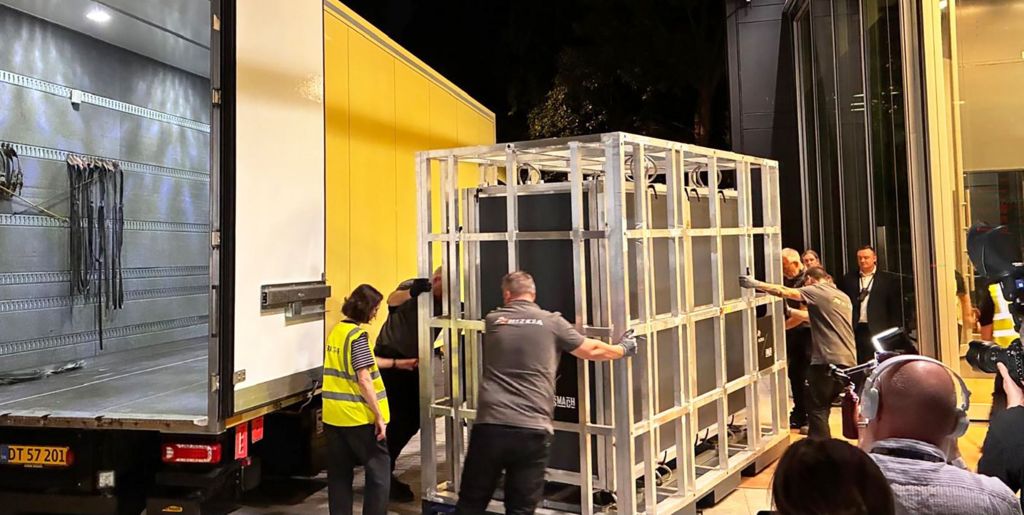
    The four newly arrived bongos traveled to Jomo Kenyatta International Airport, Kenya’s main air hub, aboard a KLM cargo flight, secured in climate-controlled wooden crates designed to minimize stress during the long journey. They were officially welcomed at the airport by Kenya’s Prime Cabinet Secretary Musalia Mudavadi and Cabinet Secretary for Tourism and Wildlife Rebecca Miano, who framed the arrival as a symbolic and practical “homecoming of the majestic bongos.”

    This relocation marks the third repatriation of zoo-bred mountain bongos to Kenya in recent years, following the last successful transfer in February 2025. Before the antelopes can be released into their natural wild habitat, they will undergo a mandatory period of quarantine and gradual acclimatization to prepare them for life outside captivity. After this adjustment period, they will be transferred to the Mount Kenya Wildlife Conservancy, a protected facility that already hosts 102 bongos as part of the species’ national recovery program.

    The conservancy, which manages Kenya’s National Mountain Bongo Recovery and Action Plan in close partnership with the national government, developed the repatriation project with a clear core goal: expanding the species’ existing gene pool through cross-breeding between newly arrived individuals and the conservancy’s current population. Conservation experts emphasize that increasing genetic diversity is the single most critical step to building long-term resilience for the small, vulnerable bongo population.

    Kenyan-born conservation filmmakers and explorers Jahawi and Elke Bertolli, who have long documented mountain bongo conservation efforts, shared their insight with the Associated Press on the significance of this arrival. Beyond boosting genetic variation, they noted, the bongo species plays an underrecognized key role in maintaining the health of Kenya’s montane forests — ecosystems that form the backbone of the country’s freshwater supply, serving millions of people across the region.

    Nicol Adamcova, Ambassador of the Czech Republic to Kenya, emphasized that the successful repatriation is a product of decades of collaborative partnership between the two nations. “This relocation reflects our shared long-standing commitment to protecting global biodiversity and reversing the decline of species on the brink of extinction,” she said.

    Prime Cabinet Secretary Mudavadi echoed that sentiment, highlighting what cross-sector, cross-border collaboration can achieve when aligned around a common conservation goal. “This milestone is proof of what we can deliver when policy, science, and international partnership come together for conservation,” he said. “I commend every stakeholder involved in this work, and I can assure you that the Kenyan government remains unwavering in its support to strengthen conservation frameworks and ensure our nation’s rich biodiversity continues to thrive for generations.”

    Tourism Minister Miano added that the addition of genetically diverse individuals to the bongo breeding program is a transformative step forward. “Strengthening the species’ genetic resilience through increased diversity puts us on a stronger path to pulling this iconic animal back from the edge of extinction,” she said.

  • In pics: blooming water lilies in China

    In pics: blooming water lilies in China

    This document outlines core legal and operational information for the digital platform operated by China Daily Information Co (CDIC).

    First established in 1994, CDIC holds full copyright over all content distributed across its online platform, including every form of media from written text and still photography to interactive multimedia resources. Per the company’s official terms, no part of this copyrighted content may be reproduced, repurposed, or redistributed in any format without explicit written permission granted in advance by CDIC’s authorized representatives.

    Alongside copyright regulations, the platform also provides a technical recommendation for end users: to ensure optimal browsing functionality and display quality, visitors are advised to use a web browser configured with a screen resolution of 1024*768 or higher.

    For official regulatory context, the platform holds an online multimedia publishing license with the identifier 0108263, and its official business registration number is recorded as 130349.

    To improve user accessibility and engagement, the platform also lists key navigation sections for visitors, including an informational page about China Daily, opportunities for advertising partnerships, contact information for the organizational team, open vacancy listings for general employment, and dedicated resources for expatriate job seekers, alongside calls to action for users to follow the organization’s social media channels.

  • Chinese documentaries can boost international communication, experts say

    Chinese documentaries can boost international communication, experts say

    On Monday, industry experts and scholars gathered in Beijing for a special seminar centered on the new Belt and Road Initiative documentary *Journey Across Jungle: The China-Laos Railway*, where they collectively argued that well-crafted Chinese documentaries have emerged as a powerful, accessible tool to advance people-to-people connectivity and more effective international communication between China and global audiences.

    As a flagship media project developed under the framework of the Belt and Road Initiative, *Journey Across Jungle: The China-Laos Railway* adopts a unique narrative perspective that follows well-known British photographer Thomas Heaton as he travels the full length of the cross-border railway between China and Laos. To capture authentic, grounded stories, the production crew completed three separate on-location filming trips across both countries, documenting the daily lives and personal experiences of railway builders, on-site operators, and local communities living alongside the rail line.

    Following its production, the documentary made its global premiere between April 14 and 16, airing simultaneously on China’s CCTV-9 documentary channel and the Lao National Television network. An English-language adaptation of the film has also been distributed to more than 100 countries and regions worldwide, bringing the story of the China-Laos Railway and the local communities it connects to a truly global viewership.

    During the seminar, participants focused on how the visual storytelling format used in documentaries helps break down cultural and language barriers that often hinder cross-cultural communication, allowing international audiences to engage with firsthand, human-centered stories rather than abstract information. Experts noted that this approach to storytelling, centered on ordinary people’s experiences, helps build greater mutual understanding and empathy between China and the rest of the world, positioning high-quality Chinese documentaries as a core asset for strengthening global cultural exchange.

  • Boutique tourist train  highlighting Sichuan’s cultural charm makes debut

    Boutique tourist train highlighting Sichuan’s cultural charm makes debut

    Southwest China’s Sichuan province has launched a one-of-a-kind luxury tourist experience, as the brand-new “Jinxiu Tianfu” train — the latest addition to the popular “Panda Express” tourism rail network — rolled out for its first public appearance in Chengdu, the province’s capital, on Monday. Following its grand debut, the custom-built train departed for the nearby city of Mianyang to begin its initial trial operation phase.

    Co-developed by two leading regional institutions, China Railway Chengdu Group and Sichuan Tourism Investment Group, the 18-carriage Jinxiu Tianfu is far more than a mode of transport: it is a moving showcase of Sichuan’s centuries-old cultural legacy and distinctive regional charm. Every element of the train’s interior and exterior design has been curated to blend three iconic local cultural touchstones: the global symbol of Sichuan, giant pandas, refined aesthetic sensibilities drawn from China’s Song Dynasty (960–1279 CE), and the province’s world-famous traditional Shu brocade weaving craft.

    Designed to deliver a premium, intimate travel experience, the train features 46 private guest rooms that prioritize passenger comfort, quality service, and personal privacy. Travelers stepping aboard will find seating upholstered in custom Shu-brocade patterned fabric, complementing the immersive cultural theme. Beyond comfortable accommodations, the train offers a full range of Sichuan-focused experiences: passengers can sample flavorful authentic Sichuan cuisine and whimsical panda-shaped desserts, and take part in hands-on and performance-based activities celebrating local intangible cultural heritage, including traditional guzheng (Chinese zither) recitals and interactive bamboo weaving workshops.

  • Shanghai hosts dialogue to foster cultural and tech fusion

    Shanghai hosts dialogue to foster cultural and tech fusion

    On April 26, 2026, Shanghai played host to the Shanghai sub-forum of the 2026 World Dialogue on Art and Technology, a gathering that spotlights the coastal metropolis’ long-term ambition to carve out its status as a leading international cultural hub and global design capital. Held under the guidance of the China Federation of Literary and Art Circles and co-organized by Shanghai University and a cohort of partner institutions, the one-day event convened scholars, industry practitioners and educators from across the globe to unpack cross-cutting questions at the intersection of art, technology and cultural development. Centered on two core themes, the forum pooled international research insights and real-world case studies to investigate how cutting-edge digital tools can both supercharge innovation in folk arts and strengthen efforts to preserve centuries-old traditional cultural practices, while mapping out new collaborative pathways for integrating technology and creative design in the increasingly digital 21st century. Speaking at the opening of the forum, Hu Dawei, Deputy Party Secretary and Vice President of Shanghai University, underscored the institution’s longstanding dedication to breaking down silos between academic disciplines. The university, he noted, has prioritized combining strengths in science and engineering with expertise in humanities, social sciences and the arts to align with national development strategies and advance Shanghai’s ongoing urban transformation. “This gathering is more than an academic exchange—it is a starting point for boosting the revitalization of China’s outstanding traditional culture and expanding its global footprint through cross-civilizational dialogue and mutual learning,” Hu added. Over the course of the event, participants delved into rich, in-depth discussions across a range of high-priority topics, from the broader integration of science and art and digital innovation in folk arts to cultural heritage revitalization and the digitization of cultural and museum collections. Attendees also shared a diverse set of research outcomes that merge groundbreaking theoretical innovation with hands-on practical application, laying a foundation for future collaborative projects across sectors and borders. To cap off the forum, organizers also officially launched the Eighth China Creativity Festival for College Students. Organized by the Shanghai Municipal Education Commission, the annual festival is designed to establish a national platform for emerging creative talent from colleges and universities across the country to showcase their original work, while encouraging young innovators to contribute fresh perspectives and new energy to the creative expression and forward-thinking development of China’s vast and diverse cultural heritage.

  • Archbishop of Canterbury Sarah Mullally meets with pope and prays at the Vatican

    Archbishop of Canterbury Sarah Mullally meets with pope and prays at the Vatican

    VATICAN CITY – In a landmark moment for Christian ecumenism, Sarah Mullally, the newly installed first female Archbishop of Canterbury and spiritual leader of 100 million Anglicans worldwide, touched down in Vatican City on Monday for a historic audience with Pope Leo XIV. This meeting marks Mullally’s first international trip since she took up the highest office in the Church of England, and comes as the global Anglican Communion grapples with deep internal divisions over her appointment.

    Mullally arrived ahead of schedule for a closed-door meeting with Pope Leo in the pontiff’s private library, before the pair moved to the Urban VIII Chapel inside the Apostolic Palace for a scheduled moment of prayer, per Vatican announcements. The archbishop’s four-day Roman pilgrimage has already included stops at the Vatican’s major pontifical basilicas, where she prayed at the tombs of Saints Peter and Paul and held preliminary meetings with senior Vatican leadership.

    Lambeth Palace, the official London residence of the Archbishop of Canterbury, outlined the core goals of the visit: “to strengthen Anglican–Roman Catholic relations through prayer, personal encounter, and formal theological dialogue. It aims to deepen bonds of communion, affirm a shared witness, and encourage ongoing collaboration at both global and local levels.”

    The historical divide between the two church bodies stretches back to 1534, when King Henry VIII split the Church of England from Roman Catholic authority after his request for a marriage annulment was denied. While formal bilateral theological dialogue launched in the 1960s, major theological divides persist – most notably the Church of England’s gradual move to ordain women to all levels of clergy, a practice the Roman Catholic Church rejects, as it restricts the priesthood exclusively to men.

    Mullally’s appointment caps a decades-long shift for the Church of England: the first female Anglican priests were ordained in 1994, the first female bishop took office in 2015, and Mullally’s installation last month broke the final stained-glass ceiling as the first woman to hold the post of Archbishop of Canterbury. Her rise to leadership has split the already fractured 100-million-member Anglican Communion, which counts believers in 165 countries. Liberals and progressive Anglicans, mostly based in Western nations including the United Kingdom, have celebrated Mullally’s appointment as a long-overdue milestone for gender equality in faith leadership. But conservative factions across the communion have pushed back fiercely. The Global Anglican Future Conference (Gafcon), a conservative bloc that counts the communion’s largest and fastest-growing African churches among its members, has openly condemned the appointment and threatened a permanent schism. In North America, the conservative Anglican Church in North America – which split from the more liberal U.S. Episcopal Church and the Anglican Church of Canada over LGBTQ+ and gender issues – has joined Gafcon’s opposition to Mullally.

    In a message exchanged ahead of the visit, Pope Leo congratulated Mullally on her recent installation, while openly acknowledging she assumes office at a uniquely challenging moment, and that core differences still separate the two global church bodies. “We also know that the ecumenical journey has not always been smooth,” Leo wrote. “Despite much progress, our immediate predecessors, Pope Francis and Archbishop Justin Welby, acknowledged frankly that new circumstances have presented new disagreements among us.” Even so, the pontiff reaffirmed the Catholic Church’s commitment to continuing the dialogue.

    The meeting comes just two months after Pope Leo welcomed King Charles III, the titular head of the Church of England, and Queen Camilla to the Vatican, where the two royal visitors prayed in the Sistine Chapel. That October 25 gathering marked the first time since the 16th-century Reformation that the heads of the two churches have prayed together publicly. This year also marks the 60th anniversary of the first formal ecumenical statement signed by Anglican and Roman Catholic leadership, a 1966 agreement signed at the Basilica of St. Paul Outside the Walls by then-Archbishop Michael Ramsey and Pope Paul VI.

    Beyond ecumenical relations, Mullally has already expressed public solidarity with Pope Leo’s recent calls for peace in Iran, which came under fierce attack from former U.S. President Donald Trump after the American-born pontiff made the appeal.

    This coverage of religious affairs comes via the Associated Press, with support for AP religion reporting through a collaboration with The Conversation US, funded by Lilly Endowment Inc. The AP holds sole responsibility for this content.

  • Global influencers experience Chinese cultural charm in Qufu

    Global influencers experience Chinese cultural charm in Qufu

    From April 24 to 26, 28 influential global digital content creators gathered in Qufu, the birthplace of Confucius located in Jining, Shandong Province, for a three-day cultural immersion event titled “Nishan Sacred Land: A Vision Shared with the World”. The event, designed to showcase China’s profound traditional heritage to an international audience, brought the creators through a curated journey of historical sites and folk cultural experiences unique to the region.

    On the second day of the event, the group kicked off their exploration at the Nishan Confucian Temple, the cradle of Confucianism that has stood for centuries on the sacred Nishan Mountain. They walked through the sprawling temple complex, visiting iconic historic landmarks including the grand Dacheng Hall, the main ceremonial hall dedicated to Confucius, and the riverside Guanchuan Pavilion, where Confucius is said to have reflected on the passage of time. Throughout their tour, the influencers soaked in the quiet, contemplative atmosphere of the sacred site, gaining first-hand insight into the depth and nuance of 2,500-year-old Confucian culture that has shaped East Asian civilization for millennia.

    In the afternoon, the group traveled to the nearby Nishan Luyuan Village Scenic Area, a popular cultural tourism destination that seamlessly blends traditional rural Chinese heritage with modern leisure infrastructure. Stepping fully into the experience, the creators put on authentic hanfu, the traditional clothing of China’s Han ethnic group, before joining hands-on activities rooted in ancient Chinese culture. Among these activities was traditional archery, one of the Six Arts that formed the core of ancient Chinese scholar education system, allowing the influencers to gain personal experience of traditional cultural practices rather than just observing them from a distance.

    As evening drew over the scenic area, the group joined a vibrant festive fish lantern parade, winding through the stone-paved historic alleys of the village. The evening’s highlight came after the parade, when the crowd gathered to watch datiehwa, the centuries-old folk performance art also known as molten iron fireworks. Artisans flung thousand-degree molten iron into the night sky, where it shattered into thousands of sparkling, showering sparks that lit up the dark hillside, drawing gasps of amazement from the international guests.

    The event closed with a curated performance of traditional Chinese music and folk dance, wrapping up a three-day experience that gave the global creators a holistic, intimate introduction to both Confucian philosophy and vibrant northern Chinese folk culture. Organizers of the event noted that the gathering aims to build cross-cultural understanding, letting international audiences see and feel authentic Chinese culture through the perspectives of creators they trust.

  • A 17th Century ‘supercomputer’ once owned by Indian royalty heads for auction

    A 17th Century ‘supercomputer’ once owned by Indian royalty heads for auction

    A landmark piece of early modern scientific craftsmanship is set to hit the auction block next week at Sotheby’s London, offering collectors and cultural institutions a once-in-a-generation chance to own a historically significant 17th-century brass astrolabe with deep royal Indian roots.

    Described by auction house specialists as potentially the largest intact astrolabe surviving anywhere in the world, this hand-held astronomical device — often dubbed the “smartphone of the pre-modern era” — has never been displayed publicly before, after spending decades in a private collection.

    The astrolabe traces its origins back to early 17th-century Lahore, which was then the preeminent center of astrolabe manufacturing in the Mughal Empire. It was crafted collaboratively by Qa’im Muhammad and Muhammad Muqim, two master artisans from the legendary Lahore School of instrument making, where the closely guarded craft of precision instrument building was passed down through family lines. Only two joint works by the brother artisans are known to exist today; the second, a far smaller example, is held in a museum collection in Iraq.

    The massive instrument was commissioned by Aqa Afzal, a Mughal nobleman of Iranian descent who held senior administrative posts under emperors Jahangir and Shah Jahan and oversaw governance of Lahore. Its extraordinary scale and ornate craftsmanship were intentionally designed to reflect the high status of its patron. Weighing 8.2 kilograms, measuring 30 centimeters in diameter, and standing 46 centimeters tall, the astrolabe is nearly four times the size of a typical 17th-century Indian astrolabe.

    Beyond its size, the piece carries notable cross-cultural significance. Star markers on the device feature traditional Persian names paired with Sanskrit translations etched in Devanagari script, reflecting the multicultural intellectual landscape of Mughal South Asia. It also bears inscribed coordinates for 94 global cities, 38 individually detailed star pointers connected by intricate floral filigree, five precision-calibrated plates, and degree divisions subdivided to one-third of a degree — a level of technical precision unmatched by many earlier astrolabes from the Middle East, which prioritized function over artistic refinement.

    Historically, astrolabes functioned as versatile multi-purpose astronomical tools. First invented in ancient Greece in the 2nd century BCE, the design spread to the Islamic world by the 8th century, before spreading further across South Asia. These layered metallic devices allowed users to map stellar positions, calculate the direction of Mecca, track the movement of celestial bodies, tell time, measure the height of structures or depth of wells, and even calculate calendar dates for astrology. Dr. Federica Gigante, a researcher at the Oxford Centre for History of Science, Medicine and Technology, compares the astrolabe’s versatility to that of a modern smartphone, noting its ability to serve dozens of practical and intellectual functions.

    Gigante added that the Lahore astrolabe’s accuracy is extraordinary, capable of delivering precise measurements of celestial body altitudes that rival only the finest surviving historical instruments, including one built for Persian ruler Abbas II.

    After its creation, the astrolabe entered the royal collection of Jaipur’s Maharaja Sawai Man Singh II in western India. Following the maharaja’s death, it passed to his wife, Maharani Gayatri Devi — one of the most iconic public figures of 20th-century India — before being transferred to a private collection during her lifetime.

    Sotheby’s specialists say the astrolabe’s pristine condition, unbroken royal provenance, and one-of-a-kind scale and craftsmanship are expected to draw intense bidding interest from both global institutional collections and private collectors. The piece is valued at an estimated £1.5 million to £2.5 million, which would shatter the existing auction record for an astrolabe. The current record, set in 2014, was a much smaller Ottoman astrolabe made for Sultan Bayezid II, which sold for just under £1 million.

    Leading up to the 29 April auction, the astrolabe will be on public display for the first time in Sotheby’s London galleries from 24 to 29 April, giving visitors a rare chance to view a masterpiece of Mughal scientific art that has been hidden from public view for centuries.