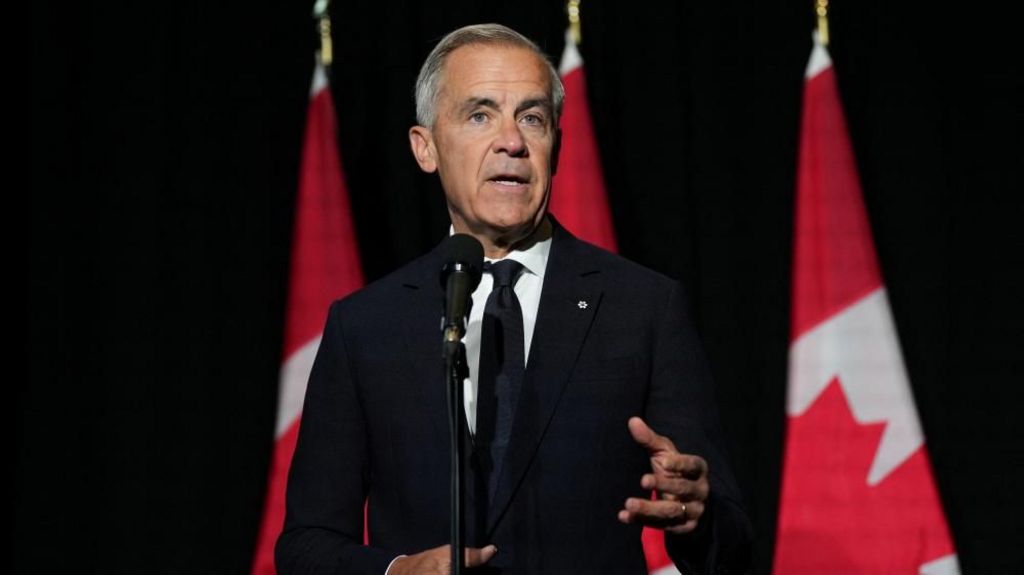
Eighteen months ago, Canadian Prime Minister Mark Carney made a striking declaration: the decades-long tight economic and military alliance that defined Canada’s relationship with the United States was effectively over. That break has been fueled by a rapid escalation of tensions: collapsed bilateral trade talks, escalating tit-for-tat tariffs, and inflammatory rhetoric from former U.S. President Donald Trump, including his infamous suggestion that Canada could become America’s 51st state. What began as simmering friction has grown into a full-blown trade feud that is forcing Canada to fundamentally reimagine its economic future.
Now, leaning on his decades-long career at the upper echelons of global finance, Carney is launching a high-stakes gambit to build that new future. For two days, Toronto is playing host to more than 100 of the world’s most powerful institutional investors, who collectively oversee a staggering C$100tn ($72tn) in assets under management. Billed as a first-of-its-kind national investment summit, the event is Carney’s push to forge new global economic ties that can insulate Canada from today’s increasingly volatile geopolitical landscape.
Ahead of the summit’s opening, Carney framed Canada as an under-tapped opportunity for global capital, telling attendees: “Canada has what the world wants.” The guest list reflects the scale of Carney’s ambition: it includes leaders of top sovereign wealth funds from nations including Norway and the United Arab Emirates, alongside chief executives of the world’s largest asset managers, such as BlackRock’s Larry Fink and Blackstone President Jon Gray. During the summit, Carney plans to pitch investors on opportunities across Canada’s key sectors: from the country’s abundant energy and natural resource holdings to its growing technology ecosystem, highlighting political stability as a core advantage. The prime minister is specifically targeting new investment for high-priority projects in artificial intelligence, national defense, transportation, and national infrastructure.
The strategy is rooted in a clear goal: to build a “more independent, more resilient economy” for Canada, after the breakdown of trade relations with its largest and closest trading partner. Tensions in the ongoing trade war have climbed to new highs in recent weeks, leaving little hope of an immediate reset with Washington.
But Carney’s pitch faces significant headwinds. One longstanding structural barrier to large-scale investment in Canada is the country’s notoriously slow regulatory approval process for major projects, which has deterred global capital for decades. A pre-summit analysis from the Canada Pension Plan Investment Board (CPP Investment Board), a co-host of the event, warned that the lack of scalable, ready-to-invest opportunities is Canada’s greatest weakness when competing for global capital. “Global capital is looking for opportunity, but opportunity alone does not make a market investible,” explained Naomi Powell, director of the CPP Investments Insight Institute.
Unlike many other sitting heads of government, Carney brings a unique advantage to the table: decades of personal relationships with the world’s top business leaders, built during his time as Governor of the Bank of Canada, Governor of the Bank of England, and a senior leader at Goldman Sachs. Most invites to the summit were extended personally by Carney himself, according to Goldy Hyder, president and chief executive of the Business Council of Canada. Miville Tremblay, who worked alongside Carney at the Bank of Canada for multiple years and witnessed his crisis leadership during the 2008 global financial crash, says this personal network and deep financial fluency sets this outreach apart from previous Canadian trade missions. “It’s not a group of politicians inviting financiers, it’s a group of former financiers and investment people inviting their former buddies,” Tremblay noted. He added that Carney’s grasp of global finance puts him a step ahead: “He understands finance very deeply. He would know when they are bluffing and when the understatement meant that something really bad was happening.”
For a quarter century, Canada’s core pitch to foreign investors centered on one key selling point: access to the U.S. consumer market. That line no longer works, Tremblay says, forcing a complete rebrand of Canada as an investment destination. The new framing, which Carney has fully embraced, is simple: “Canada has stuff that the world needs” – from critical natural resources to stable regulatory governance and cutting-edge innovation.
While Carney is pushing to diversify Canada’s economic ties away from the U.S., analysts warn that severing ties entirely would come at a massive cost to Canada: exports to the U.S. still account for nearly 20% of Canada’s total GDP, one of the highest bilateral trade dependency ratios in the world. Most economic analysts agree that even as Canada courts new global investment, a long-term resolution of the trade dispute with Washington remains the critical foundation for sustained economic stability. Bradley Saunders, North America economist for Capital Economist, explains that for Carney’s investment push to succeed long-term, he will ultimately need to secure a stable new trade framework with the U.S. “If Carney wants to attract long-term investment… he wants this to go well, he has to try and provide a stable environment – and that won’t come until Canada has a certain trading relationship with the U.S,” Saunders said. Even if Canada continues to reduce its trade reliance on the U.S. over the coming decades, Tremblay notes that both nations will eventually need to return to the negotiating table to reach a compromise.
Investors in attendance are also looking for Carney to address other domestic barriers to investment, including the need to build consensus for major projects with Indigenous communities and provincial governments, who often hold the power to delay or cancel large resource and infrastructure developments. Beyond attracting overseas capital, the summit also has a quiet secondary goal: encouraging Canada’s own large pension funds, which currently allocate the majority of their capital to overseas investments, to increase their domestic holdings.
Carney’s supporters frame this moment as a perfect fit for his proven track record as a crisis manager. “He’s a crisis manager. He managed the financial crisis, he managed Brexit, and now he’s got a super crisis for Canada,” Tremblay said. Carney has been open about the challenges ahead, acknowledging that shifting Canada’s economy away from decades of reliance on the U.S. will be a long, difficult road. So far, a majority of Canadian voters have backed his approach, though the prime minister has faced criticism for shifting away from previous climate commitments and pursuing closer resource ties with controversial nations including Saudi Arabia and China.
The biggest long-term risk, according to some analysts, is the mismatch in timelines: building new trade and investment partnerships across the globe takes years, while the rift with the U.S. has happened far more rapidly. Drew Fagan, a professor at the University of Toronto’s Munk School of Global Affairs, warns that this gap creates a dangerous “valley of death” in the interim that could hurt Canada both economically and politically. For Carney, the summit this week is the first major step on a uncertain path that will define Canada’s economic trajectory for generations.