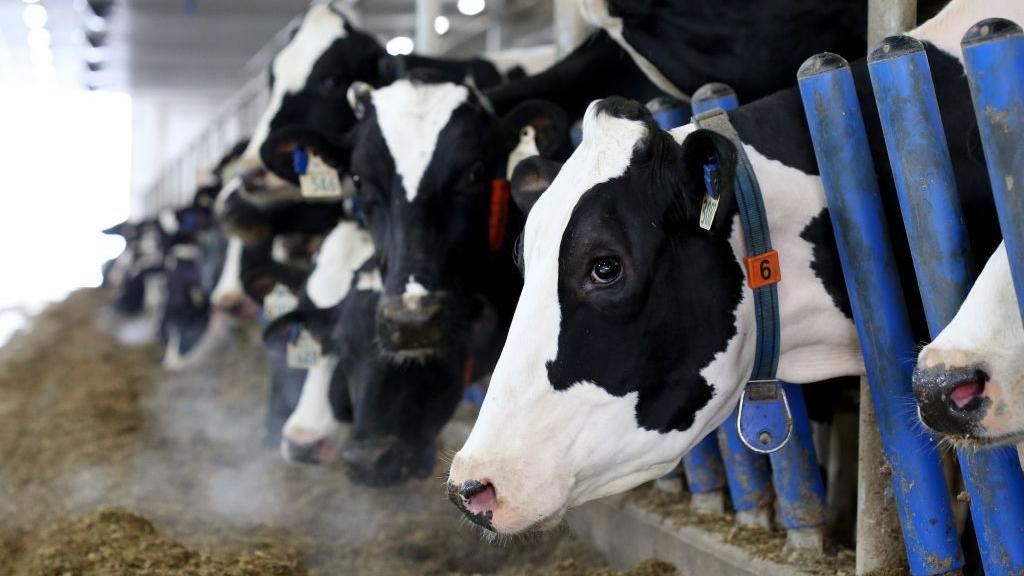
For decades, Canada’s dairy supply management framework has stood as one of the most politically untouchable policies in the country, and it has also been a persistent point of friction for former and current U.S. President Donald Trump. Today, the long-contested system is back at the center of a cross-border trade clash after Trump named it one of three key trade irritants justifying a steep 50% tariff on $20 billion worth of Canadian goods bound for U.S. markets, set to take effect this August.
Trump argues that Canada’s system, which imposes binding production quotas, fixed domestic pricing, and strict import caps on dairy, eggs and poultry, creates an uneven playing field that unfairly blocks American producers from accessing the Canadian consumer market. The dispute leaves Canadian policymakers facing an unenviable choice: dig in on the widely popular domestic policy and face costly new U.S. tariffs, or cave to American pressure to open the market, sparking backlash from the voting public and one of the country’s most powerful agricultural lobbies. So far, Canadian officials have drawn a hard line, making clear that any changes to the dairy system are off the table.
Quebec, home to Canada’s largest dairy sector, has led the charge against concessions. Premier Christine Fréchette confirmed earlier this week that supply management remains non-negotiable. Last week, Canadian Trade Minister Dominic LeBlanc emphasized to the BBC that the framework is a foundational pillar of Canada’s rural economy and local farm communities, guaranteeing Canadian consumers consistent access to premium dairy products produced by domestic farmers. Canadian leaders argue the system delivers stable support for family farms and locks in predictable pricing for core food staples that households rely on.
The power of Canada’s dairy lobby is well-documented: when past trade talks have threatened possible concessions, dairy farmers have organized high-profile protests on Parliament Hill, bringing tractors and livestock to demonstrate their opposition. David Clement, Canadian policy director for the international Consumer Choice Center, describes the dairy lobby as the most influential political interest group in the country, with deep ties across all major national political parties.
Canada’s supply management system was first launched in the early 1970s, and it has outlasted similar policies that were phased out by other Commonwealth nations including Australia and New Zealand. Under the current framework, individual dairy farmers hold fixed production quotas that cap how much milk they can bring to market. Provincial marketing boards set regulated prices, delivering a predictable steady income for farmers while ensuring a consistent domestic supply of dairy products. Only a small volume of foreign dairy is allowed to enter Canada duty-free or at low tariff rates within these set quotas; any imports exceeding the cap face steep levies ranging from 200% to nearly 300%, pricing most excess foreign goods out of the Canadian market entirely.
According to 2025 data from the U.S. Department of Agriculture (USDA), American dairy producers currently hold tariff-free access to just 3.5% of Canada’s dairy market, even as Canada ranks among the top importers of U.S. dairy, purchasing $1.3 billion worth of American dairy products last year. For American producers, expanded access to Canada’s market has become an increasingly urgent priority: the U.S. is currently facing a record high national dairy output that outpaces domestic consumption, leaving producers looking to expand into new export markets, including Canada’s 40 million consumers.
A White House policy order released Monday adds another layer to the dispute, arguing that Canada’s free trade agreement with the European Union grants European cheese producers easier access to Canadian markets than their American counterparts, amounting to unlawful discrimination against U.S. producers. Trump is far from the first U.S. leader to take issue with Canada’s policy: the prior Biden administration launched two formal challenges to Canada’s dairy quota rules under the USMCA, the current North American free trade agreement that frames bilateral trade talks between the two nations. In 2024, the United Kingdom walked away from bilateral trade talks with Canada over disputes regarding tariff-free access for British cheese producers. The Organization for Economic Co-operation and Development (OECD) has also repeatedly criticized the policy, arguing it creates harmful distortions in global dairy production and trade.
Even within Canada, a small but vocal contingent of economists, journalists and policy analysts has called for the full dismantling or major reform of the system. In a column published earlier this month ahead of Trump’s latest tariff announcement, Calgary-based writer and journalist Jen Gerson called for Canada to scrap supply management entirely, branding it an outdated anachronism that drives up food costs for Canadian households. Last year, Clement of the Consumer Choice Center wrote that the Trump administration’s claim that American farmers face unfair treatment in Canada has merit. He argues that supply management artificially inflates the price of core household staples including dairy and eggs — a particularly pressing issue amid Canada’s ongoing cost of living crisis. “We should get rid of supply management for our own good, outside of any negotiations and trade deals,” Clement told the BBC in an interview. He argues eliminating the policy would cut grocery costs for Canadian consumers, expand product choice at retail stores, and help Canada diversify its trade relationships by opening its market to global producers.
Recent pricing data backs up claims of higher dairy costs in Canada: Statistics Canada and USDA data shows the average Canadian paid C$3.19 ($2.26) for a liter of milk in May, while the average American paid just C$1.95 for the same volume. Despite these price gaps, supporters of the current system remain in the overwhelming majority. Public opinion polling shows roughly 77% of Canadian voters support retaining supply management, with most respondents saying they prioritize protecting domestic farmers and guaranteeing access to high-quality Canadian-made dairy. In reader comments to Canada’s Globe and Mail this June, many local consumers echoed that sentiment. “I don’t want cheap American milk products,” wrote Ontario resident Gary Johnson. “Let the United States send dairy products. I don’t think any of us will buy it,” added Mark Knudsen of Mississauga.
David Wiens, a third-generation dairy farmer from Manitoba and president of Dairy Farmers of Canada, argues the framework delivers tangible benefits that justify its existence, including steady consumer pricing and protection of Canadian food sovereignty. “Dairy prices are actually more stable than many other food categories, and more competitive internationally than people often realise,” Wiens told the BBC, noting that dairy prices are shaped by a wide range of economic factors beyond supply management. He pointed to the 2020s bird flu outbreak that sent egg prices skyrocketing for U.S. consumers as an example of how unregulated systems can face extreme volatility, arguing that Canada’s supply management framework shielded domestic consumers from similar sudden price spikes.
Critics of supply management argue that widespread public support stems in large part from a lack of public understanding of the complex policy, and that the political risks of pushing reform have become too high for most elected officials to touch. Ryan Cardwell, a professor at the University of Manitoba who has studied the political dynamics of supply management, says any major change would likely cost the governing Liberal Party multiple parliamentary seats, particularly in rural and Quebec ridings. There is also a massive upfront cost to any transition: the federal government would be required to pay billions in compensation to dairy farmers for their acquired quota rights, a price tag that no federal government has been willing to take on. “It would be an upfront cost, and of course governments hate that,” Cardwell noted.
Other countries that have eliminated supply management have taken different transitional approaches: Australia used a temporary consumer milk levy to fund compensation for farmers during its phase-out, while the European Union gradually increased production quotas by 1% annually before abolishing the system entirely in 2015. Despite growing international pressure, Cardwell says Canada’s system is likely to remain in place for the foreseeable future, noting that broad public support and powerful lobbying make any major overhaul politically unfeasible for current Canadian leaders.