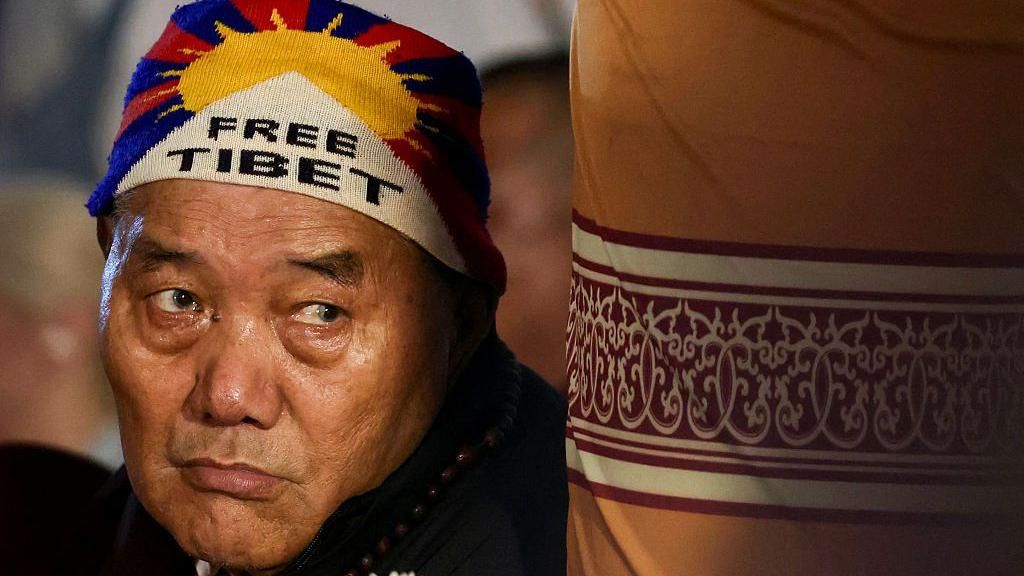
When 23-year-old Chinese student Zhang Yadi, also known by her nickname Tara, flew home for a visit to China last July, few could have predicted her trip would end in detention. A postgraduate student at a top-ranked UK university, Tara had drawn Beijing’s ire months earlier while studying abroad: she shared a public birthday greeting to the exiled Tibetan spiritual leader the Dalai Lama on the social platform X, and had assisted with editing an independent Chinese-language outlet that advocates for Tibetan human rights.
Arrested in the popular tourist town of Shangri-La, Yunnan province, she now stands accused of “inciting others to split the country and undermine national unity,” a charge that carries severe penalties under Chinese law. For Beijing, which claims Tibet as an inalienable part of its territory and labels the Dalai Lama a dangerous separatist, Tara’s words spoken from abroad crossed a non-negotiable red line. Her case now stands as a stark warning to critics of Chinese policy overseas as Beijing rolls out a sweeping new law that extends its legal reach beyond national borders.
On Wednesday, China’s long-debated Ethnic Unity Law formally comes into force. Framed by Beijing as a measure to foster social harmony and a unified national identity across the country’s 56 recognized ethnic groups, the legislation has triggered widespread fear among exiled dissidents, rights activists, and international governments. The most contentious provision, Article 63, grants Chinese law enforcement authorities explicit legal authority to target foreign-based organizations and individuals accused of “undermining ethnic unity” or “fomenting ethnic division.” For the first time, Beijing’s long-standing practice of transnational intimidation of dissidents will have formal domestic legal standing.
This development comes as China works to burnish its global image amid its rise as a major world power. In recent months, Beijing has loosened visa requirements for travelers from 77 nations, rolled out high-profile tourism campaigns, and rolled out the red carpet for visiting heads of state including U.S. President Donald Trump and UK Prime Minister Keir Starmer. Influencer social media content from trips across China, including to tightly restricted regions like Tibet and Xinjiang, has been amplified to showcase the country’s natural and cultural diversity to a global audience. But the new Ethnic Unity Law threatens to undermine that soft power push, drawing sharp condemnation from European policymakers and human rights groups.
Officially, Beijing frames the law as a logical extension of its longstanding policy of ethnic integration, which current leader Xi Jinping has framed using the metaphor of ethnic groups “hugging tightly like pomegranate seeds” to build a stronger, more unified nation. The law mandates that Mandarin Chinese, the language of the majority Han ethnic group that makes up more than 90% of China’s 1.4 billion population, be taught to all children from kindergarten through 12th grade, ending previous policies that allowed for most core coursework to be taught in local minority languages including Tibetan, Uyghur, and Mongolian. Beijing argues the mandate improves economic opportunity for minority youth by giving them fluency in the country’s dominant working language. But critics say the policy is a core part of the state-driven campaign of “sinicisation” launched in the late 2000s, which seeks to assimilate minority cultures into the dominant Han identity and erase distinct cultural and linguistic traditions.
Human rights groups say the law will formalize and expand repressive policies that have already targeted minority communities across China for years. In Tibet, authorities have seized control of monasteries, arrested monks who refuse to renounce their devotion to the Dalai Lama, and created a pervasive culture of surveillance and intimidation. In Xinjiang, the United Nations has documented credible evidence of grave human rights violations against the Uyghur Muslim minority, including the mass detention of more than one million people in what Beijing calls “vocational re-education camps.” In Inner Mongolia, 2020 saw rare mass protests by ethnic Mongolians against plans to curtail Mongolian-medium education, a movement that was quickly and violently crushed by security forces. A 2026 joint report from PEN America and the Southern Mongolian Human Rights Information Center has already documented the systematic erasure of Mongolian-language content from Chinese online platforms, with social media groups shut down, independent accounts deleted, and informal digital community networks dismantled.
For Chinese dissidents and ethnic minority activists living in exile, the law’s cross-border jurisdiction clause has turned anxiety into immediate fear. Many activists still have close family members residing inside China, and rights groups report that relatives of foreign-based critics have already faced increasing harassment and threats over the past year. Even peaceful advocacy for minority rights from outside China, activists say, can now be labeled a criminal offense under the new law, and retaliation can fall on loved ones back home. For many, this closes off any possibility of a safe return to China in the future.
“As the Ethnic Unity Law goes into effect, the Chinese government’s fist of repression will continue to squeeze as it unabashedly weaponises cultural institutions, technology, and the media to further dictate a state-controlled version of Mongolian culture,” said Erika Nguyen, senior manager at PEN America’s PEN/Barbey Freedom to Write Center and co-author of the 2026 report on Mongolian cultural erasure. “Article 63 should be seen as a call to action for other countries to shore up their protection and support for the exiled Tibetan, Uyghur, and Mongolian writers, artists, journalists, and activists who continue their work at great personal risk.”
At a press conference introducing the law last month, Chinese Deputy Justice Minister Hu Weilie rejected international criticism that the law constitutes “long-arm jurisdiction,” calling the provision “legitimate, lawful, necessary and a workable legal provision.” “Safeguarding national unity, territorial integrity, and social stability falls within the sovereign rights of all countries, and is a basic principle established under international law,” Hu added.
But international policymakers have pushed back hard against the new law. Members of the European Parliament have already drafted a warning to EU member states, urging a review of existing extradition treaties with China and noting that if the law is used to target European citizens, it could lead to “severe consequences for EU-China relations.”
While legal experts note the law will be difficult to enforce in foreign jurisdictions, they argue its primary purpose is to chill free speech and deter any open criticism of China’s ethnic policies from abroad. For thousands of activists living outside China, the new legal framework represents a dangerous escalation of Beijing’s transnational crackdown on dissent, one that threatens to close off open debate even beyond China’s borders. Rights groups warn that as the law takes effect, minority languages will be further pushed out of public life inside China, and the space for advocacy globally will shrink dramatically.