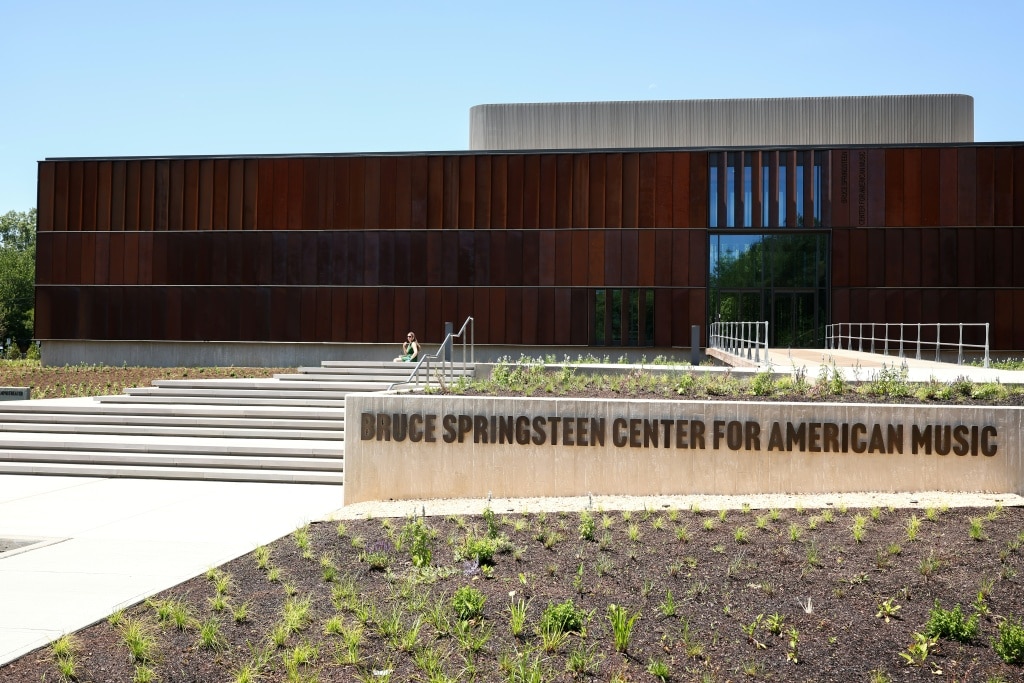
As one of the most iconic native sons of the Garden State, rock legend Bruce Springsteen is about to receive a permanent, heartfelt tribute from his home: the Bruce Springsteen Center for American Music, a new $53 million museum celebrating both his decades-long career and the broader tapestry of American music, is set to open its doors to the public this Saturday in Long Branch, New Jersey. This coastal town is Springsteen’s birthplace, and sits just minutes from Asbury Park, the working-class seaside community that fostered the young musician’s growth and carved its indelible mark on his artistic voice.
Spanning two floors and covering roughly 3,000 square meters of exhibition space, the museum’s layout is designed to weave together the broader history of American roots and popular music with the specific story of Springsteen’s rise to stardom. One entire floor is dedicated to tracing the evolution of core American music genres, from blues, country and jazz to modern hip-hop. A central throughline of this section is highlighting the long tradition of protest music that has shaped American culture, featuring iconic artists from Woody Guthrie, Bob Dylan and Nina Simone to Public Enemy, Kendrick Lamar, and Springsteen himself. Springsteen, a well-documented vocal critic of former President Donald Trump, introduces this theme in a 25-minute introductory film that greets all visitors upon arrival, where he frames himself as one messenger in a long, unbroken line of musical storytellers.
Exhibition curators drew direct inspiration from Springsteen’s own words to shape the museum’s design. According to Jared Gilbert, an associate at lead architectural firm CookFox, Springsteen’s memoir *Born to Run* and the narratives woven into his song lyrics served as the core inspiration for many of the space’s key design choices. The museum’s collection features a host of one-of-a-kind artifacts loaned by artists or their estates, including a gold jacket once owned by Elvis Presley, a saxophone played by jazz legend John Coltrane, a guitar from rock icon Eddie Van Halen, and a signature cap from Public Enemy frontman Chuck D. Bob Santelli, the center’s executive director and a close personal friend of Springsteen, told reporters that securing these rare items was far simpler than many expected, noting that Springsteen’s reputation and name opened almost every door for the curatorial team. The entire project, which will house Springsteen’s personal professional archives, was funded primarily through donations from high-net-worth fans of the rock star, Santelli added.
To make the collection accessible to all visitors, the museum integrates interactive listening stations and touchscreen displays that let guests explore hundreds of tracks across different styles and eras. Curators acknowledged one notable gap, however: popular dance genres including disco, funk, house and techno are not featured in the genre exhibition, a omission the team says was purely due to space constraints rather than an intentional choice.
The museum’s upper floor is dedicated entirely to tracing Springsteen’s decades-long career, starting from his earliest live performances on the campus of Monmouth University, through the formation of his long-time backing group the E Street Band, his commercial breakthrough in the mid-1970s, and the global blockbuster success of his 1984 seminal album *Born in the U.S.A.*. A large, dedicated section of the exhibition unpacks the album’s iconic title track, clarifying its nuanced message for the many listeners who still misinterpret it as a straightforward patriotic anthem: the song was actually written to condemn the poor treatment of Vietnam War veterans after they returned home from service.
Additional interactive and personal exhibits include a virtual library holding the key books that shaped Springsteen as an artist – the singer, who dropped out of college, shares in a recorded video that he only developed his love of reading at age 28 – and a replica recording studio where visitors can experiment with mixing their own musical tracks. Notably, while Springsteen used his 20-date U.S. tour completed in May to openly criticize former President Trump at every stop, the former president’s name does not appear anywhere in the museum’s permanent exhibitions. Santelli explained that the center has intentionally kept its core narrative apolitical, noting that Springsteen’s personal political views are his own, not the institutional stance of the museum. To address the intersection of music and politics that runs through Springsteen’s work and American music broadly, the center will launch a six-month temporary exhibit alongside the opening, titled *Chimes of Freedom: Politics, Protest and the Power of Song*, which will explore that theme in depth.