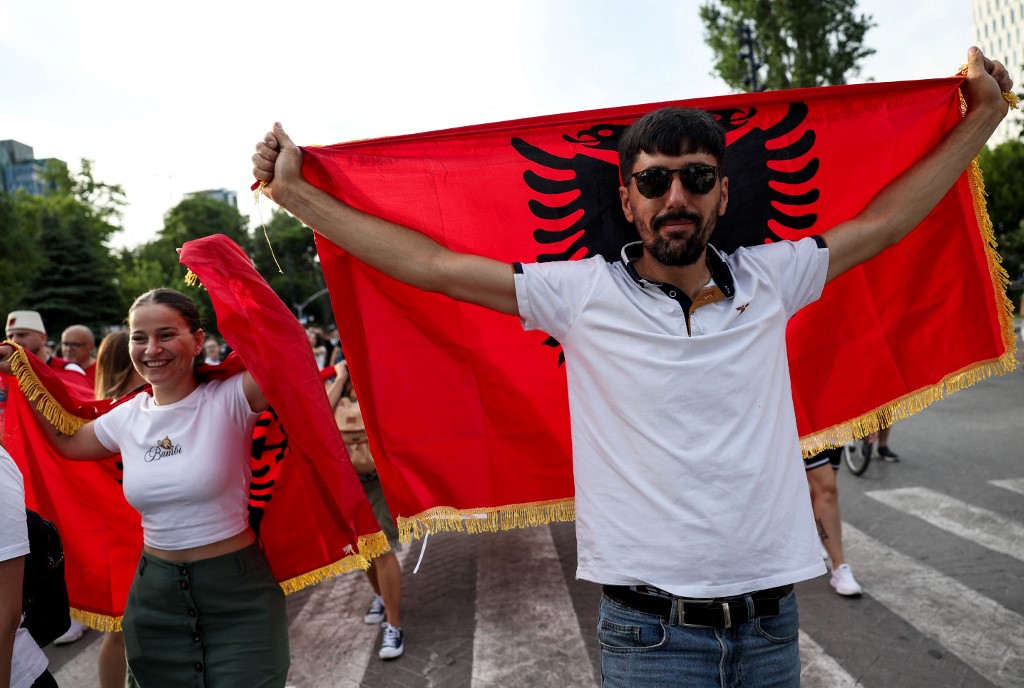
As the clock strikes 6 p.m. on a midweek Wednesday, several hundred Albanian demonstrators assemble along the perimeter of Tirana’s central Skanderbeg Square. A small group of speakers steps forward to address the crowd, while new arrivals stream in, carrying hand-painted posters and national flags. Roughly 30 minutes after the first gathering, the crowd begins a coordinated march toward the residential compound of Albanian Prime Minister Edi Rama, located in the capital’s core. Along the route, informal street vendors do brisk business selling Albanian national flags, branded scarves, whistles, and traditional white wool qeleshe hats, a symbol of national identity. By the time the crowd reaches the prime minister’s office, their numbers have swollen to thousands, stretching nearly a full kilometer along the city’s central boulevard. Chants ring out across the thoroughfare, mixed with the sound of drumming, whistles, and defiant singing. One slogan, scrawled on signs and shouted in unison, translates plainly: “Edi Rama ka mbaru” — Prime Minister Edi Rama’s time is up. By 9 p.m., the march has spread through central Tirana, gridlocking traffic for blocks. But most stranded drivers do not express frustration; instead, many wave Albanian flags, cheer on the marchers, or lean on their horns in solidarity, with some even climbing onto the roofs of their vehicles to display their support. What began as a localized environmental demonstration against a controversial luxury development has erupted into a sustained national uprising, entering its 13th consecutive day of action by the end of last week. The unrest first ignited on May 30, sparked by plans for high-end resorts on Sazan, Albania’s largest island, and within the protected Vjosa-Narta nature reserve — a unique ecosystem home to flamingos, sea turtles, more than 200 bird species, and over 70 plants and animals classified as endangered. The multi-billion-dollar development project is led by Affinity Partners, the private investment firm founded by Jared Kushner, son-in-law of former U.S. President Donald Trump. Public scrutiny of the project intensified after Ivanka Trump, Kushner’s wife, claimed she “discovered” Sazan during a private yacht trip, a comment that drew widespread anger among Albanians. In 2024, the Rama administration oversaw amendments to legislation governing protected natural areas, a change critics say deliberately opened formerly off-limits conservation zones to private tourism development. Construction work on the project kicked off in late May, and local residents immediately began staging small protests around the fenced construction site, which was guarded by private security contractors. Tensions boiled over after a video went viral showing security guards dragging a protester across the ground, an incident that galvanized public anger and drew thousands of new demonstrators to the movement. In the opening days of the protest, demonstrators centered their opposition on the threat to Vjosa-Narta’s fragile ecosystem, with viral photos of marchers holding signs featuring the reserve’s iconic pink flamingos spreading across social media. But in less than two weeks, the movement has undergone a profound transformation: what started as a single-issue environmental campaign has evolved into a broad-based anti-government uprising targeting Rama’s administration and the entire Albanian political establishment. Rama has repeatedly dismissed the protests, dismissing the movement as “engineered digital hysteria,” accusing international media of exaggerating the scope of public anger, and drawing a hard line on the development project. “There is no chance for this investment to stop as long as I am here,” the prime minister said. For demonstrators, however, anger extends far beyond the proposed resort. Many have grown deeply frustrated with years of unaddressed public grievances, entrenched corruption, and policy decisions they say prioritize the interests of wealthy foreign investors over the basic needs of ordinary Albanian citizens. Oljam Dervishi, founder and CEO of Albanian environmental NGO Resu, explained that the project sets a dangerous precedent for the future of the country’s protected natural spaces. “If the resort gets built, that will mean that everywhere where there are protected areas, they are not protected anymore,” Dervishi told Middle East Eye. “This project shouldn’t happen. If they want to develop, they should develop somewhere else.” Dervishi added that the movement’s priorities have already shifted far beyond environmental protection: “I don’t think this is a question of protected areas or the environment anymore. People feel like decisions are not taken for the people, but for investors. And that’s why they are furious.” Jonida, a computer programming student who has joined every day of the protests since they began, echoed that sentiment, noting that opposition to the project is not rooted in anti-American sentiment or opposition to the Trump family specifically. “Even if it was another billionaire, we would still be here,” she said. “Because the real problem is the principle of selling the country.” For Jonida, the Albanian government should be prioritizing far more urgent domestic issues: improving the country’s underfunded healthcare and public education systems, and lowering skyrocketing fuel prices. “This needs to be fixed first. You can think about tourism for elites after. But even then, it has to be outside of protective areas. You cannot change laws through corruption.” Like many demonstrators, Jonida’s ultimate demand goes far beyond canceling the resort: she is calling for Rama’s resignation, and says she does not support the country’s traditional political opposition either. Instead, she hopes the protests will pave the way for a new grassroots people’s party that will prioritize the needs of Albanian citizens. “I hope there will be a party that cares about Albanian citizens; that there will be people who are in it for the country and not for the money.” Rezarta, a 21-year-old architecture student and fellow protester, laughed off Ivanka Trump’s comment about “discovering” the island, noting “Ivanka the explorer says she found our island, but it was ours to begin with.” While Rama has promoted the resort as a major driver of economic growth for Albania, Rezarta says ordinary Albanians will see none of the benefits. “We Albanians get nothing. Only Ivanka, her friends, our prime minister and his friends can enjoy it.” For her, the protests are a reflection of widespread anger at a political system that prioritizes elite luxury tourism over the basic needs of the Albanian public. “The healthcare is horrible and living here is very expensive compared to the wages we get. We cannot take it anymore.” Rezarta also joined calls for the removal of the entire top political leadership, including both Rama and opposition leader Sali Berisha, echoing the popular protest slogan “Rama to prison; Berisha to prison.” The 81-year-old leader of the Democratic Party, who previously served as prime minister and president, is widely accused by demonstrators of colluding with Rama to protect elite interests. “We know that they are working together,” Rezarta said. “We want them gone from our politics. We want new people and new faces.” She added that the large presence of young people at the protests reflects a last stand for the future of the country: “Many of the people here are Gen Z and Millennials. You can feel that they’re here to fix everything – or else we’re all leaving Albania.” That fear of a mass exodus of young people is what drove Hortensa, a mother of two, to join the protests. Her motivation is simple: “I don’t want my kids to leave Albania.” Her anxiety is well founded: roughly 1.2 million Albanians — a third of the country’s total population — currently live abroad. “What don’t we have that Italy or Germany have?” she asked. “Our youth should remain in Albania.” Redes, a dentist who has watched dozens of his relatives and friends emigrate “because of this corrupted government,” shares that frustration. Even with a stable professional career, Redes says daily life in Albania remains a struggle. “The wages are bad. Everyone is fed up.” He is also calling for Rama’s resignation, arguing the resort project is designed to line the prime minister’s pockets and curry favor with the U.S. “But at what cost?” he asked. “None of the working-class people would be able to go to the resort. It’s for billionaires, not for us. Even though this is our land.” Ilir, a long-time anti-government activist who has been demonstrating against Albanian administrations for years, notes this movement is different from previous small-scale protests. “In the past, it was just a couple of hundred people. This time is different. Most people here want both the government and opposition leaders in prison. We consider them traitors,” he said. Ilir accuses the government of “selling and destroying the most beautiful parts of Albania,” adding that the protected natural areas were “sold to foreigners under the table.” While the protests have already shifted far from their original environmental roots, they have notched early partial wins. Albania’s top anti-corruption judicial body, SPAK, has launched a formal investigation into the project and frozen assets and bank accounts linked to the developing company. Separately, the European Commission has issued a formal warning that the project could create significant complications for Albania’s bid to join the European Union — a goal that public polling shows is supported by 91% of Albanians. Earlier this week, a European Commission spokesperson confirmed that after the body raised formal concerns, Albania’s environment minister committed to pausing construction and ordering a full independent environmental impact assessment of the project. As of Friday, when the protests entered their 13th consecutive day, there is no sign of the movement winding down. For Dervishi, even the act of sustained public protest is already a victory. “One of my goals is to end this state of being scared of speaking out,” he said. “That’s why this protest is so meaningful for me and for all the people here. And I’m very positive that the protests will have good outcomes that will serve the people of Albania.”
‘I hope Rama resigns’: Why Albania’s Flamingo Revolution isn’t actually about flamingos