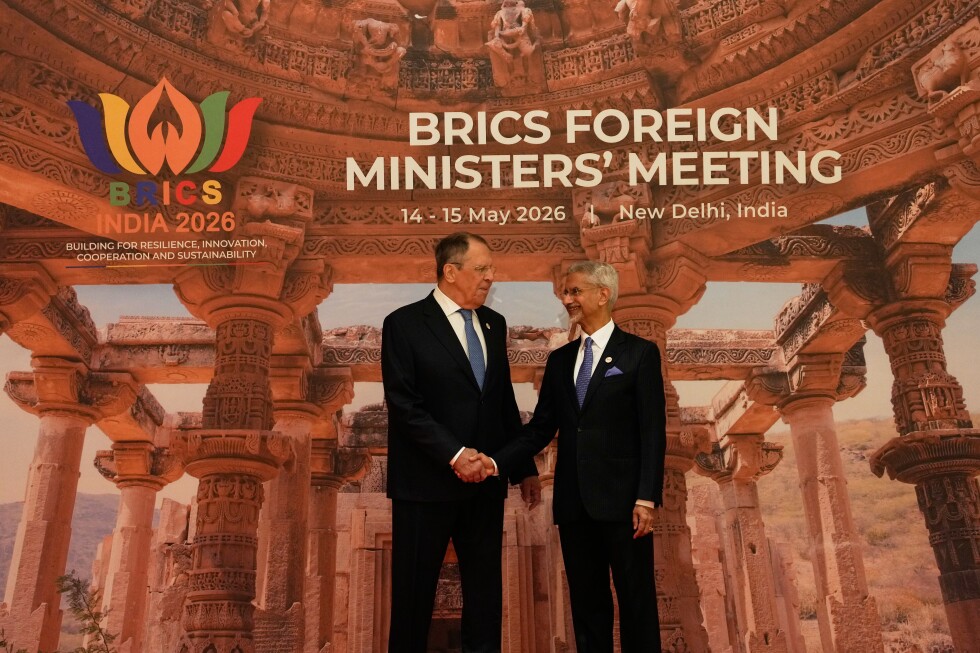
Two days of high-stakes diplomatic talks between BRICS foreign ministers kicked off in New Delhi on Thursday, bringing together representatives from the bloc’s 10 current member states at a moment of deepening geopolitical friction and growing global economic volatility. The summit unfolds against a backdrop of multiple overlapping crises: the ongoing conflict involving Iran has disrupted global energy supply chains, pushed international oil prices sharply higher, and created new rifts among the grouping’s recently expanded membership, while U.S. President Donald Trump holds a landmark meeting with Chinese President Xi Jinping in Beijing concurrently.
Founded in 2001 and formally established as a coordination bloc in 2006, BRICS was originally built as a collective voice for major emerging economies, designed to counterbalance the influence of Western-dominated global governance bodies such as the G7. South Africa joined the original four members—Brazil, Russia, India, and China—in 2010, marking the bloc’s first expansion. A major wave of new memberships followed in 2024, when Egypt, Ethiopia, Iran, and the United Arab Emirates joined, with Indonesia becoming the 10th full member in 2025. Over the past two decades, the bloc has positioned itself as an alternative leadership channel for the Global South, attracting widespread support from developing nations that have long criticized Western-led financial institutions for skewed representation and unfair policies.
Attendees at this year’s summit include Iranian Foreign Minister Abbas Araqchi and Russian Foreign Minister Sergey Lavrov. China is being represented by Ambassador Xu Feihong, as top Chinese diplomat Foreign Minister Wang Yi remains in Beijing to support the Trump-Xi summit. India’s Foreign Minister Subrahmanyam Jaishankar, who holds the 2025 BRICS chairmanship, opened the talks by outlining the summit’s core priorities: addressing pressing global and regional challenges, and identifying actionable pathways to deepen practical cooperation across all member states.
In his opening address, Jaishankar emphasized that BRICS has a critical role to play in helping developing nations navigate overlapping, cascading crises, from public health vulnerabilities and inadequate development financing to skyrocketing prices for energy, food, and fertilizer. “We meet at a time of considerable flux in international relations,” Jaishankar told delegates, noting that emerging and developing economies increasingly look to BRICS to deliver a “constructive and stabilizing role” amid global uncertainty.
Despite the bloc’s expanding global influence and growing appeal in the Global South, deep internal divisions have come to the fore ahead of this week’s talks, testing BRICS’ ability to present a unified front to the world. Longstanding regional rivalries, including the competition for influence between India and China, have created persistent frictions, while member states hold widely differing alignments with Western powers. Russia’s full-scale invasion of Ukraine already laid bare these ideological and strategic gaps, and the bloc’s 2024 expansion has added new layers of strain, as competing regional interests have made it even harder to align on collective positions.
Now, the escalating conflict in the Middle East has pushed these divisions into the open. Both Iran and the UAE are current BRICS members, but the two nations hold sharply competing interests in the region. On Wednesday, Iranian deputy foreign minister Kazem Gharibabadi confirmed that disagreements over the conflict had already blocked BRICS from agreeing to a unified statement.
Gharibabadi told India’s Press Trust of India that one unnamed BRICS member had pushed for the bloc to release language formally condemning Iran, a move that has derailed consensus-building efforts. “We want India’s BRICS chairship to be successful. It is not a good approach to send a signal to the world that the BRICS is divided. One country is insisting on condemning Iran,” Gharibabadi said.