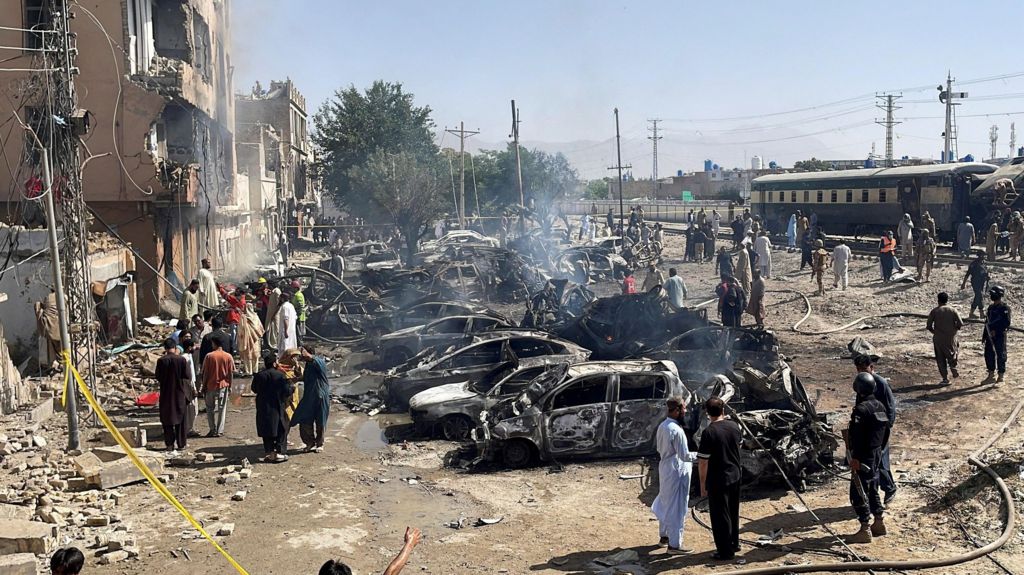
On a Sunday morning in Quetta, the capital of Pakistan’s restive western province of Balochistan, a powerful explosion targeted a shuttle train carrying military personnel and their families, leaving at least 20 people dead and 70 more injured, according to official and witness accounts. The blast struck as the train passed through Chaman Phatak station, triggering significant structural damage to the rail cars: railway sources confirmed to BBC Urdu that three passenger coaches and the train’s engine derailed, while two additional cars overturned completely.
Most of the passengers on the service were service members and their relatives traveling home for the Eid holiday, making the attack an even deadlier disruption to long-awaited family gatherings. The Balochistan Liberation Army (BLA), a separatist militant group active in the region, has claimed responsibility for the incident, stating it was carried out as a suicide bombing. Pakistani government officials have not yet verified the militant group’s claim as of the latest updates.
Graphic photos from the attack site show charred, twisted remains of train carriages, damaged nearby civilian vehicles, and visible structural damage to a neighboring building from the force of the blast. Local resident Naseer Ahmed described the shock of the explosion to the BBC, noting that his entire family was asleep at the time of the Sunday morning blast, and the force was powerful enough to shatter all the glass windows in his home.
Both a senior Balochistan police officer and a civil administration official confirmed the current death toll of 20 to BBC Urdu, and warned that the number of fatalities could climb as first responders continue to clear debris and assess the extent of casualties. Emergency protocols have been activated at all local hospitals treating victims, to speed up care and mobilize additional medical resources for the injured.
Additional official details clarify that the shuttle had been traveling from a nearby military encampment toward Quetta’s main railway station, where passengers were set to board a connecting train to Peshawar before heading to their hometowns across the country for the holiday. This attack is not an isolated incident: the BLA has a documented history of targeting rail infrastructure in Balochistan, having carried out multiple attacks on the Jaffar Express, a major intercity train route, over the past two years. Most recently, in March 2025, BLA militants hijacked the same train and held multiple passengers hostage while it traveled toward Peshawar.
The separatist group has long framed its armed campaign around claims that the Pakistani federal government extracts and exploits Balochistan’s rich natural mineral resources without sharing economic benefits with the local population. Geopolitically, Balochistan is Pakistan’s largest province by area, covering roughly 44% of the country’s total landmass, with a population of just 5% of Pakistan’s 240 million total residents. It shares unstable border regions with both Iran and Afghanistan, and also holds a portion of Pakistan’s Arabian Sea coastline, giving it significant strategic importance for the country.
Tensions and violent clashes between BLA fighters and Pakistani security forces have surged in recent months: in early February 2026, coordinated attacks across Quetta and other areas of the province left 31 civilians dead. Following Sunday’s attack, Pakistani Prime Minister Shehbaz Sharif issued a strong condemnation of the bombing, saying that “such cowardly acts of terrorism cannot weaken the resolve of the people of Pakistan.” He added that “the entire nation stands in solidarity with the people of Balochistan in this hour of grief.”