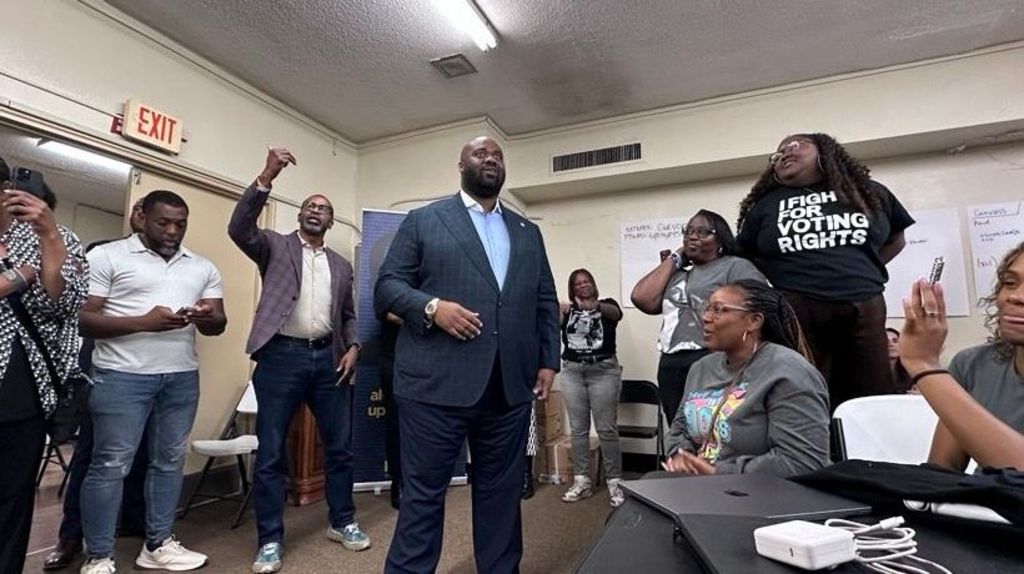
In a landmark political upset 145 years in the making, Democrat Scott Colom secured Mississippi’s U.S. Senate seat, marking the first Democratic win for the position in more than four decades and the first time a Black politician has held the office since 1881. The historic outcome unfolded as jubilant crowds packed the NAACP’s Mississippi headquarters, housed in Jackson’s 70-year-old historic Masonic Lodge Hall, a space that once hosted civil rights icon Medgar Evers, the voting rights activist assassinated in 1963 for his work registering Black voters.
Mississippi, a longstanding Republican stronghold where Donald Trump won the 2024 presidential contest by a 22-point margin, had long been written off by national Democratic leadership, which had conceded the state’s federal races for decades. Colom overcame staggering structural disadvantages: he faced a $2 million funding gap against incumbent Republican Cindy Hyde-Smith, who drew widespread criticism for a low-energy campaign with minimal public appearances, and operated in a political landscape reshaped by a U.S. Supreme Court ruling that gutted key provisions of the Voting Rights Act, enabling state Republicans to redraw districts to dilute Black voting power. Mississippi’s Black population makes up nearly 40% of the state’s total electorate, the largest share of any U.S. state.
The upset was powered by unprecedented grassroots organizing: the nonpartisan NAACP more than doubled its 2022 election outreach, knocking on 150,000 doors across the state and visiting 2,500 churches, compared to 70,000 door knocks and 500 church stops in the prior midterm cycle. Youth voter turnout also surged, driven by groups like Mississippi Votes, which mobilized more than 600 students at Jackson State University, a local historically Black college, to cast ballots — a sixfold increase from the 2022 midterm. Overall, roughly 300,000 more Mississippians turned out to vote in the 2026 midterms than in the previous comparable election, with exit polls showing 91% of Black voters casting their ballots for Colom.
Additional tailwinds included a national conservative backlash against Republican incumbents across multiple traditionally red states including Texas, Kansas, and Iowa, fueled by widespread voter frustration over cost-of-living spikes tied to recent Trump administration policies. Colom’s viral “Pick Another Senator” ad, a playful jab at Hyde-Smith’s public comment that constituents could switch to alternative proteins if beef prices were too high, resonated widely across social media. The candidate also ran a relentless retail campaign, visiting every one of Mississippi’s 82 counties and launching the “Where’s Cindy Tour” to draw attention to his opponent’s sparse public schedule.
Celebrations erupted across Jackson as results were confirmed more than a week after Election Day: supporters cheered, cried, and embraced inside the NAACP lodge, with one overjoyed attendee dropping to the carpet to mimic making a snow angel out of sheer elation. At Colom’s official victory rally held on the campus of historically Black Tougaloo College, hundreds of attendees held signs referencing the viral campaign slogan, as the Tougaloo Concert Choir performed the national anthem and his two young daughters led the Pledge of Allegiance. In his first public address as senator-elect, Colom invoked the legacy of Medgar Evers, noting, “He had faith that Mississippi could make progress. I do not take credit for this win — this is something we built together, all of us, by refusing to write our state off.”