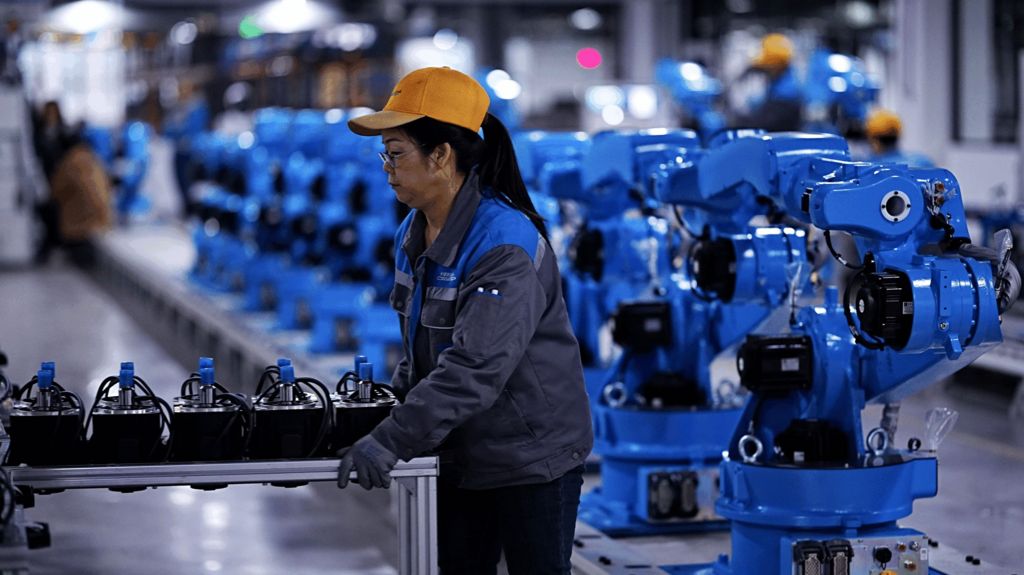
In classrooms and factory floors across China, a sweeping technological transformation is already underway, driven by a $20 billion national strategy aimed at catapulting the country to the forefront of global innovation and creating direct competition with the United States. This push for mass automation, centered on integrating robotic workers into every layer of the world’s largest manufacturing hub, is reshaping not only how goods are made but also how the next generation of workers is trained.
At the Hangzhou Technician Institute, a sprawling purpose-built vocational school on the outskirts of one of China’s leading tech hubs, 28-year-old instructor Chen Tianyu brings real-world factory automation insights back to his classroom of 30 aspiring robotics and AI specialists. Surrounded by rows of unprogrammed industrial robots and teams of students developing robotic medical devices, Chen emphasizes a stark reality: professionals who fail to adapt to the AI and robotics age will be left behind. Unlike traditional academic institutions, this vocational campus is designed to churn out a new generation of tech-savvy engineers that can keep up with China’s rapid automation expansion. Chen notes that the institute’s graduates are already in high demand, with many pre-hired by companies before they complete their training – a potential solution to China’s ongoing youth unemployment crisis, where one in five young people currently struggle to find work.
China already leads the world in factory robot deployment, with more than two million robotic units operating across its manufacturing facilities, and half of all industrial robots produced globally now come from Chinese factories. The BBC’s on-the-ground visits to facilities in Chengdu and Hangzhou reveal a mixed landscape where human workers and robots currently work side by side, even as companies push to expand automation to fill growing gaps left by China’s shrinking and aging population. Official projections estimate that by 2035, more than one-third of China’s population will be over 60, and some forecasts predict the country will lose nearly 60 million working-age people over the next decade – a drop roughly equal to the entire population of France. For manufacturers, this looming labor shortage is a core driver of automation investment.
At CRP Technology in Chengdu, a 300-person firm that has built customizable industrial robot arms for nine years, a team of young engineers is currently developing a prototype robot designed to build other robots. Right now, the prototype can only complete simple repetitive tasks like scanning QR codes, but 31-year-old R&D engineer Pang Kai says the team celebrates every small incremental win, with the goal of adding new capabilities within six months. “We need these kinds of robots because maybe in 10 years, we won’t have enough workers in China,” Pang explains, noting that a single standard robot arm can already complete more than 90% of a factory’s repetitive assembly tasks.
Even at electric vehicle maker Leapmotors, where automation has already replaced human workers in core manufacturing stages like stamping, welding, and painting, human workers still play a critical final role. The company’s Hangzhou factory integrates robots into every step of vehicle production, but hundreds of human workers still conduct final quality checks on new rolling vehicles. Cao Li, Leapmotors’ vice-president, acknowledges that full automation of even these final roles could come relatively soon, but adds that robots still require regular maintenance, inspection, and repair – work that still falls to human technicians.
Industry experts note that China holds unique competitive advantages in the global robotics race, rooted in its massive existing manufacturing ecosystem. Dr. Susanne Bieller, General Secretary of the International Federation of Robotics, explains that China’s centralized long-term planning, paired with its accessible local supply chains, gives it an unrivaled edge: building a new robot in Shenzhen takes less than an hour to source all required components, compared to up to a week in Europe. While the U.S. still leads in developing the AI “brain” that powers advanced robotic systems, Chinese AI firms have been closing the gap faster than many expected, even amid U.S. export controls on cutting-edge semiconductors. Fueled by an open-source innovation model that encourages code sharing among startups, Chinese companies are now positioning themselves to compete by integrating AI into millions of industrial machines, rather than just developing large language models.
Even with this rapid progress, major uncertainties remain. With 120 million people still employed in China’s manufacturing sector, a too-rapid transition to full automation could trigger mass job displacement, delivering a catastrophic blow to millions of households that rely on factory wages. It also remains unclear whether this automation revolution will solve China’s broader ongoing economic challenges, which include a lingering property sector crisis, massive local government debt, and persistently weak domestic consumption. For workers and trainers alike, the future remains unwritten. “Technology is changing so fast,” Chen says. “But we can’t just stand still and sleep here. We have to move forward to see what we are capable of doing.”