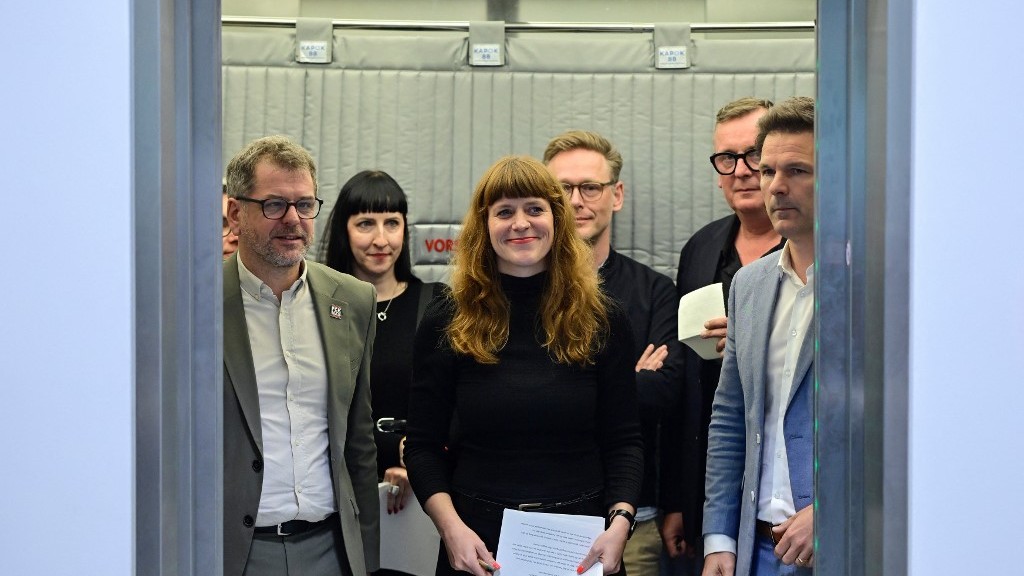
Berlin’s post-election coalition building has erupted into a major political standoff, centered on competing positions toward the Israeli-Palestinian conflict that have thrown plans for a left-led city government into disarray. After the September 20 regional election, the left-wing Die Linke party emerged as the largest bloc in the capital’s parliament, claiming 25.7% of the vote and putting its leading candidate Elif Eralp in position to become Berlin’s next governing mayor. But to form a governing majority, Die Linke must secure a coalition partnership with two larger center-left parties: the Social Democrats (SPD) and the Greens. Those talks have now ground to a halt over non-negotiable preconditions set by the SPD and Greens that demand Die Linke codify explicit commitments to Israel before any policy discussions can advance.
The clash was triggered this week when Die Linke moved to admit pro-Palestinian politician Vanessa Emde into its parliamentary caucus, prompting the SPD and Greens to suspend negotiations that had already been paused once earlier in the process. Emde, who won her Neukölln constituency with 46% of the vote, has stood by comments made during her campaign stating, “There is no right to exist for states – people have a right to exist.” On Thursday, she reaffirmed that this position is rooted in core principles of international law, saying she would not retract a single word of her original statement. Green leaders have claimed that excluding Emde from the caucus was a precondition for talks, a claim Die Linke rejects, noting no such requirement was included in the formal written framework of conditions.
Back in early October, the SPD and Greens forced Die Linke to sign a joint document as a prerequisite for even opening exploratory negotiations. The text declares “Israel’s right to exist” as non-negotiable, rejects broad boycotts of the Israeli state, and formally condemns the 7 October 2023 attacks led by Hamas while acknowledging the widespread suffering, hardship and destruction endured by Palestinian civilians in Gaza and the West Bank. Critically, however, the agreement stops short of affirming the right of a Palestinian state to exist, even as it endorses Palestinian self-determination and a two-state solution. It also does not name Israel as the party inflicting harm on Palestinian civilians, and includes provisions for disciplinary action up to expulsion for any Die Linke member who violates the document’s principles.
Die Linke is unique among German national political parties for its unflinching criticism of Israeli actions against Palestinians over the past three years. In June of this year, the party formally designated Israel’s military campaign in Gaza as genocide, while its national executive has previously condemned Israeli actions as crimes against humanity and ethnic cleansing. Regional party branches have also publicly denounced the system of Israeli apartheid in the occupied Palestinian territories. These positions have drawn fierce backlash from establishment political and Jewish groups: Josef Schuster, president of the Central Council of Jews in Germany, has argued that left-wing anti-Zionism is just thinly veiled antisemitism, while Andre Bock, a lawmaker from the federal ruling Christian Democratic Union (CDU), has called on Germany’s domestic intelligence service to place Die Linke under formal surveillance as a suspected extremist organisation.
But critics of this backlash argue that accusations of antisemitism are being deployed as a political weapon to sideline left-wing opposition to Israeli policy. Wieland Hoban, chair of Jewish Voice for a Just Peace in the Middle East, framed the attack on Die Linke as an effort to distract from pressing domestic issues facing Berlin residents, including a growing affordable housing crisis and persistent cost-of-living struggles. “There are people who have a vested interest in avoiding a discussion of those actual problems and would rather have ridiculous debates about whether the word ‘intifada’ is antisemitic,” Hoban told Middle East Eye. He added that the goal of the campaign is to force Die Linke onto the defensive, pressuring the party to water down its platform to gain coalition acceptance or collapse negotiations entirely.
Hoban pushed back on the conflation of criticism of Israel with antisemitism, noting that Emde’s comment about statehood is a widely accepted principle in international law. “No state has a ‘right to exist’. But the political and media establishment insists on this mantra because it’s central to the moral narrative with which Germany justifies its support for Israel and its participation in US-led imperialism,” he explained. Emde has also earned support from within her own party: Jorinde Schulz, Die Linke’s Neukölln district chair, rejected all claims that Emde’s statements qualify as antisemitic, affirming that “We naturally assume that Vedi Emde will be part of the future Left parliamentary group.” More than 120 Die Linke politicians and officials have signed a joint statement criticizing the party’s own negotiators for agreeing to the preconditions set by the SPD and Greens, accusing the two center-left parties of inserting “mechanisms of discipline and division into Die Linke from outside.”
Hoban drew a clear distinction between antisemitism and legitimate political opposition to Israeli policy: “antisemitism is directed at Jews simply for being Jews, while Israel is a state – an occupying apartheid state that has been committing genocide for three years.” He warned, however, that the ongoing conflation of criticism of Israel with antisemitism carries severe risks: as Israeli atrocities mount, public anger is increasingly being directed at Jewish communities globally, many of whom are incorrectly tarred with collective responsibility for Israeli actions.