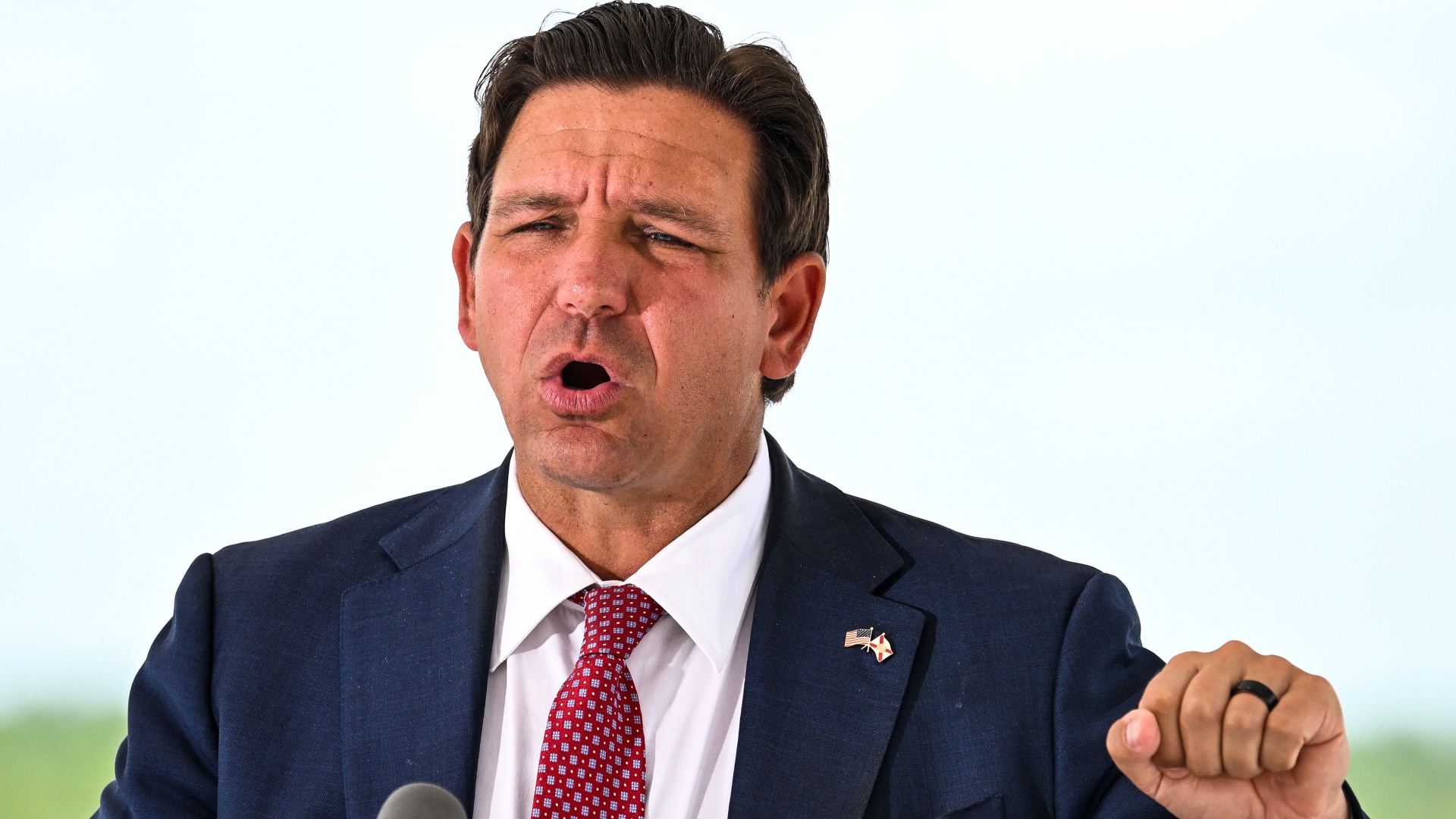
A landmark legal challenge has been launched against Florida Governor Ron DeSantis by the United States’ largest Muslim civil rights advocacy organization, the Council on American-Islamic Relations (CAIR), over a controversial state law that labeled CAIR a domestic terrorist organization — placing the civil rights group in the same legal category as some of the hemisphere’s most violent international drug cartels.
The lawsuit, filed Thursday, brings together three major non-profit legal and advocacy organizations: CAIR itself, the American Civil Liberties Union (ACLU), and the Southern Poverty Law Center (SPLC). The legal teams describe the designation enshrined in House Bill 1471 (HB 1471) as entirely unfounded, constitutionally flawed, and a direct threat to fundamental First Amendment rights.
In an official statement announcing the legal action, CAIR emphasized that the terrorist designation exposes the organization to immediate and irreversible damage. If enforced, the law would allow Florida state authorities to shut down all of CAIR’s programming, advocacy, and community operations across the state. Beyond CAIR, Florida’s new terror list also includes two additional vaguely defined entities: the Muslim Brotherhood, a transnational Islamist movement that has no documented active operations in the United States and no centralized global headquarters, and antifa, the loose decentralized anti-fascist movement that has no formal structure, membership roster, or fixed operating base.
The law grants Florida officials sweeping power to attach crippling stigmatizing labels to non-profit organizations, then deploy a broad range of state powers to immediately silence and disable the targeted group, its staff, its members, and any other individuals connected to the organization. Penalties include harsh criminal charges, civil fines, and administrative sanctions that reach far beyond standard regulatory measures, CAIR argues in the suit.
Alongside CAIR, the Muslim Brotherhood, and antifa, DeSantis has proposed adding more than 90 other organizations to the state’s terror registry. That list includes major international groups like the Islamic Revolutionary Guard Corps, the Venezuela-based transnational criminal gang Tren de Aragua, and Mexico’s notorious Sinaloa Cartel, one of the deadliest drug trafficking organizations in the world.
The current designation traces back to HB 1471, a bill approved by the Florida state legislature in March this year, signed into law by DeSantis in April, and implemented on July 1. This is not the first time DeSantis has attempted to blacklist CAIR: in December 2023, the governor issued a unilateral executive order to place the group on a terror watchlist, but that action was blocked by a federal judge earlier this year.
In his ruling blocking the initial executive order, federal judge Mark Walker centered his decision on a core constitutional question: whether a state governor can, outside of a formal emergency, unilaterally label one of the nation’s largest civil rights groups a terrorist organization and cut off any government benefits to individuals or entities that provide material support or resources to the group. Walker’s ruling was clear: “This Court finds he cannot.”
Now, CAIR is asking the court to issue an emergency injunction to block enforcement of HB 1471 entirely, arguing the new law retains all the constitutional flaws of the original executive order.
The text of HB 1471 states that any person or entity that provides support to a designated terrorist group can face criminal prosecution, and it also includes a provision asserting that no religious code — a measure widely interpreted to target Sharia law, which is protected under First Amendment religious freedom provisions for many American Muslims — can supersede Florida state law.
In their legal challenge, CAIR and its co-counsel point out that the designation process laid out in HB 1471 lacks basic due process protections. The law does not require state officials to provide the targeted organization with formal notice that includes all justifications for the designation, all material evidence — both incriminating and exculpatory — that decisionmakers relied on to approve the label. It also does not require the state to prove, or even provide evidence, that the targeted organization has violated any existing state or federal law.
Founded in 1994, CAIR is a U.S.-based non-profit focused on protecting civil liberties for Muslim Americans, and it funds almost all of its work through public donations from American citizens of all faith backgrounds. Edward Ahmed Mitchell, CAIR’s deputy national director based in Washington, D.C., previously told Middle East Eye that when similar executive orders targeting CAIR were in effect in Florida and Texas, the organization was blocked from purchasing property and barred from accessing state government contracts. Both states have also added the Muslim Brotherhood to their domestic terror lists.
Republican leaders, most notably Texas Senator Ted Cruz, have repeated longstanding claims that the Muslim Brotherhood maintains secret influential ties to CAIR and seeks to impose Sharia law across the United States. CAIR has repeatedly pushed back against these accusations, noting that more than 95% of its annual budget comes from individual donations from the American public, including both Muslim and non-Muslim supporters.
Internationally, the Muslim Brotherhood is designated a terrorist organization by several Middle Eastern nations, including the United Arab Emirates, Bahrain, Syria, Egypt, and Saudi Arabia. At the U.S. federal level, the Trump administration issued an order designating specific national chapters of the Muslim Brotherhood in Egypt, Jordan, and Lebanon as terrorist organizations, but no such designation applies to the movement as a whole or to any U.S.-affiliated groups. Critics of these designations have long argued that blacklisting the Muslim Brotherhood is largely a geopolitical concession to authoritarian monarchies and authoritarian regimes in the Middle East that view the popular reformist movement as a threat to their hold on power.
Cruz has argued that the movement, which retains widespread public support in many parts of the Arab world thanks to its combination of Islamic religious identity, grassroots political organizing, and community social welfare programs, poses a direct threat to U.S. national security. But when asked by Middle East Eye how the Muslim Brotherhood threatens U.S. security, Nathan Brown, a leading expert on Middle East politics at George Washington University and a trustee of the American University in Cairo, offered a blunt response: “None at all.”