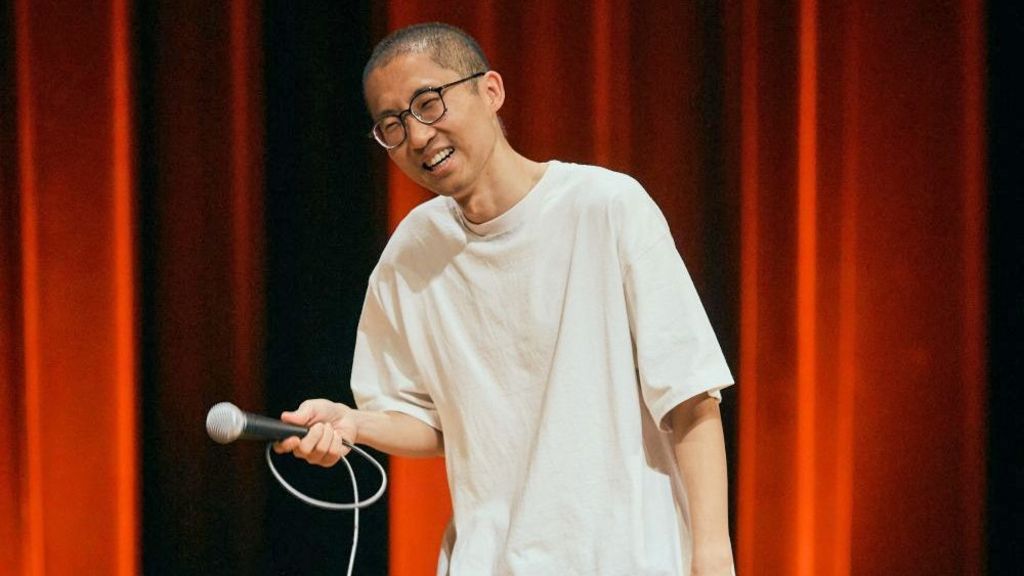
Three years after being abruptly barred from performing in his home country, once one of China’s biggest stand-up comedy stars Chizi, born Wang Yuechi, has launched a sold-out 2026 world tour, with a stop in Taiwan at the top of his ambition list — a choice he describes as equal parts high-risk and deeply compelling.
The 30-year-old comedian opened his recent Singapore show at the National University of Singapore, where a packed crowd of mostly Chinese Singaporeans and expatriate Chinese greeted a subtle joke about China’s top leader Xi Jinping with loud cheers and scattered approving expletives. “This is fire,” one audience member shouted in Mandarin. For context, public commentary or jokes about Xi, who has consolidated unprecedented personal power over nearly 15 years in office, remain strictly off-limits within mainland China, making even this subtle quip an act few comics would dare attempt.
Chizi’s path to this 2026 tour began in 2023, when Chinese authorities banned him from all performances across the mainland following a series of international shows that touched on politically sensitive topics. Beijing never issued an official public statement explaining the ban, but the move effectively erased the once-household name from mainland Chinese public life. Today, Chizi resides outside of China, and his name is rarely spoken openly on mainland social media. In a recent post on Threads, he highlighted the pervasive censorship of his image: “In China my face is treated like a sexual organ. It’s not something that can be freely shown or circulated,” he wrote, after learning a fan had their social media account suspended for sharing a photo of him.
After an extended hiatus from the stage, Chizi made his return in April 2026, kicking off a tour that includes stops in Tokyo, Taipei, Kuala Lumpur, and Singapore, with every show selling out within days of going on sale. In an exclusive interview with the BBC following his Singapore set, Chizi framed this tour as his first truly authentic body of work after more than a decade in comedy. While many observers cast his comeback as an act of open defiance against Chinese censorship, Chizi downplayed that framing, noting his core goal is simple: “I wanted to perform for people who speak Chinese, to introduce myself, showing them how I live, or think as someone who lived in China for 30 years.” He added that he has long been drawn to challenging work, a mindset that shaped his comeback: “If something feels risky or dangerous, I find it interesting.”
That appetite for risk is what led him to prioritize a performance in Taiwan, a self-governing island that Beijing claims as its own territory, making any public performance there by a Chinese-born comedian an inherently provocative act. “No Chinese comedian had ever performed in Taiwan,” he explained. “People speak the same language and the cultures are so similar. But there are so many tensions. So why not? Even if it turns into an argument, that’s okay. We could argue face-to-face.”
Chizi’s 60-minute tour set centers largely on his own life story: he describes himself as an excessively talkative child who frequently frustrated authority figures, and he discovered his love of comedy in his late teens. Now working outside the constraints of Chinese censorship, Chizi could lean heavily into political humor, but he says he has intentionally limited the share of political jokes in this tour’s material. When he did reference Xi, he avoided using his name, instead calling him “Peng Liyuan’s husband,” a nod to Xi’s wife, the well-known Chinese soprano.
The 2023 ban that ended his mainland career came on the heels of a North American tour where he served as the opening act for Chinese-American comedian Joe Wong. In those shows, Chizi spoke openly about topics that are completely off-limits for mainland comics: widespread state censorship, the rise of aggressive online nationalism and populism, and eroding rights for ethnic minority groups in China. He also pushed well past unwritten red lines by sharing his hope that people in Hong Kong — where Beijing has crushed all large-scale political opposition since 2019 — and Taiwan would get to live happy, self-determined lives. He learned of the ban while still on tour in February 2023.
Chizi told the BBC his first reaction to the ban was actually relief. “The show was based on reflections and realisations I’d had over the past few years, and I wanted to express how I truly felt,” he explained. Once he accepted that his mainstream comedy career inside mainland China was over, he leaned further into candor for his next show in Toronto, and he says he has no regrets today. He noted that the space for uncensored stand-up comedy inside mainland China has grown far more constrained in recent years, with most permitted material focusing on shallow, non-controversial topics.
Chizi’s comedy career stretches back more than a decade. A high school dropout, he began performing at open mic nights in 2015, and quickly found his footing: “I was always the chatty one, happy to make people laugh… I was like a fish in water,” he recalled. His big break came when he was invited to appear on a popular national talk show, the first television program in China to feature stand-up comedy regularly. He became a fan favorite, and within a year he was the face of two hit streaming comedy shows that racked up billions of views, cementing his status as one of China’s biggest stand-up superstars.
He developed a trademark style that won widespread acclaim: he often rapped his jokes, excelled at off-the-cuff improvisation, and dished out sharp but good-natured roasts of A-list celebrities that left guests and audiences alike in stitches. He also became known for weaving current events and social commentary into his sets, a rare choice among mainland comics at the time. In one viral segment with pianist Lang Lang, he joked that Lang practiced piano exclusively at home as a child because “teachers would prick him with needles” — a subtle jab at a high-profile child abuse scandal at a Chinese kindergarten that was largely censored from mainstream media. Even when he was forced to cut forbidden jokes from his aired sets to comply with censorship rules, he saved every cut line in a folder labeled “Things I can’t say,” holding out hope that he would one day get to share them publicly.
Despite his massive mainstream success, Chizi grew increasingly disillusioned with the constraints of working in China’s entertainment industry. He often questioned whether he was truly able to create meaningful work, rather than just being a popular celebrity, eventually quitting his regular spot on the hit talk show and leaving his talent agency after a public falling out. In late 2021, during the height of China’s zero-COVID lockdowns, he published his final post on his Weibo account, which had 4.7 million followers, announcing he would step away from the toxic, heavily censored social media environment. “It’s not that I don’t want to bring everyone joy. Of course I want everyone to be happy. But this place doesn’t carry joy,” he wrote.
In his interview with the BBC, Chizi explained he had grown frustrated with the limits on his ability to help his audience even during the country’s most difficult pandemic moments. As lockdowns dragged on, he received hundreds of messages from locked-down residents asking for help accessing medicine, food, and other essential supplies. He reposted most of the requests, but censors repeatedly deleted the posts and warned him his account would be permanently shut down if he continued. “It was a helpless feeling,” he recalled. “The so-called privilege wasn’t that meaningful.” He said his approach to stepping back came from a lesson his father, an oil painter, taught him: “He taught me that when you paint, you can’t keep staring at one spot. You need to step back to see whether it’s any good.”
Now that he has returned to the stage, Chizi plans to extend his 2026 tour to Australia, New Zealand, and North America. He says he doesn’t know how long he will keep touring, but for now he is relishing the freedom and connection of performing for enthusiastic, uncensored audiences. “Usually you make friends one by one, but on stage, I feel like I’m making 500 friends at once. That feeling – where there is a mutual understanding between me and the audience – I really like that,” he said.