作者: admin

  • Israel bombs Beirut, allegedly hoping to sabotage US-Iran deal

    Israel bombs Beirut, allegedly hoping to sabotage US-Iran deal

    On a Sunday that was meant to bring new momentum to long-stalled diplomatic negotiations between the United States and Iran, an unexpected Israeli military strike on the southern suburbs of Beirut upended fragile hopes for a breakthrough, leaving at least three people dead and triggering widespread accusations that Israeli Prime Minister Benjamin Netanyahu’s government is deliberately working to derail the emerging diplomatic agreement.

    According to Lebanese security officials, the airstrike targeted a five-story residential apartment building in the densely populated suburb. Netanyahu defended the operation immediately after the strike, framing it as a proportional response to recent rocket fire launched by Hezbollah into northern Israeli territory.

    The bombing came just hours after U.S. President Donald Trump announced that he expected a preliminary memorandum of understanding (MOU) to be finalized and signed as early as that same Sunday. The document is intended to lay the foundational framework for broader negotiations to end the offensive military campaign that Trump launched against Iran in late February. While Iranian officials pushed back on Trump’s timeline for an immediate Sunday signing, Iranian Foreign Minister affirmed just two days prior that a preliminary agreement had never been closer to completion.

    A reporting from The Associated Press published Sunday emphasized that the new Israeli strikes pose a significant threat to the negotiating process, noting that the current draft of the MOU has already been a source of deep disappointment for Netanyahu’s right-wing government. This is not the first time an Israeli strike on Beirut’s southern suburbs has triggered a major escalation: just one week before this latest attack, a similar strike sparked the most severe confrontation between Iran and Israel since a fragile ceasefire took effect across the region on April 7.

    Multiple high-profile observers have echoed the accusation that the attack was a deliberate act of sabotage. Kenneth Roth, the former executive director of Human Rights Watch, took to social media to highlight the striking timing of the strike, noting that the attack came just as a U.S.-Iran agreement appeared within reach. “As a US-Iranian deal seems like it might be closer, Israel predictably bombs the Beirut suburbs, evidently hoping to sabotage the deal,” Roth wrote, adding a sharp question directed at the Trump administration: “Why does Trump put up with this and continue to arm and fund such obstructionism?”

    Iranian officials have echoed this criticism, arguing that the strike exposes a failure of the United States to control its closest regional ally. Mohammad Bagher Ghalibaf, Iran’s chief negotiator and speaker of the Iranian parliament, said that the Israeli strike signals the U.S. “either does not have the will or the ability to fulfill its obligations.” He added, “The good cop, bad cop routine has become old. If you do not have the will or the ability to fulfill your commitments, then there is no basis for talking about continuing down this path.”

    While the full text of the draft MOU has not been released to the public, key details of its broad provisions have been confirmed by multiple media outlets and senior officials from both sides in recent days. According to a Sunday report from Reuters, the final draft covers a sweeping set of core issues, ranging from limits on Tehran’s nuclear program to the reopening of the strategic Strait of Hormuz and U.S. waivers on Iranian oil sanctions. The MOU would set a 60-day window after the preliminary agreement is signed for both sides to negotiate a final, comprehensive deal.

    Under the reported terms of the draft, Iran would immediately reopen the Strait of Hormuz — a critical chokepoint for global oil supplies that Iran had restricted in recent months — and the U.S. would end its ongoing illegal blockade of Iranian ports. Additionally, the U.S. would agree to lift sanctions on Iranian oil exports and unfreeze $25 billion in Iranian assets that have been held overseas, while Iran would agree to maintain the current status of its nuclear program, refraining from further uranium enrichment and any expansion of existing nuclear facilities. Iranian Foreign Minister Abbas Araghchi confirmed in a televised interview Friday that the 60-day ceasefire extension outlined in the MOU would also extend to Lebanon, where Hezbollah and Israeli forces have exchanged regular fire for months.

    Axios reporting has revealed that Netanyahu has been largely sidelined from the recent progress in U.S.-Iran talks, with the Israeli prime minister “finding himself in the dark” as negotiations advanced. In recent days, he has reportedly reached out to close allies within the Trump administration repeatedly to try to gather intelligence on the draft agreement’s terms.

    In an extraordinary public rebuke following Sunday’s airstrike, President Trump lashed out at Netanyahu in comments to Axios reporter Barak Ravid, saying the Israeli prime minister “has no fucking judgment.” Trump added, “I passed this message on to him – that I am very unhappy with the attack in Beirut.” The criticism comes even as the Trump administration has approved billions of dollars in new weapons sales to Netanyahu’s government in recent months.

    Trita Parsi, executive vice president of the Quincy Institute for Responsible Statecraft, warned that the airstrike is unlikely to be the last act of sabotage unless the Trump administration takes concrete action to penalize Israel for the attack. “Netanyahu knows exactly what he is doing and is judging that an attack on Beirut – rather than southern Lebanon – is exactly what’s needed to derail the pending US-Iran deal,” Parsi argued.

  • Russian strikes kill nine in Ukraine and damage historic cathedral, officials say

    Russian strikes kill nine in Ukraine and damage historic cathedral, officials say

    In a sharp escalation of cross-border hostilities between Russia and Ukraine on Monday, a coordinated wave of Russian strikes across Ukraine has left at least nine people dead, multiple others injured, and inflicted severe damage on one of Ukraine’s most cherished cultural and religious landmarks, the 11th-century Dormition Cathedral.

    Ukrainian officials confirmed the death toll breakdown: four civilians were killed in attacks targeting the capital Kyiv, while five rescue workers lost their lives while responding to a blaze sparked by a Russian strike in the northeastern city of Kharkiv. In Kyiv, drone and missile barrages set multiple residential buildings, vehicles and infrastructure ablaze, cutting electricity access to more than 140,000 residents across the capital. Air raid sirens blared across nearly the entire country, forcing Kyiv residents to seek shelter in underground metro stations and other bomb-proof facilities. The Kyiv strikes alone wounded 23 people, with an additional five people injured in Kharkiv.

    The most culturally devastating loss from the attacks is the significant damage to Dormition Cathedral, a core site within the Kyiv Pechersk Lavra monastery complex that stands as a defining symbol of Ukrainian national and religious identity. Ukrainian Prime Minister Yulia Svyrydenko condemned the attack as a deliberate, brutal assault against both the Ukrainian people and their irreplaceable cultural heritage. In response, Ukrainian Foreign Minister Andrii Sybiha announced that Kyiv would immediately launch formal procedures through UNESCO and other global international bodies to demand accountability for what he called “state barbarism” targeting cultural sites.

    The violence was not confined to Ukrainian territory: Russian officials in Tula, a city south of Moscow, reported that a Ukrainian drone strike on the city killed three people and wounded three more, including a one-year-old child.

    Regional tensions spilled beyond Ukraine’s borders as neighboring Poland, a key NATO ally of Kyiv, took precautionary defensive measures: the country scrambled fighter jets and activated all ground-based air defense systems in response to the Russian strike wave, in a move designed to safeguard its own territory.

    The latest outbreak of deadly fighting comes just days before a scheduled G7 summit in France, where the ongoing Ukraine war is a top item on the meeting’s agenda. The strikes also follow a high-level conversation Sunday between Ukrainian President Volodymyr Zelensy and former U.S. President Donald Trump focused on exploring paths to end the full-scale conflict that Russian President Vladimir Putin launched in February 2022.

  • Rape trial verdict due in the case of Norwegian crown princess’ eldest son

    Rape trial verdict due in the case of Norwegian crown princess’ eldest son

    On Monday, a Norwegian district court will deliver its long-awaited verdict and sentence in the high-profile criminal trial of Marius Borg Høiby, the 29-year-old eldest son of Crown Princess Mette-Marit, wrapping up a legal proceeding that has captured public attention across the Scandinavian nation and drawn widespread international scrutiny.

    Høiby, who was born from Crown Princess Mette-Marit’s pre-marital relationship with a commoner and grew up in the royal household alongside heir to the throne Crown Prince Haakon, but holds no official royal title or ceremonial duties, faces a total of 40 separate criminal charges. The most serious accusations against him include four counts of rape, alongside additional allegations of violence, threats, and abusive behavior spanning from 2018 to 2024. Prosecutors allege that in each of the four rape cases, the accusers were either asleep or severely incapacitated and unable to consent at the time of the alleged incidents.

    Høiby has issued a full denial of all four rape charges and pushed back on key details of many other allegations against him. He has only admitted to a series of less severe offenses, including drug-related violations, traffic misdemeanors, and violating the terms of a previously issued restraining order. Prosecutors have formally requested that Oslo District Court hand down a seven-year and seven-month prison sentence, while Høiby’s defense team has argued for the dismissal of all rape charges, and asked that any sentence for the crimes their client has admitted to not exceed 18 months of incarceration.

    The six-week trial concluded back in March after testimony from four separate accusers, alongside the submission of extensive evidence, including digital communications, images and video files recovered from Høiby’s personal cellphone. In the weeks leading up to Monday’s ruling, public interest has been further amplified by the declining health of Høiby’s mother, Crown Princess Mette-Marit, who lives with pulmonary fibrosis and is currently waiting for a life-saving lung transplant. Legal debates unfolded over whether Høiby should be granted temporary release from pre-verdict custody to see his mother, but appeals courts ultimately ruled that he must remain detained through the conclusion of the case. Legal analysts broadly note that regardless of how the court rules on the most severe rape charges, Høiby is still widely expected to receive a prison sentence for the lesser offenses he has already admitted.

    The case has gained outsized attention both domestically and globally due to Høiby’s direct ties to Norway’s royal family, and it comes at a time when the monarchy is already facing increased public scrutiny. Recently, public disclosures revealed that Crown Princess Mette-Marit maintained past social contacts with Jeffrey Epstein, the deceased American financier and convicted sex offender. The crown princess has publicly apologized for the connection, acknowledged that she exercised poor judgment in continuing her relationship with Epstein, and has not been accused of any criminal wrongdoing in connection with the Epstein disclosures.

    Editor’s note: This report includes discussion of sexual violence. For individuals in the U.S. seeking support for sexual assault experiences, contact the National Sexual Assault Hotline at 1-800-656-4673. For survivors based in Norway, the national sexual abuse victim helpline can be reached at +47 800 57 000.

  • Trump’s track record of insults and awkward moments with the G7 leaders he’s meeting in France

    Trump’s track record of insults and awkward moments with the G7 leaders he’s meeting in France

    As U.S. President Donald Trump prepares to depart Washington for France on Monday to attend the upcoming G7 summit, the gathering of the world’s most powerful Western democratic leaders is shaping up to be defined by underlying friction rather than collaborative unity. Despite ideological differences that separate the assembled heads of government, every attending leader shares one common experience: each has either been the target of public criticism from Trump, or has navigated awkward, unscripted confrontations with the U.S. commander-in-chief in recent months.

    Over three days of closed-door and public talks set against the scenic backdrop of the French Alps, leaders are scheduled to tackle a packed agenda that includes the newly announced ceasefire agreement aimed at ending the recent Iran war, ongoing trade tensions with China, and the lingering aftermath of Russia’s full-scale invasion of Ukraine. Beyond policy negotiations, the summit also presents a critical opportunity for global leaders to assess the future of their bilateral relationships with Trump, at a time when the U.S. president has doubled down on his “America First” unilateral approach to major global issues.

    Max Bergmann, a senior analyst at the Center for Strategic and International Studies, framed the summit’s dynamic as comparable to a tense family holiday gathering. “It’s like having an uncle you don’t quite like,” Bergmann explained. “No one wants to initiate a full confrontation, even when interactions turn passive-aggressive. But there’s always a risk that something snaps, and the gathering could spiral into a very dramatic public clash.”

    Ahead of the summit, a look back at recent high-profile frictions between Trump and his fellow G7 leaders highlights how far relations have strained across the alliance:

    ### United Kingdom: Starmer Draws Unflattering Churchill Comparison
    British Prime Minister Keir Starmer has become a repeated target of Trump’s criticism, centered on three core points: the UK’s reluctance to back U.S. military strikes against Iran, its national immigration policies, and its expanded renewable energy agenda.
    Trump’s sharpest rebuke came after Starmer initially refused U.S. military access to a British Indian Ocean base for Iran bombardment missions. “This is not Winston Churchill that we’re dealing with,” Trump remarked, contrasting Starmer unfavorably with the UK’s iconic World War II prime minister.
    Trump also publicly lashed out at Starmer after the UK placed the HMS Prince of Wales aircraft carrier on advanced readiness for potential Middle East deployment in the early days of the Iran war. “We don’t need people that join wars after we’ve already won!” Trump wrote on social media.

    ### Canada: “Governor” Carney Draws Ire Over Condemnation of Great Power Coercion
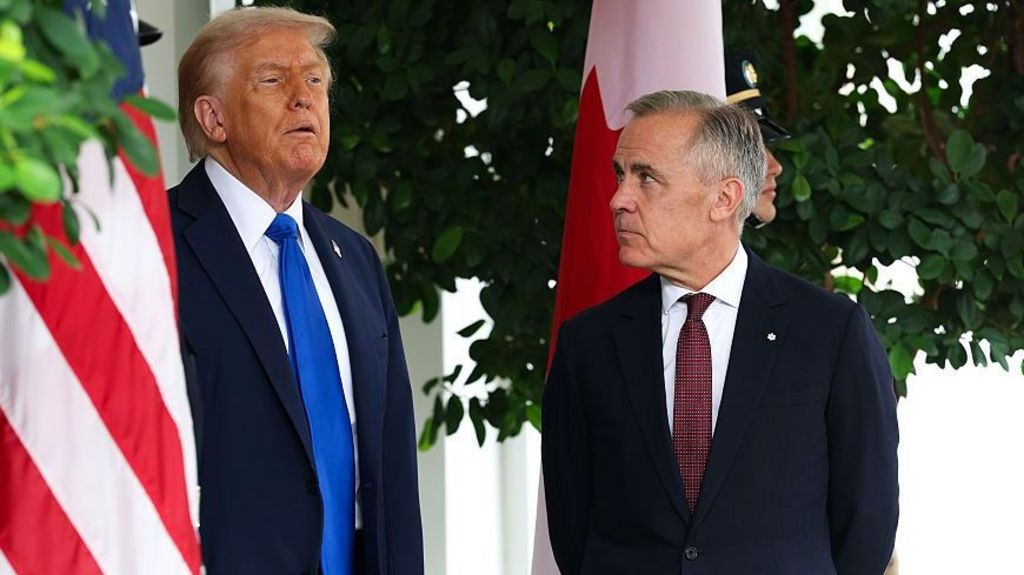
    Trump has long railed against trade imbalances with the U.S.’s northern neighbor, and has repeatedly made offhand comments about annexing Canada to make it America’s “51st state.” In recent months, he has taken to habitually referring to Canadian Prime Minister Mark Carney as “governor” rather than by his official title.
    The most public clash between the two leaders came earlier this year at the World Economic Forum in Davos, after Carney condemned great power coercion of smaller nations without naming Trump directly. “Canada lives because of the United States,” Trump fired back during his own remarks in Davos. “Remember that, Mark, the next time you make your statements.”
    Carney has opted for a calm response to repeated jabs, telling reporters earlier this month that Trump was an “exceptionally active user of social media” and that he would not waste time responding to every provocative post.

    ### France: Personal Jabs at Macron’s Marriage Over Iran War Opposition
    At an Easter lunch at the White House in April, Trump launched criticism of France and other NATO countries for refusing to join the U.S.-led war effort against Iran. In a shocking aside, he referenced viral footage from a 2023 Vietnamese state visit that captured First Lady Brigitte Macron appearing to nudge President Emmanuel Macron’s face away as the couple exited a plane.
    Trump told attendees Brigitte treats Macron “extremely badly” and joked the French president was “still recovering from the right to the jaw.” Macron later clarified the interaction was just a private joke between the couple, and called Trump’s comments “neither elegant nor appropriate.”
    Trump has also repeatedly mimicked Macron’s accent in public rallies and speeches when recounting trade negotiations, claiming the French president always quickly capitulates to U.S. demands in order to frame himself as a master dealmaker.

    ### Italy: Once-Praised Meloni Loses Trump’s Favor Over Non-Alignment
    Until this year, Italian conservative Prime Minister Giorgia Meloni was one of the few G7 leaders held in high public regard by Trump. When world leaders gathered in Egypt for a post-Gaza war summit last October, Trump publicly called Meloni “a very successful, very successful politician” and even praised her as “beautiful.”
    But Trump has completely reversed his stance after Italy refused to join the U.S. war against Iran, and after Meloni publicly criticized Trump’s high-profile feud with Pope Leo XIV over the conflict. “Do people like her? I can’t believe it,” Trump told Italian newspaper Corriere della Sera. He added, “I thought she had courage. I was wrong.”

    ### Japan: Awkward Pearl Harbor Joke Leaves New Prime Minister Reeling
    Trump has not launched direct public criticism of Japan’s Prime Minister Sanae Takaichi, who took office last October, but an offhand comment during her first White House visit left Takaichi in an extremely awkward diplomatic position.
    When a Japanese reporter asked why Trump failed to alert European and Asian allies before launching strikes on Iran, Trump casually invoked the 1941 Pearl Harbor attack to defend his choice to act unilaterally. Standing right beside Takaichi, he joked, “Who knows better about surprise than Japan? Why didn’t you tell me about Pearl Harbor, OK?”
    The comment sparked widespread shock in Japan, where it is longstanding convention for U.S. presidents to avoid provocative discussion of the attack that dragged the U.S. into World War II, with previous presidents instead focusing on strengthening the post-war U.S.-Japan alliance. Takaichi, a hard-line conservative, faced a mixed reaction at home for her muted response: she simply glanced at her assembled ministers and let the comment pass without public pushback.

    ### Germany: Merz’s Iran War Critique Draws Trump’s Retribution
    German Chancellor Friedrich Merz triggered a major public feud with Trump in April, when he argued the U.S. was “being humiliated” by Iran and criticized the Trump administration for launching the war without a clear end strategy, a move he said made a ceasefire harder to achieve.
    Trump hit back on social media the next day, saying Merz “should spend more time on ending the war with Russia/Ukraine” and “fixing his broken Country, especially Immigration and Energy.” Days later, the Pentagon announced it would withdraw roughly 5,000 U.S. troops from German territory, and Trump hinted he would seek even deeper cuts to the U.S. military presence in the country.
    The two leaders also navigated an awkward historical exchange during Merz’s 2023 White House visit, which fell on the eve of the D-Day anniversary. As Merz noted the historic occasion, which marked the start of the liberation of Western Europe from Nazi dictatorship, he argued the U.S. should again take a leading role in resolving the conflict in Ukraine. Trump interjected that D-Day was “not a pleasant day for you,” before acknowledging Merz’s point that the day also marked Germany’s liberation from Nazi rule.

    As leaders prepare to gather in the Alps, the question remains not whether friction will emerge, but how the group will manage long-simmering tensions when they are face to face on the global stage.

  • British leader expected to impose teen social media ban that goes further than Australia’s

    British leader expected to impose teen social media ban that goes further than Australia’s

    LONDON – On Monday, United Kingdom Prime Minister Keir Starmer is scheduled to announce a far-reaching ban on social media use for children under the age of 16, a policy crafted to shield young people from toxic online content and reduce the public health risks linked to excessive screen time. The planned regulatory move positions Britain as the latest country in a rapidly expanding global coalition working to strengthen online safety protections for minors, with multiple nations already rolling out or developing similar age-based access restrictions.

    The initiative comes at a tense moment for Starmer, who has faced growing internal criticism from members of his own party, with many calling for his resignation over what they characterize as ineffective leadership. Framing the upcoming policy as a “world-leading” intervention to protect children, Starmer noted it will go further than Australia’s existing under-16 social media ban to limit underage access to major platforms.

    Across the world, the push for stricter youth online safeguards has gained consistent momentum in recent years. Australia, Canada, Brazil and Indonesia have already enacted formal legislation or introduced binding age-based restrictions for social media access, while France, Spain, Denmark, Thailand and South Korea are currently in the process of researching or drafting their own parallel regulatory frameworks.

    In a pre-announcement statement released Sunday, Starmer framed the policy as a defining moral choice for the government. “How we keep kids safe online is one of the biggest debates of our time,” he said. “This is a choice about whose side we’re on: families across the country, or a status quo that isn’t working.”

    According to reporting from The Sunday Times, the under-16 ban will apply to all of the world’s largest social media platforms, including TikTok, Instagram, Facebook, X (formerly Twitter), YouTube, Snapchat, Threads, Twitch, Kick and Reddit. Beyond the core under-16 ban, the paper also reported additional planned restrictions: new rules for chatbot tools, limits on social media-style features integrated into popular gaming apps, and a targeted late-night curfew to stop older teenagers from scrolling social media during overnight hours.

    The upcoming announcement is the culmination of a months-long public consultation process that drew an extraordinary 116,000 responses from parents, tech industry stakeholders, and children and young people themselves. This level of public engagement ranks second only to the 2012 public consultation on equal marriage in the UK, reflecting the intense public interest in the issue of youth online safety. Culture Secretary Lisa Nandy confirmed that an overwhelming majority of respondents, including young people, supported implementing an under-16 ban. Nandy emphasized that the ban will be paired with additional complementary safeguards, rather than standing as a standalone solution. “I don’t think banning social media on its own is the silver bullet solution, but I do think Australia has shown very clearly that it has a significant role to play,” Nandy told the BBC on Sunday.

    The new regulations have already sparked diplomatic tension with the United States. In a public statement, the U.S. Embassy in London warned that overly broad UK regulations could violate international free speech commitments, and expressed concern that the new rules would impose disproportionate regulatory costs on major U.S.-based technology companies.

    Not all experts have backed the planned ban, however. Jon Crowcroft, a professor of communications systems at the University of Cambridge, argued that while proponents of the ban act with good intentions, the policy is likely to backfire. He noted that overly broad access restrictions could cut off young people from legitimate, beneficial online resources, and carry a real risk of pushing underage users onto unregulated, less safe platforms that operate outside mainstream oversight. “There is a real risk this will drive some users to worse sites and policing devices is close to impossible technically,” Crowcroft said. “Policing platforms is far easier, if only regulators would bother.”

  • Trump heads to G7 summit with wind at his back after announcing agreement aimed at ending Iran war

    Trump heads to G7 summit with wind at his back after announcing agreement aimed at ending Iran war

    In the hours ahead of his departure for the annual Group of Seven summit in the French Alpine resort of Evian-les-Bains, U.S. President Donald Trump announced a landmark tentative agreement that he says will bring an end to the 15-week U.S.-Israeli conflict with Iran – a deal that reshapes the dynamics of this year’s gathering of world leaders even as it draws immediate skepticism from political opponents and key U.S. allies alike.

    For days, both Trump’s team and Iranian officials signaled steady progress toward a negotiated ceasefire. But the road to the announcement remained rocky as recently as Sunday, when fresh cross-border strikes erupted between Israel and Iran-backed Hezbollah militants along the Lebanese border. Key details of the agreement remain tightly held: neither the White House nor Iranian authorities have released the full text of the deal, and Iranian Deputy Foreign Minister Kazem Gharibabadi clarified Sunday that Tehran will continue its closure of the Strait of Hormuz until the agreement is formally signed. Pakistan, which served as the primary mediator for the indirect negotiations, confirmed that preliminary pre-implementation talks will kick off this week, setting the stage for 60 days of technical negotiations focused on Iran’s nuclear program.

    The last-minute deal hands Trump a key political win as he sits down with G7 leaders, many of whom have openly criticized his handling of the conflict that sent global energy prices soaring over the past three months. Polls show a majority of American voters disapprove of Trump’s management of the war, and Republican lawmakers have openly worried about the damage it could do to the party’s prospects in the upcoming November midterm elections. Friction has already been simmering for months between Trump and the four leading European G7 members – French President Emmanuel Macron, British Prime Minister Starmer, German Chancellor Friedrich Merz, and Italian Prime Minister Giorgia Meloni – over Trump’s decision to launch the conflict without consulting NATO allies. In turn, Trump has pushed back against the leaders, accusing them of failing to offer sufficient U.S. backing during the conflict. The tentative deal is expected to shift the tone of this week’s talks, with demining the Strait of Hormuz already set as a top agenda item. Roughly 20% of the world’s global crude oil supplies pass through the strategic waterway, and mining fears have brought nearly all commercial tanker traffic to a halt since the conflict began. Both Britain and France have already signaled they are willing to assist with clearing operations once a ceasefire takes effect, a step seen as critical to restoring global shipping confidence and easing energy market volatility.

    Macron, this year’s G7 host, has structured the summit to center heavily on the Middle East following the deal announcement. He extended invitations to the leaders of Egypt, Qatar, and the United Arab Emirates – three non-G7 nations with deep stakes in the region – for a dedicated Tuesday session focused on the implications of the new agreement. In a Sunday social media video, Macron outlined the session’s goals: assessing the agreement’s impact, extending support to Lebanon, planning for the long-term reopening of the Strait of Hormuz, and advancing negotiations toward a final deal on Iran’s nuclear and ballistic missile programs.

    A core point of controversy already emerging around the deal centers on its lack of transparency, particularly regarding nuclear safeguards and proposed economic incentives for Tehran. Trump famously pulled the U.S. out of the 2015 Joint Comprehensive Plan of Action (JCPOA), the multilateral nuclear agreement negotiated by former President Barack Obama, arguing that the deal failed to block Iran’s path to a nuclear weapon and funneled billions of dollars in sanctions relief to the Islamic Republic. But Trump has yet to release key details of his new framework, including who will verify Iranian compliance, and how the deal will address the 440 kilograms of highly enriched uranium buried at nuclear sites damaged by U.S. strikes last summer. Senior White House officials have confirmed the deal includes sanctions relief and economic incentives for Iran tied to compliance benchmarks, echoing the core structure of the Obama-era deal Trump once condemned.

    Critics from both parties have already seized on the lack of transparency. Senate Intelligence Committee top Democrat Mark Warner noted Sunday on CBS’ *Face the Nation* that Trump’s unilateral framework lacks the multilateral oversight and allied buy-in that defined the JCPOA. “For all his critique of JCPOA, we had international observers, we actually had an alliance there that included the Europeans, and Russia and China were all signatories,” Warner said. “Now it is America going alone or going with Israel only, and that does not make us safer.” Even prominent Trump ally and Iran hawk Republican Sen. Lindsey Graham has voiced skepticism, noting that key discrepancies already exist between U.S. and Iranian descriptions of the agreement. Graham added that any final nuclear deal with Iran requires congressional review and approval, and said he expects Vice President JD Vance, described by Graham as “the architect of the deal,” to present the full framework to lawmakers soon.

    Beyond Iran, the G7 summit will also address the ongoing Russia-Ukraine war, which has been largely overshadowed by the 15-week Iran conflict. Macron invited Ukrainian President Volodymyr Zelenskyy to attend a working session on the war Tuesday, though no one-on-one meeting between Zelenskyy and Trump is currently scheduled. On Sunday, a day before the summit kicked off, Trump held separate phone calls with both Zelenskyy and Russian President Vladimir Putin. Russian presidential aide Yuri Ushakov told reporters the call with Putin lasted nearly an hour, with Trump emphasizing his commitment to ending hostilities and stating he would push European allies and Kyiv toward a negotiated settlement during his G7 appearances. Ushakov also noted Trump told Putin recent strikes on Russian civilian targets have complicated peace efforts. The White House has not issued any comment on the call, and Ushakov added that Trump envoy Steve Witkoff and Trump’s son-in-law Jared Kushner are expected to travel to Russia for follow-up talks in the near future. In a Telegram statement, Zelenskyy said he updated Trump on recent improvements to Ukraine’s defensive positions along the eastern front, and the two agreed to hold further discussions in person during the summit. The two last met in December at Trump’s Mar-a-Lago resort in Florida. Since returning to the White House, Trump’s focus on delivering a quick end to the war in Ukraine – a core promise of his 2024 presidential campaign – has been sidelined by the outbreak of the conflict with Iran and the subsequent global energy disruptions.

  • Mexican man apologises for making racist gesture at World Cup

    Mexican man apologises for making racist gesture at World Cup

    An international incident sparked widespread public outrage after a Mexican man made a widely recognized anti-Asian racist gesture during a World Cup match between South Korea and the Czech Republic, held in Guadalajara, Mexico last Thursday. The perpetrator, Ulises Fernando Bernal Miramontes, who served as president of the College of Geomatics and Topographic Surveying Engineers of Jalisco (CITGEJ), has since issued a public apology and been removed from his leadership position over the offensive act. The incident was captured by popular South Korean content creator Yoon Su-jin, better known online by her alias Ino Cat, who boasts 6.6 million YouTube subscribers and more than 2 million TikTok followers. Yoon posted the clip to her Instagram, documenting the moment Bernal, seated directly behind her in the stadium stands, pulled the corners of his eyes into a slanted shape — a gesture long understood as a demeaning, racist mockery of East Asian people — before laughing at the action. In her caption accompanying the viral video, Yoon wrote: “You traveled across the world for the World Cup… and experienced racism…” The clip quickly spread across major social media platforms, amassing more than 65,000 comments and at least 120,000 shares or reposts within days. The overwhelming majority of reactions condemned Bernal’s behavior, with many commenters expressing disgust at the casual, unapologetic racism on display. One widely liked comment read: “Ugh so terrible. And then he laughs like he cracked the best joke.” Notably, dozens of commenters identifying themselves as Mexican also issued collective apologies on behalf of their compatriot, stressing that Bernal’s offensive actions do not represent the views or behavior of the broader Mexican population. In the wake of the viral backlash, leadership of CITGEJ confirmed to the New York Post that Bernal had been removed from his post as organization president. Two days after the incident, on Sunday, Bernal released a formal public apology addressing the widespread circulation of the clip and the heated public reaction it sparked. “For that reason, I believe it is important to offer a public apology,” he wrote in the statement. “I sincerely regret everything this situation has caused. I have taken time to reflect on what happened and I understand the responsibility I have in this moment.” Bernal declined to attempt to justify his action or debate varying interpretations of the gesture, adding: “Throughout my personal and professional life, I have always tried to treat others with respect, and I will continue working to ensure that my actions consistently reflect those values.” The match itself ended with South Korea staging a second-half comeback to secure a 2-1 victory over the Czech Republic.

  • Trump heralds Iran deal but questions – and risks – remain

    Trump heralds Iran deal but questions – and risks – remain

    A surprise breakthrough in diplomatic talks between the United States and Iran that will end open hostilities between the two nations has landed as a politically timely birthday gift for former and current US President Donald Trump – one that comes wrapped in significant layers of uncertainty, multiple senior sources and official statements confirm.

    In a social media post announcing the tentative agreement over the weekend, Trump confirmed the strategic Strait of Hormuz, a critical chokepoint for 20% of the world’s daily oil supply, will reopen to unimpeded commercial shipping, and the US will end its naval blockade of Iranian export routes. “Let the oil flow!” Trump wrote in the post Sunday.

    The president went on to frame the agreement as a historic win, contrasting it with what he cast as failed diplomatic efforts by his predecessors. He claimed the deal would deliver lasting “peace and security to the whole region” – sweeping rhetoric that mirrors past declarations from Trump, including his 2025 claim that a ceasefire deal ending the Gaza War would bring “a peace for all eternity.” That agreement has yet to deliver on its most ambitious promises, with stability remaining elusive in the region more than a year on.

    As with all high-stakes international diplomatic accords, the success or failure of the US-Iran deal will ultimately come down to fine print – and right now, that fine print is largely missing.

    US Vice President JD Vance told Fox News in a Sunday evening interview that a permanent ban on Iran developing a nuclear weapon is a core component of the agreement, and that Washington has secured robust mechanisms to verify Iranian compliance. But critical questions remain unanswered: what specific limits will be placed on uranium enrichment activities, and how will the deal address Iran’s existing stockpile of highly enriched uranium?

    A 60-day extension of the current ceasefire has been agreed to allow for further technical negotiations and to resolve outstanding details. But after decades of international efforts to curb Iran’s nuclear ambitions through both negotiation and pressure, no final outcome can be guaranteed, even within the framework of the newly announced memorandum of understanding.

    Iran’s Supreme National Security Council underscored this ambiguity in a Sunday statement, noting that “final negotiations will be postponed until after the implementation of the other party’s commitments under the memorandum.” The exact text of those commitments, and how Iran chooses to interpret them, will be a core determinant of whether the deal holds long-term.

    Energy market analysts caution that even with the deal in place, full pre-conflict shipping volumes through the Strait of Hormuz will not rebound overnight. Clearing a massive backlog of stranded tankers, removing naval mines laid during the conflict, and restoring regular oil production and export infrastructure will take weeks of coordinated work.

    With the official signing ceremony still several days away, both sides have time to resolve sticking points – but that window also leaves room for the agreement to collapse entirely. One major wildcard that could derail the deal is Israel, which has been a key actor in the recent regional conflict.

    Speaking to the Wall Street Journal on Sunday, Trump said he was furious with Israeli Prime Minister Benjamin Netanyahu over newly ordered Israeli strikes in Lebanon that the US president believes nearly killed the nearly finalized Iran deal. While the agreement survived to be announced, any new large-scale Israeli military operations in Lebanon could push Iran to reclose the Strait of Hormuz, putting new pressure on the global economy and sinking the accord.

    Vance acknowledged Sunday that the months-long conflict has already hit American households hard, driving up energy prices and creating broader economic ripple effects across the country. “My primary message to the American people is thank you,” he said, promising that energy costs will begin to fall in the coming weeks.

    How quickly energy prices decline, and how fast those savings translate to lower overall consumer costs for households already struggling with financial strain, will play a major role in determining whether political pressure on Trump’s Republican Party eases ahead of November’s midterm congressional elections. Recent polling shows growing public discontent with the administration’s economic performance: a YouGov survey released last week found 63% of Americans disapprove of Trump’s handling of the economy, with 57% saying they believe economic conditions are worsening.

    Even if the deal’s larger strategic goals remain unfulfilled for now, Sunday’s announcement is expected to ease at least some of the economic strain caused by the conflict. If gasoline prices begin to fall substantially, that will give voters a tangible signal of improvement ahead of the midterms.

    The agreement marks a notable step back toward the regional stability that existed before the outbreak of the US-Iran war, even as Trump’s core policy goals remain unmet and he continues to face significant political risk at home.

  • Why Delhi feels hotter than what temperatures show

    Why Delhi feels hotter than what temperatures show

    For weeks, New Delhi, India’s bustling capital, has been trapped in the grip of an unrelenting severe heatwave, with official daily air temperatures regularly climbing past the 40-degree Celsius mark. Weather forecasts routinely note that “real feel” temperatures run even higher, but a new on-the-ground investigation by Greenpeace India has laid bare just how stark the gap between official readings and the dangerous heat experienced by street-side workers and low-income residents actually is.

    On the Tuesday the survey was conducted, the Indian Meteorological Department (IMD) logged an official maximum air temperature of 43.5C across the capital. But when Greenpeace researchers deployed a high-resolution thermal camera to measure surface temperatures across crowded streetscapes, the readings told a far more alarming story: in sun-exposed spots, surface temperatures hit as high as 64C, more than 20 degrees above the official air measurement.

    It is important to note the difference between the two metrics: IMD’s official data measures ambient air temperature under standardized shaded conditions, while thermal imaging captures the temperature of solid exposed surfaces. On intense heat days, asphalt roads, concrete infrastructure, idling vehicles, and open ground absorb solar radiation far more intensely than the surrounding air, pushing their temperatures far higher than official air readings. These extreme surface temperatures amplify heat absorption by the human body through radiant heat, making urban areas feel vastly hotter than official forecasts suggest—especially in areas with almost no tree cover or shade.

    The Greenpeace team’s first measurement stop came at midday at the IIT flyover, one of south Delhi’s busiest traffic intersections, where hundreds of thousands of vehicles pass daily and peak-hour waits can stretch to 10 minutes. When researcher Nibedita Saha pointed the camera at shaded areas under the flyover, the reading hit 42C. But when she shifted focus to idling motorcyclists waiting under direct sun at the stop line, the reading spiked to 64C. The open pavement where the team stood registered 61C—yet just 10 feet away under the cover of a single tree, the temperature dropped sharply to 39.8C.

    “Consistent exposure to such extreme heat can trigger serious, life-threatening health complications,” Saha explained, noting the transformative impact of even one tree. “We felt immediate relief just moving that short distance. That’s how much difference a single tree can make.”

    Medical experts warn that the gap between official temperatures and actual on-the-ground heat creates severe public health risks. Dr. A Fathahudeen, a leading pulmonologist, explains that the human body maintains a core temperature of 37C, and prolonged exposure to high surrounding heat can push this core temperature higher. “When core temperature exceeds 40C, the body stops functioning normally,” he said. “The most common issue is heat exhaustion, marked by extreme sweating, headaches, and fatigue. In more severe cases, people experience confusion, disorientation, and even seizures. Without urgent medical intervention, patients can develop multi-organ failure and die.”

    To reduce risk during heatwaves, Dr. Fathahudeen advises the public to drink water regularly even when not thirsty, wear loose light-colored clothing, and use sun protection like umbrellas. He also called on the Indian government to enforce mandatory restrictions banning outdoor labor between 10:30 a.m. and 3 p.m., when heat is at its peak.

    But for Delhi’s millions of low-income workers who rely on daily street-side work to survive, following this guidance is not a viable option. When the Greenpeace team traveled to Old Delhi’s iconic Red Fort to speak with street vendors, they found hundreds of people still working through the brutal heat, driven by the need to earn enough to feed their families.

    “What choice do poor people like me have?” asked Sanjana Ben, a dry fruit vendor who sells her goods from the pavement. She sat on a thin cloth cushion on the scorching ground, with stacks of dry fruit laid out in front of her. The thermal camera recorded a temperature of nearly 40C on her face, but the ground just inches from her body hit 51.4C, and nearby open pavement registered 57C.

    “Sometimes my head starts spinning and my vision blurs,” Sanjana Ben told the reporting team. “When the ground feels too hot, I stand up for a minute, but I can’t stand all day, so I have to sit back down.”

    Nearby footwear vendor Mohammad Mahfouz Alam described the unrelenting nature of the heat, which seeps up from the ground and beats down from the sun with no escape. “There’s no relief day or night,” he said. “I feel sluggish all day, my legs ache, and I get home completely exhausted. Even after I bathe, I can’t sleep—the fan just blows hot air, and I toss and turn all night.”

    Alam added that Delhi’s weather has grown far more erratic over the years, a shift that hits street-dependent workers the hardest. “Seasons aren’t predictable anymore—summer, winter, monsoon all come and go when they shouldn’t, and it hits us worst of all,” he said. Gesturing to the tree behind his stall, he added, “If this tree wasn’t here, I couldn’t work here at all. The day it’s cut down, that’s the end of me working this spot.” When the thermal camera scanned Alam’s surroundings, it registered 58.65C on nearby open pavement, and 44.8C on his shoulder.

    A short walk from the Red Fort stalls lies Chandni Chowk, Delhi’s historic bustling shopping district, where a main pedestrian promenade was built years ago with stone seating areas for visitors to rest. But with no shade covering the open promenade, the seats go unused: the thermal camera registered 56.9C on the concrete pillar where a young toy vendor was sitting.

    By the time the team traveled to Sundar Nagri, a lower-middle-class neighborhood in east Delhi’s Seelampur area, it was past 5 p.m. and the sun had begun to weaken. Even so, sun-exposed concrete surfaces were still scorching: a public bench at the neighborhood entrance registered 51.6C.

    In this crowded neighborhood, small concrete homes are packed tightly along narrow lanes barely wide enough for one person to pass. For two weeks, 19-year-old Abhishek has kept a “Garmi Khata”, or heat register, for a Greenpeace research project, documenting how the extreme heat has disrupted his family’s health, sleep, income, and daily routines. When the team visited, the thermal camera registered 42C just outside Abhishek’s home. Walking up a narrow flight of stairs to the family’s two-room home, the team found almost no reprieve indoors: temperatures of dishes and kitchen surfaces on the wall hovered around 40C, barely lower than the outdoor reading.

    The home has no window or ventilation to let trapped hot air escape, and only a small ceiling fan that circulates the same stale hot air through the rooms. “When it’s this hot, I feel nauseous all the time,” said Abhishek’s sister Kajal. “You can’t stand being outside, but you can’t stand being inside either.”

    Abhishek read a recent entry from his register, which detailed how the heat has upended the family’s daily life: “This week’s heat has changed all our routines. Everyone gets home late, and no one can sleep properly,” he wrote. “In the mornings, we turn off the fan to cook, and the heat becomes unbearable. My sister can barely get her chores done, and my mother is more tired than I’ve ever seen her.”

    For Abhishek, the worst part of the heatwave is the sweltering nights. “I cut my hair short, I get up multiple times a night to wash my face, I even sleep without a shirt, and I still can’t sleep,” he said. “Outside, at least there’s a little breeze. Inside, it feels like standing right next to a burning oven.”

  • Russian attack sets fire to centuries-old religious site in Kyiv and kills 5 in Kharkiv

    Russian attack sets fire to centuries-old religious site in Kyiv and kills 5 in Kharkiv

    On a chaotic Monday morning, Ukraine faced one of the most destructive large-scale Russian aerial assaults in recent weeks, with attacks spreading across multiple major cities that left first responders dead, civilians injured, and a globally significant historic religious site damaged by fire.

    The deadliest toll of the day was recorded in Ukraine’s second-largest city, Kharkiv, where five emergency service rescuers lost their lives when a second Russian strike hit the site while they were extinguishing a blaze started by an initial missile attack. Ukrainian Interior Minister Ihor Klymenko confirmed that at least five additional emergency workers were also wounded in the secondary strike.

    In the capital city of Kyiv, the assault unfolded in waves: a first volley of ballistic missiles was followed by a swarm of Iranian-made Shahed assault drones, sending loud explosions echoing across residential neighborhoods. Terrified residents rushed to underground shelters as local officials repeatedly urged the public to stay in safe cover amid the ongoing attack. Klymenko confirmed that Kyiv was the primary target of the assault, with widespread damage recorded across non-military civilian infrastructure.

    According to Tymur Tkachenko, chief of the Kyiv City Military Administration, at least 20 people in Kyiv, including one minor child, have required medical attention for injuries sustained in the strikes. Over the course of less than 30 minutes, five separate Russian projectiles hit civilian locations in the capital’s Shevchenkivskyi district. Targets included a 25-story residential apartment block, an open-air market and a local grocery store, all of which broke out in large fires. In Kyiv’s Obolonskyi district, a nine-story residential building was hit by a direct strike. Tkachenko said the targeting of these residential blocks was no accident, stating “This is their deliberate decision.”

    Beyond civilian residential and commercial sites, the attack caused severe damage to the Kyiv-Pechersk Lavra, a centuries-old sprawling monastic complex that ranks among Eastern Christianity’s most important pilgrimage sites. Tkachenko emphasized that Russian forces deliberately targeted the site, calling the strike an attack on “the heart of one of the largest Christian shrines.” A large fire broke out at the UNESCO World Heritage Site following the strike, with the roof of the complex’s Dormition Cathedral catching fire.

    Metropolitan Epiphanius, the head of the Orthodox Church of Ukraine, condemned the attack as another in a series of Russian crimes “against humanity, against history, against Christianity” and issued a public appeal for global prayers to help preserve the landmark site.

    Known colloquially as the Monastery of the Caves, the Kyiv-Pechersk Lavra is a sprawling collection of churches and monastic structures constructed between the 11th and 19th centuries, featuring an extensive network of underground cave passages spanning more than 600 meters that connect many of its key buildings. Perched on the right bank of the Dnipro River running through Kyiv, the site has drawn Christian pilgrims from across the globe for more than a millennium.