作者: admin

  • Trump, Nigeria claim killing of senior IS leader

    Trump, Nigeria claim killing of senior IS leader

    In a landmark counterterrorism success announced jointly by the United States and Nigerian governments, a top-ranking Islamic State leader identified as Abu-Bilal al-Minuki — the group’s global second-in-command — has been killed in a precision joint operation in northeast Nigeria’s Lake Chad region. The strike, which also eliminated several of al-Minuki’s senior lieutenants, marks one of the most significant blows to the jihadist network’s leadership in recent years.

    US President Donald Trump first broke the news of the operation in a post to his Truth Social platform, confirming he had personally authorized the mission. “Tonight, at my direction, brave American forces and the Armed Forces of Nigeria flawlessly executed a meticulously planned and very complex mission to eliminate the most active terrorist in the world from the battlefield,” Trump wrote in the announcement.

    Nigerian President Bola Tinubu later released an official statement confirming the outcome of the operation, noting that the strike targeted al-Minuki’s fortified compound in the Lake Chad Basin, a volatile, resource-scarce region that spans the borders of Nigeria, Niger, Chad and Cameroon. The Nigerian army detailed that the operation was a coordinated air-land assault carried out between midnight and 4 a.m. local time on Saturday, following weeks of intelligence gathering on al-Minuki’s hidden stronghold.

    Nigerian military spokesman Sani Uba explained that intelligence confirmed al-Minuki and his loyal cell had established a concealed, heavily fortified enclave in a remote village within Borno State, the heart of a 17-year-long Islamist insurgency that has killed tens of thousands and displaced millions across northeast Nigeria. Both US and Nigerian officials frame al-Minuki’s death as a catastrophic disruption to IS global operations. The Nigerian defense statement called him a critical operational and strategic leader who not only directed IS activity in West Africa and the Sahel, but also provided guidance to IS affiliates across the globe on media strategy, economic warfare, and the production of weapons, explosives and drone technology.

    “This operation dealt a heavy blow to the ranks of the Islamic State,” Tinubu said, emphasizing the coordinated effort between the two nations’ armed forces. “Our determined Nigerian Armed Forces, working closely with the Armed Forces of the United States, conducted a daring joint operation that removes a key coordinator of global terror networks.”

    Al-Minuki, who was also known by the alias Abu-Mainok, had been subject to US sanctions since 2023 over his terror activities. A former senior commander in Boko Haram — the original jihadist group that launched its insurgency in northeast Nigeria in 2009 — al-Minuki was linked to some of the group’s most notorious atrocities. Nigerian military records tie him directly to the 2018 Dapchi kidnapping, in which more than 100 schoolgirls were abducted from their dormitory in Yobe State. Between 2015 and early 2016, he also facilitated the transfer of hundreds of Islamist fighters to Libya to reinforce IS operations in North Africa, according to official military accounts. In recent years, he oversaw coordinated IS-linked attacks targeting ethnic and religious minority communities across the Sahel and West Africa, officials confirmed.

    Nigeria has faced growing pressure from the United States since late 2025, with Washington accusing the Tinubu administration of not moving aggressively enough to root out jihadist insurgent groups operating across the country’s northern regions, including Boko Haram and the Islamic State West Africa Province (ISWAP), an IS-aligned offshoot. The joint operation follows a December 25 airstrike in northwestern Sokoto State, carried out by US forces alongside Nigerian partners, that targeted fighters from the Islamic State in the Sahel group, which is primarily based in neighboring Niger. In the weeks following that strike, Washington deployed hundreds of additional US troops to Nigeria to train and support local counterterrorism forces.

    Tinubu opened his statement thanking Trump for his continued partnership, calling the US “an indispensable ally in our fight to eliminate terror from our soil.” He added that he looked forward to “more decisive strikes against all terrorist enclaves across the nation” in the coming months. The Nigerian army confirmed that no Nigerian or US military personnel were killed, and no coalition military assets were lost during the operation, a rare clean outcome for a high-risk counterterrorism mission in the region’s difficult terrain.

  • A cargo train hits a public bus at a Bangkok rail crossing, killing at least 8

    A cargo train hits a public bus at a Bangkok rail crossing, killing at least 8

    A devastating collision between a cargo train and a public passenger bus left at least eight people dead and more than 20 others injured in the heart of Thailand’s capital Bangkok on Saturday, according to emergency response officials.

    The accident unfolded in the late afternoon hours in close proximity to an airport rail link station, a high-traffic transportation hub in Bangkok’s central district, local Thai media outlets reported. Erawan Medical Center, the city’s lead emergency services coordination body, confirmed the casualty count in an official update shortly after the crash.

    Graphic user-generated footage of the incident, widely circulated across social media platforms, captures the sequence of the collision. The video shows a queue of vehicles waiting at a level railway crossing when an incoming cargo train slammed into the front end of an orange public bus. The sheer force of the impact dragged multiple adjacent stopped vehicles along the railway tracks before the bus was completely engulfed in large flames. Several motorcyclists waiting at the crossing were thrown from their bikes onto the adjacent roadway by the collision’s force, according to the footage.

    Subsequent videos posted to social media show a team of emergency rescue personnel entering the burned-out husk of the bus after firefighters brought the blaze under control, as first responders worked to clear the scene and account for all casualties.

  • War in Middle East: latest developments

    War in Middle East: latest developments

    Just one day after the United States broker a 45-day extension of a ceasefire between Israel and Hezbollah, the Israeli military launched a new wave of airstrikes against Hezbollah positions across southern Lebanon, marking an abrupt end to the temporary calm that followed the Friday diplomatic breakthrough. The escalation has triggered mass displacement of local residents, with hundreds of civilians fleeing five targeted southern villages toward the coastal city of Sidon and Beirut, Lebanon’s capital, according to the country’s official National News Agency.

    The violence was not confined to rural border areas: State media confirmed that an Israeli airstrike hit a multi-story residential building in the southern Lebanese port city of Tyre, carried out hours after the Israeli military issued evacuation warnings for the structure. AFP correspondents on the ground confirmed the strike. Separately, Lebanon’s health ministry announced that an Israeli strike in the southern town of Haruf killed three paramedics affiliated with the Hezbollah-linked Islamic Health Committee. The Israeli military reported that over the past seven days, its operations in southern Lebanon killed more than 220 Hezbollah militants and struck over 440 militant targets across the region.

    The ceasefire extension, announced Friday by the US State Department following two days of Washington-mediated talks, was intended to create space for negotiations toward a permanent, long-term political settlement between the two neighboring states. “The April 16 cessation of hostilities will be extended by 45 days to enable further progress,” State Department spokesperson Tommy Pigott confirmed in a statement. He added that US officials will host new negotiations for a permanent agreement on June 2 and 3, while the Pentagon will convene military delegations from both sides for security talks on May 29.

    Lebanon’s official delegation described the deal as a critical step toward long-term regional security, noting in a statement released by the Lebanese presidency that the truce extension and US-facilitated security negotiating track “pave the way for lasting stability” and provide “critical breathing space for our citizens.” Lebanese Prime Minister Nawaf Salam echoed that sentiment, adding in remarks at an NGO gathering Friday that his country has been exhausted by decades of “reckless” foreign-backed conflicts and called on Arab and international stakeholders to back Beirut’s position in upcoming negotiations with Israel.

    The conflict in the broader Middle East has already rippled through global energy markets, after Iran’s blockade of the Strait of Hormuz — the world’s busiest chokepoint for crude oil shipments — has gutted oil exports from OPEC founding member Iraq. Iraq’s new oil minister announced Friday that the country exported just 10 million barrels of crude through the strait in April, a stark drop from the typical monthly volume of 93 million barrels. Like most Persian Gulf oil producers, Iraq routes the vast majority of its crude exports through the strategic waterway, and has struggled to reorient its supply chain to alternate routes after the Iranian blockade took effect.

    The disruption to global oil supplies has shaken financial markets: Global equity indexes slumped Friday after high-level US-China summit talks failed to produce any breakthrough agreement to reopen the strait, stoking renewed fears that sustained energy price increases will fuel persistent global inflation and slow economic growth. Energy markets moved sharply in the opposite direction: International benchmark Brent crude rose 3% to trade near $109 per barrel following the news.

    In another development tied to regional tensions, the United Arab Emirates issued a firm rejection of Iranian accusations that the Gulf state has played an active offensive role in the ongoing conflict. “The UAE affirms its categorical rejection of Iranian claims and attempts to justify Iranian terrorist attacks targeting the UAE” and other regional countries, Minister of State Khalifa bin Shaheen Al Marar said in an official statement.

    Separately, in the occupied West Bank, Palestinian health officials reported that Israeli forces shot and killed 34-year-old Nour al-Din Kamal Hassan Fayyad on the outskirts of the Jenin refugee camp in the northern portion of the territory. The Ramallah-based Palestinian Ministry of Health confirmed Fayyad’s identity, saying he was “killed by occupation forces’ fire in the Jenin camp.” The Israeli military had not issued an immediate response to requests for comment on the killing as of Friday.

  • London police prepare for a busy day with two big rallies planned and a soccer final

    London police prepare for a busy day with two big rallies planned and a soccer final

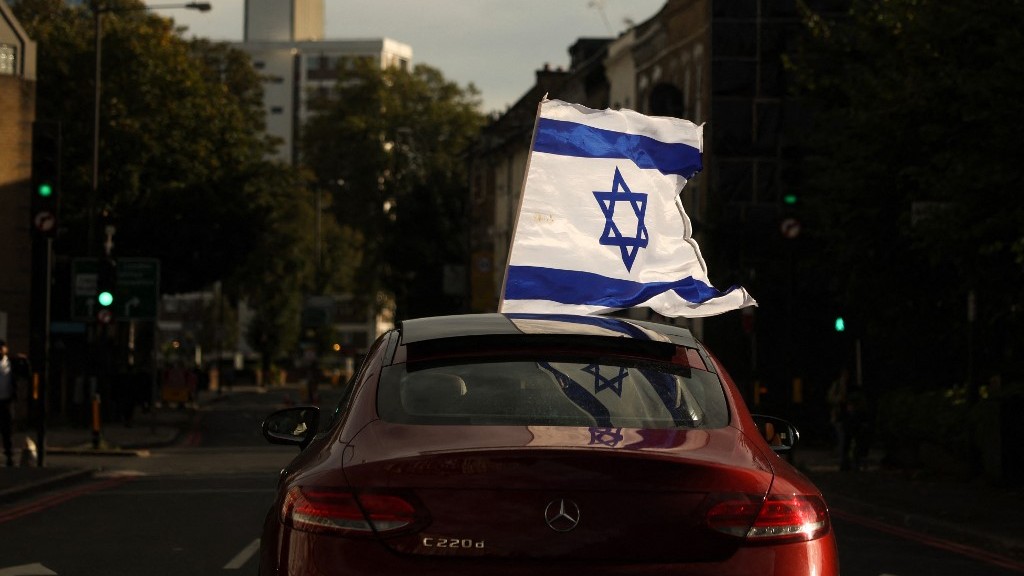
    LONDON – The British capital is bracing for a high-stakes weekend of public assembly, with Metropolitan Police rolling out one of the largest recent domestic security deployments to manage two massive competing demonstrations and a major soccer championship, all occurring within hours of each other on Saturday. Tens of thousands of protesters were expected to converge on central London, while another crowd of tens of thousands of football fans would gather at Wembley Stadium for England’s FA Cup Final between Chelsea and Manchester City, creating unprecedented coordination challenges for law enforcement.

    To prevent violent clashes between opposing groups and maintain public order, authorities have deployed more than 4,000 police officers, supported by a full suite of security resources including armored vehicles, mounted police units, canine teams, surveillance drones, and air support from helicopters. A core priority for police is separating two diametrically opposed protest marches along designated, isolated routes: a rally organized by far-right figure Stephen Yaxley-Lennon, who uses the pseudonym Tommy Robinson, under the “Unite the Kingdom” banner, and an annual demonstration marking Nakba, the 1948 displacement of roughly 700,000 Palestinians from their historic homeland. While main marches are kept apart, law enforcement remains on high alert for unsanctioned contact between smaller splinter groups unaffiliated with either main organizing body.

    In a move to pre-empt potential hate crime, the UK’s Crown Prosecution Service (CPS) has instructed prosecutors to evaluate whether protest materials — including placards, banners, and chants documented on social media — cross the line from protected speech into criminal offense of inciting hatred. CPS Director Stephen Parkinson emphasized that the guidance does not target legitimate free expression. “This is not about restricting free speech,” Parkinson stated. “It is about preventing hate crime and protecting the public, particularly at a time of heightened tensions.”

    The national government has also taken pre-emptive action, barring 11 foreign far-right figures from entering the country to attend the “Unite the Kingdom” rally. High-profile figures already confirmed as excluded include Polish politician Dominik Tarczynski, Belgian politician Filip Dewinter, anti-Islam commentator Valentina Gomez, and Dutch activist Eva Vlaardingerbroek. Prime Minister Keir Starmer made clear the government’s zero-tolerance stance for incitement of violence and disorder. “We will block those coming into the UK who seek to incite hatred and violence,” Starmer said. “For anyone who sets out to wreak havoc on our streets, to intimidate or threaten anyone, you can expect to face the full force of the law.”

    A day ahead of the demonstrations, Starmer visited the Metropolitan Police’s central command center to review security plans alongside Met Commissioner Mark Rowley and London Mayor Sadiq Khan. In a landmark moment for UK protest policing, Saturday’s operation marks the first time live facial recognition technology will be used to monitor a major protest gathering. Security cameras have been installed in the Camden neighborhood of north London, a popular thoroughfare for attendees traveling to the “Unite the Kingdom” rally that falls outside the official march route.

    A short distance away at Wembley Stadium, police are working to ensure the FA Cup Final, one of the biggest events on the UK domestic sports calendar, proceeds without disruption. Kickoff for the match between Chelsea and Manchester City is scheduled for 3 p.m. Saturday, with authorities coordinating crowd management across the capital to keep protest routes, fan travel corridors, and the stadium perimeter separate and secure.

  • Putin to visit Chinese leader Xi Jinping days after Trump’s trip to Beijing

    Putin to visit Chinese leader Xi Jinping days after Trump’s trip to Beijing

    The Kremlin made a key announcement Saturday confirming that Russian President Vladimir Putin will travel to Beijing next week for a two-day official visit, where he will hold high-level talks with Chinese President Xi Jinping. The meeting comes less than 24 hours after U.S. President Donald Trump concluded his own state visit to China, where he discussed trade and the ongoing conflict between the U.S.-Israel coalition and Iran with Xi.

    Per the Kremlin’s official statement, Putin’s trip, scheduled for May 19 and 20, is timed to mark the 25th anniversary of the 2001 Sino-Russian Treaty of Friendship. During the bilateral talks, the two leaders are set to cover the full scope of the two countries’ bilateral relationship, pressing global and regional security challenges, and deepening cross-border economic cooperation.

    Sino-Russian ties have grown substantially closer over the past several years, a shift accelerated after Russia launched its full-scale invasion of Ukraine in early 2022. Western sanctions imposed over the war left Moscow largely isolated across much of the global stage, forcing the country to become far more economically dependent on Beijing for bilateral trade. When Putin last traveled to China for an official visit in September 2025, Xi greeted him as an “old friend”, while Putin referred to Xi as his “dear friend” in return. Following this upcoming May visit, Putin is also scheduled to return to China this coming November to attend the Asia-Pacific Economic Cooperation (APEC) summit scheduled to be held in Shenzhen.

    Beyond the diplomatic developments between Russia, China and the U.S., the active conflict between Russia and Ukraine continued over the weekend, with new violence and prisoner exchanges unfolding across both sides of the front line. Over the course of Saturday, Ukraine confirmed that it had repatriated the remains of 525 fallen Ukrainian soldiers in a separate exchange with Moscow, following a larger prisoner of war swap held one day earlier. Ukraine’s Coordination Headquarters for the Treatment of Prisoners of War announced that Russia transferred the remains, which Russian officials believe belonged to deceased Ukrainian service members. Forensic experts in Ukraine will now conduct full identification processes to name each fallen soldier and return their remains to their families.

    Friday’s exchange saw the two sides swap 205 captured service members each, a move Ukrainian President Volodymyr Zelenskyy framed as the first phase of a larger planned exchange that will see 1,000 prisoners of war returned to each side. Zelenskyy noted that many of the recently released Ukrainian fighters had been in Russian custody since 2022, after participating in some of the war’s bloodiest battles.

    Simultaneously, Russia carried out a large-scale overnight drone attack targeting Ukraine’s southern Odesa region this past Saturday, local Ukrainian authorities confirmed. Regional governor Oleh Kiper reported that the strike hit a five-story apartment building and a smaller single-story residential structure, leaving two people injured, and also caused significant damage to Odesa’s critical port infrastructure. Ukraine’s Air Force released figures noting that Russia launched a total of 294 drones in the overnight assault, with 269 of those successfully shot down by Ukrainian air defenses.

    For its part, Russia’s Ministry of Defense claimed its own air defenses shot down 138 Ukrainian drones overnight across 14 different Russian regions, including the area surrounding the Russian capital Moscow. Russian officials added that drones were also intercepted and destroyed over Crimea, the Ukrainian peninsula illegally annexed by Russia in 2014, as well as over the Black Sea and Azov Sea.

    The Associated Press continues to provide full ongoing coverage of the Russia-Ukraine war, accessible at https://apnews.com/hub/russia-ukraine.

  • Veteran star Son Heung-min will lead South Korea’s World Cup campaign

    Veteran star Son Heung-min will lead South Korea’s World Cup campaign

    South Korea’s 2026 FIFA World Cup campaign will be fronted by veteran talisman Son Heung-min, head coach Hong Myung-bo confirmed Saturday when he announced his final 26-man squad for the expanded 48-team tournament, co-hosted by the United States, Mexico and Canada.

    For 31-year-old Son, this World Cup marks a historic fourth appearance at football’s biggest global stage. The forward ended his decade-long stay in England’s Premier League with Tottenham Hotspur last summer, making the move to Major League Soccer side Los Angeles FC, a change of scenery that has kept him in peak form to lead the Taeguk Warriors once again.

    South Korea’s qualification for 2026 extends an unprecedented run for the East Asian nation: this will be its 11th consecutive World Cup appearance, an unbroken streak dating all the way back to the 1986 tournament in Mexico. Alongside Son, star names including Paris Saint-Germain playmaker Lee Kang-in and Bayern Munich elite defender Kim Min-jae all earned spots in Hong’s final selection. In a show of confidence in his impact, the coach also included Feyenoord influential midfielder Hwang In-beom, despite the star currently managing a nagging ankle injury.

    Speaking to reporters in Seoul, Hong laid out the team’s clear competitive ambitions for the tournament. “Our primary goal is to reach the round of 32,” Hong said. “We do not know what will happen after that. We could go even further than we could have imagined. Our World Cup goal is not the round of 32; our primary goal is the round of 32.”

    South Korea has a history of punching above its weight at recent World Cups. Four years ago in Qatar, the side advanced to the knockout round after a stunning final group stage win over Portugal, before bowing out to five-time tournament champion Brazil. Hong brings unique World Cup pedigree to the role: he captained the iconic 2002 South Korean side that made a historic semi-final run on home soil, and also led the national team at the 2014 World Cup in Brazil, where the side picked up just one point from three group matches.

    All three of South Korea’s Group A matches will be held in Mexican cities, with the side kicking off its campaign on June 11 against the Czech Republic. Seven days later, it will face host nation Mexico, before wrapping up group play against South Africa on June 24. The team heads into the tournament with inconsistent recent form, however, suffering a 4-0 thrashing by Ivory Coast in March followed by a narrow 1-0 loss to Austria. To sharpen up ahead of the opener, South Korea will travel to Salt Lake City on Monday to begin final preparations, with warm-up friendlies scheduled against Trinidad and Tobago and El Salvador before the tournament gets underway.

    The full 26-man South Korea squad is as follows:
    Goalkeepers: Jo Hyeon-woo, Kim Seung-gyu, Song Bum-keun
    Defenders: Kim Min-jae, Cho Yu-min, Lee Han-beom, Kim Tae-hyeon, Park Jin-seob, Lee Gi-hyuk, Lee Tae-seok, Seol Young-woo, Jens Castrop, Kim Moon-hwan
    Midfielders: Yang Hyun-jun, Paik Seung-ho, Hwang In-beom, Kim Jin-gyu, Bae Jun-ho, Eom Ji-sung, Hwang Hee-chan, Lee Dong-gyeong, Lee Jae-sung, Lee Kang-in
    Forwards: Oh Hyeon-gyu, Son Heung-min, Cho Gue-sung

  • Maldives divers search for 4 missing Italians in an underwater cave

    Maldives divers search for 4 missing Italians in an underwater cave

    COLOMBO, Sri Lanka – After rough ocean conditions derailed initial recovery efforts on Friday, divers from the Maldives resumed search operations Saturday for four Italian divers who are presumed dead after being trapped deep in a remote underwater cave off the archipelago’s coast. The tragedy, which unfolded during a deep technical diving expedition on Thursday, has prompted official investigations and new regulatory action, with one victim’s body already recovered.

    Italian Foreign Ministry officials confirmed early Friday that the group was exploring an underwater cave located roughly 50 meters below sea level in the Vaavu Atoll when the accident occurred. Of the five Italian divers who entered the cave, only the body of lead diving instructor Gianluca Benedetti was recovered on Thursday, found just outside the cave’s entrance. Maldivian government spokesperson Mohamed Hussain Shareef confirmed that authorities believe the remaining four divers ventured further into the cave system before conditions turned deadly.

    The victims have been formally identified by the Maldivian government as: Monica Montefalcone, an associate professor of ecology at the University of Genoa; her 24-year-old daughter Giorgia Sommacal; Federico Gualtieri, a practicing marine biologist; Muriel Oddenino, a marine research fellow; and diving instructor Gianluca Benedetti. All members of the 25-person larger expedition, 20 of whom are also Italian nationals staying aboard the expedition vessel *Duke of York*, have been confirmed unharmed. Italy’s embassy in Colombo is currently offering consular support to the uninjured group, and the Maldivian Red Crescent has mobilized volunteer counselors to provide emergency mental health support to the surviving expedition members.

    Cave diving is widely classified as an extreme high-risk activity that demands years of specialized technical training, custom deep-diving equipment, and rigid adherence to safety protocols. At depths over 40 meters, risks of disorientation, decompression sickness, and equipment failure rise exponentially; major recreational scuba certification bodies cap recreational diving at 40 meters, and the Maldives enforces a national recreational depth limit of just 30 meters, meaning the 50-meter dive far exceeded standard safety guidelines. Inside cave systems, disturbed sediment can cut visibility to near zero in seconds, leaving even experienced divers unable to locate exit routes.

    Search teams made incremental progress on Friday, exploring two of the cave system’s three large interconnected chambers before oxygen supply limits and required decompression stops forced teams to suspend operations for the day. Two specialized Italian rescue experts – a deep-sea recovery specialist and a veteran cave diving expert – are en route to the Maldives to join the search effort, according to Shareef. Italian Foreign Minister Antonio Tajani has confirmed that the ministry is coordinating closely with Divers Alert Network, a global non-profit specializing in diving safety and rescue, to support recovery operations and arrange for the repatriation of all victims once recovered. Italian consular officials are also in constant contact with the victims’ next of kin to provide updates and consular assistance.

    In the wake of the accident, the Maldives Ministry of Tourism has announced an immediate suspension of the *Duke of York*’s operating license, which will remain in place throughout the official investigation into the incident. Authorities have not yet released any conclusions on the cause of the accident, which remains under active review.

  • Senior IS leader killed by US and Nigerian forces

    Senior IS leader killed by US and Nigerian forces

    A high-stakes joint counterterrorism operation conducted by Nigerian and U.S. military forces has resulted in the death of one of the Islamic State (IS) group’s most senior global commanders, Abu-Bilal al-Minuki, Nigerian President Bola Tinubu has officially confirmed.

    In an official statement announcing the success of the mission, Tinubu emphasized that the operation marked a major milestone in the two nations’ deepening counterextremism partnership. “Our determined Nigerian Armed Forces, working closely with the Armed Forces of the United States, conducted a daring joint operation that dealt a heavy blow to the ranks of the Islamic State,” the president said.

    The operation was first disclosed by U.S. President Donald Trump, who identified al-Minuki as the second-highest-ranking leader in the global ISIS network. Washington had officially designated al-Minuki as a Specially Designated Global Terrorist back in 2023, recognizing his outsize role in orchestrating violence across the African continent and beyond. Taking to his platform Truth Social, Trump praised the mission as flawlessly executed, calling the eliminated commander “the most active terrorist in the world.”

    According to details released by Nigerian authorities, the precision strike that killed al-Minuki targeted his compound in the volatile Lake Chad Basin, where he was hiding alongside several of his top lieutenants. All of the senior IS figures in the compound were killed in the operation.

    Nigeria’s military confirmed that the successful mission was directly enabled by a recently established strategic counterterrorism partnership and expanded intelligence-sharing framework between Abuja and Washington. Military officials outlined al-Minuki’s rapid rise through the IS ranks: he was most recently promoted to the position of Head of the General Directorate of States, placing him among the core leadership of the global extremist organization.

    Prior to his promotion to the global IS hierarchy, al-Minuki oversaw all IS-affiliated operations across the Sahel region and West Africa. Under his leadership, the group carried out dozens of deadly attacks targeting civilian populations, vulnerable minority communities, and local security infrastructure.

    Nigerian military investigators have also linked al-Minuki to one of the most high-profile extremist kidnaps in the country’s recent history: the 2018 abduction of more than 100 schoolgirls from a boarding school in Dapchi, northeastern Nigeria, which was carried out by Boko Haram, the extremist faction that al-Minuki once served as a senior commander before pledging allegiance to IS in 2015. Earlier in his militant career, military spokesperson Samali Uba confirmed al-Minuki facilitated the movement of extremist fighters to Libya to support IS operations across North Africa.

    Trump framed al-Minuki’s death as a devastating blow to both IS’s African networks and its global operational infrastructure, noting that the strike has disrupted key terrorist funding channels and fractured the group’s command structure. The U.S. president extended his gratitude to Nigeria’s government for its close collaboration, adding that al-Minuki “will no longer terrorize the people of Africa or help plan operations to target Americans.”

    The successful operation comes as part of a growing trend of deepened military cooperation between Nigeria and the United States, as Nigeria escalates its years-long campaign to root out extremist violence across the country’s northern and northeastern regions. Just weeks prior to this strike, in April, IS claimed responsibility for a mass shooting at a football pitch in northeastern Nigeria’s Adamawa State that left at least 29 people dead. Late last year, during the Christmas holiday period, the two countries carried out another joint airstrike targeting IS-affiliated groups in Sokoto State, demonstrating the consistent momentum of their counterterrorism partnership.

  • Putin to visit China May 19-20, days after Trump trip

    Putin to visit China May 19-20, days after Trump trip

    In a move that underscores the steady deepening of Moscow-Beijing ties, the Kremlin announced Saturday that Russian President Vladimir Putin will embark on a two-day official visit to China starting May 19, arriving just days after U.S. President Donald Trump concluded his groundbreaking trip to Beijing — the first visit to China by a sitting U.S. president in almost a decade.

    According to an official statement from the Kremlin, the core agenda of Putin’s visit will center on advancing the comprehensive partnership and strategic cooperation between Russia and China. During high-level talks with Chinese President Xi Jinping, the two leaders will exchange detailed perspectives on pressing international and regional issues of shared concern, with a joint declaration set to be signed at the conclusion of their discussions. Putin is also scheduled to hold a separate meeting with Chinese Premier Li Qiang, where the pair will focus on expanding bilateral economic and trade cooperation, a cornerstone of the increasingly robust relationship between the two nations.

    The timing of Putin’s visit announcement comes immediately on the heels of Trump’s Friday departure from China, a trip marked by ceremonial grandeur that masked the persistence of unresolved trade disputes and geopolitical rifts, chief among them the lingering conflict between Russia and Ukraine. During his talks with Xi, Trump raised the ongoing Ukraine conflict, which has stretched into its fifth year, as well as the stalled U.S. standoff with Iran that began when hostilities broke out between the U.S.-Israeli bloc and Iran on February 28. However, Trump departed China without securing any visible breakthrough on either issue, despite Ukrainian President Volodymyr Zelensky’s pre-summit request that Trump push for progress on ending the conflict during his discussions with Beijing.

    Moscow has repeatedly made clear that it will not accept a ceasefire or enter into full negotiations with Kyiv unless Ukraine concedes to the Kremlin’s sweeping territorial and political demands. For its part, China has maintained a formal position of neutrality: it has consistently called for diplomatic negotiations to end the fighting, but has never condemned Russia’s 2022 full-scale incursion into Ukraine, and denies Western accusations that it supplies weapons or military components to Russia’s defense industry. Beijing has instead pinned blame for the conflict, the deadliest conflict in Europe since World War II, on Western nations, arguing that their ongoing arms shipments to Kyiv have prolonged the violence.

    As the world’s largest importer of Russian fossil fuels, China has emerged as Russia’s most critical economic partner, a role that has expanded dramatically since Western powers imposed sweeping sanctions on Russian oil and gas exports following the 2022 invasion. That close alignment has been repeatedly emphasized by top Russian officials, including Foreign Minister Sergey Lavrov, who spoke on the sidelines of an event in New Delhi just one day after the China-U.S. summit.

    Lavrov welcomed the outcome of the China-U.S. talks, noting that “if the agreements reached or to be reached by Beijing and Washington are in the interests of our Chinese friends, we can only be delighted.” But he was quick to underscore the unique strength of Moscow’s relationship with Beijing, emphasizing that Russia and China are “bound to China by ties… that are deeper and stronger than traditional political and military alliances.”

    The contrast between the outcomes of Trump’s Beijing visit and the upcoming Putin trip is already drawing attention from global observers. Following his departure, Trump claimed he had secured “fantastic” new trade deals with China, including a purported commitment from Beijing to purchase 200 Boeing aircraft along with increased volumes of U.S. crude oil and soybeans. But the details of these agreements remain sparse and vague, and Chinese officials have not released any formal public confirmation of the trade deals. Beijing’s overall response to the Trump-Xi summit was also far more muted than Trump’s own glowing descriptions of his interactions with Xi, whom Trump called a “great leader” and “friend.”

  • ‘My China Album’ interviewees anticipate new stories

    ‘My China Album’ interviewees anticipate new stories

    Against the backdrop of a landmark US presidential state visit to China, long-time advocates of people-to-people exchange between the two nations are sharing their hopeful outlooks on bilateral ties, their perspectives featured in a newly released collaborative book project between two leading Chinese publishing and media institutions.

    The collection, titled *My China Album*, published by Tsinghua University Press in partnership with China Daily, compiles firsthand stories from individuals who have dedicated years to building mutual understanding and cross-cultural friendship between the United States and China. As former US President Donald Trump concluded his official state visit to Beijing on a Friday, these contributors collectively expressed measured optimism about the future of the world’s most consequential bilateral relationship.

    Charles Foster, vice-chairman of the George H. W. Bush Foundation for US-China Relations, framed the visit as an unequivocally positive milestone for bilateral engagement. Echoing the long-held belief of the late former US president George H.W. Bush that China has been and will remain the United States’ most important bilateral partnership, Foster noted that while public messaging from Washington has often been inconsistent in recent years, direct, high-level dialogue between the two countries’ top leaders delivers far more value than empty rhetorical posturing.

    Foster emphasized that the visit signals a clear willingness from the US side to build a more productive, mature dynamic with China, one that opens space for ongoing honest, solution-focused dialogue on the core issues that matter to both nations. He also pointed to the unusually large, cross-sector delegation accompanying Trump, which included senior administration officials and leaders from major American corporations, as a particularly meaningful detail. After experiencing China firsthand, Foster said, these delegates will return to the US with a far deeper understanding of the sweeping transformation that has reshaped China since Richard Nixon’s groundbreaking 1972 visit. Echoing the old adage that a first-hand impression is worth more than thousands of secondhand accounts, he added that on-the-ground experiences create lasting mutual understanding that lays the groundwork for more durable, stable US-China relations.

    For Benjamin Renton, a research associate at Brown University’s School of Public Health, the Beijing summit could not have come at a more critical moment, and it has left him more hopeful than ever for the future of bilateral ties. “For those of us who care deeply about the US-China relationship, seeing the two leaders sit down together for substantive talks is incredibly encouraging,” Renton said. “It sends a strong positive signal for people-to-people exchange between our two societies.” He added that he hopes the summit will keep bilateral engagement moving in a constructive direction, noting that ordinary Chinese and American people share far more common ground than often is highlighted: both value hard work, prioritize family, and aspire to build better lives for future generations. It was encouraging, he said, that the summit’s leadership-level discussions acknowledged these shared priorities. Renton also called for the summit to translate into concrete expanded support for student exchange and study abroad opportunities, pointing out that current participation rates remain low, and increasing opportunities for young Americans to study and live in China would have a transformative impact on bilateral understanding.

    Kayla Raden, a high school biology educator from New Jersey and a self-described Chinese language enthusiast, said she feels optimistic that the two countries are working together to find collaborative solutions to shared global challenges. “It is absolutely essential that our two nations reach common ground and build frameworks to sustain positive relations long-term,” Raden said. “Our futures are deeply intertwined: our shared economic prosperity depends on cooperation between us.” Raden, who said she feels a personal connection to China every time she studies the Chinese language, argued that expanding cultural and linguistic exchange would go a long way toward defusing unnecessary tensions between the two countries. “If more Americans learned Chinese, many of the misunderstandings that currently feel insurmountable would become far easier to resolve,” she said. “Language and cultural exchange build the strong foundation of mutual understanding that strong bilateral relations need.”

    Jeffrey Greene, chairman of the Sino-American Aviation Heritage Foundation, said he was pleased to see the leadership summit go forward, noting that the meetings between the two heads of state were marked by clear sincerity and mutual interest in dialogue — two qualities that are indispensable for productive relations. As the world’s two largest economies, Greene noted, cooperation between the US and China is non-negotiable for global prosperity and stability, and the Beijing summit marked a welcome, positive step forward in that direction.

    Ren Ming, a professor at multiple California-based art institutions and a pioneering figure in US-China arts exchange, said he followed the summit closely and was encouraged by the clear, genuine willingness on both sides to deepen engagement. Ren echoed the widespread call for expanded people-to-people exchange, noting that these grassroots connections make a lasting contribution to global peace, the advancement of human civilization, and the building of a more harmonious shared future.

    Emmy Award-winning documentary producer Bill Einreinhofer added that people-to-people diplomacy is more critical today than it has ever been. “It is important that the two countries have more to talk about than just their differences,” Einreinhofer said. “We also need to intentionally explore the many things we share in common. That kind of connection often happens away from the spotlight of sensational media coverage — it happens one person at a time, through direct personal engagement.”

    The *My China Album* project, first launched in 2019 by the Chinese embassy and consulates across the United States in collaboration with China Daily, is now in its seventh year of operation. The initiative centers on documenting the personal journeys of Americans who have lived, worked, and built connections in China, with a core focus on highlighting the power of grassroots ties to bridge cultural and political divides.