作者: admin

  • First-time Taiwan applicants for mainland travel permits surge over 57%

    First-time Taiwan applicants for mainland travel permits surge over 57%

    In a significant development for cross-strait relations, Taiwan residents are applying for mainland travel permits at unprecedented rates following the implementation of a fee exemption policy. Official data from China’s National Immigration Administration reveals a remarkable 57.2% year-on-year increase in first-time applicants from Taiwan since the policy took effect on July 1, 2025.

    The comprehensive statistics demonstrate a substantial growth in cross-strait mobility. Overall permit applications from Taiwan residents increased by 11.9% during the same period, while first-time entries to the mainland surged by 40.9% in the latter half of 2025. The total number of Taiwan residents entering mainland China climbed by 24.4% year-on-year, indicating strengthened people-to-people exchanges across the strait.

    Administration spokesperson Lyu Ning emphasized the policy enhancements that have accompanied the fee waiver. “Immigration authorities have implemented refined systems to ensure equal treatment for Taiwan compatriots,” stated Lyu. These measures include issuing temporary travel documents for emergency situations involving lost or damaged permits, and establishing verification services that link travel permits with residence permits.

    The administration has maintained free real-time identity verification services to facilitate first-time visitors’ access to transportation, financial, and telecommunications services on the mainland. Looking forward, authorities plan to introduce additional innovative policies specifically targeting first-time applicants and younger demographics to further streamline cross-strait travel procedures.

    Infrastructure expansion has also played a crucial role in this increased connectivity. In 2025, the administration significantly expanded processing capabilities by adding 42 ports authorized to issue single-entry travel permits, bringing the total to 100 facilities across the mainland. Additionally, nationwide processing was implemented for mainland residents applying for exit and entry permits to visit relatives in Taiwan, creating more balanced travel opportunities across the strait.


  • Google unveils AI tool probing mysteries of human genome

    Google unveils AI tool probing mysteries of human genome

    Google DeepMind has launched AlphaGenome, a groundbreaking artificial intelligence system designed to interpret the complex regulatory language of the human genome. This deep learning model represents a significant advancement in genomic research, potentially accelerating the discovery of treatments for genetic disorders.

    According to Pushmeet Kohli, Vice President of Research at Google DeepMind, while the 2003 mapping of the human genome provided ‘the book of life,’ interpreting its contents remained profoundly challenging. ‘We have the text—a sequence of three billion nucleotide pairs—but understanding the grammar of this genome represents the next critical frontier,’ Kohli explained during the announcement.

    The technology specifically targets non-coding DNA, which constitutes approximately 98% of the human genome. Once dismissed as ‘junk DNA,’ this genetic material is now understood to function as a regulatory conductor, directing how genetic information operates within cellular structures. These sequences contain numerous variants associated with diseases that have previously eluded comprehensive analysis.

    AlphaGenome distinguishes itself through its ability to process exceptionally long DNA sequences—up to one million nucleotides—while maintaining high resolution predictions. The model analyzes how each nucleotide pair influences biological processes, including gene activation and RNA production. This capability allows researchers to compare mutated and non-mutated sequences, providing unprecedented insight into genetic disease mechanisms.

    Trained on public datasets measuring non-coding DNA across hundreds of human and mouse cell types, AlphaGenome builds upon Google’s established scientific AI work, which includes the Nobel Prize-winning AlphaFold protein structure prediction system. The tool is already being utilized by 3,000 researchers across 160 countries and remains openly accessible for non-commercial scientific investigation.

    Independent researchers have acknowledged the model’s transformative potential while noting limitations. Ben Lehner of Cambridge University confirmed the system ‘performs very well’ but emphasized that AI models remain constrained by training data quality. Robert Goldstone of the Francis Crick Institute noted that while environmental factors influencing gene expression fall outside the model’s scope, AlphaGenome nevertheless represents a ‘breakthrough’ for simulating genetic disease foundations.

  • Senior Biden aide demands ‘thank you’ for US role in Israel’s Gaza genocide

    Senior Biden aide demands ‘thank you’ for US role in Israel’s Gaza genocide

    A sharp diplomatic rift has emerged between the Biden administration and Israeli leadership as senior US official Amos Hochstein publicly condemned Prime Minister Benjamin Netanyahu for what he termed as “untruthful and ungrateful” statements regarding American military support.

    The controversy erupted following Netanyahu’s assertion that Israeli military casualties in Gaza resulted from perceived US arms restrictions. Hochstein, a specially appointed envoy with deep ties to Israel having been born there and served in the Israeli military, delivered a stinging rebuke minutes after Netanyahu’s press conference remarks.

    Hochstein’s background lends particular weight to his criticism. After his military service in the 1990s as a tank crewman, he transitioned into business and energy sectors before becoming a key diplomatic intermediary between Israeli leadership and multiple US administrations.

    The US envoy detailed the substantial military assistance provided to Israel, citing over $20 billion in support—the largest in Israel’s history—along with the deployment of two aircraft carriers to the region. Hochstein emphasized that President Biden’s administration had “saved Israel at its most vulnerable moment,” making Netanyahu’s claims particularly jarring.

    This criticism was echoed by another senior Biden official, Brett McGurk, who categorically denied Netanyahu’s account of arms restrictions. McGurk highlighted the administration’s achievements including securing a Gaza ceasefire, facilitating hostage returns, neutralizing Hezbollah threats in Lebanon, and countering Iranian aggression through coordinated military operations.

    The White House has consistently denied implementing any comprehensive arms embargo, acknowledging only a single paused shipment of high-payload bombs due to concerns about their use in densely populated urban areas. Netanyahu revived these claims while attempting to explain his previous comments to The Economist regarding Israeli military tactics in Gaza.

    This public airing of grievances reveals underlying tensions in the US-Israel relationship despite substantial American military and diplomatic support throughout recent conflicts.

  • Australian Open: ‘Extremely lucky’ Djokovic into semifinals as Musetti retires

    Australian Open: ‘Extremely lucky’ Djokovic into semifinals as Musetti retires

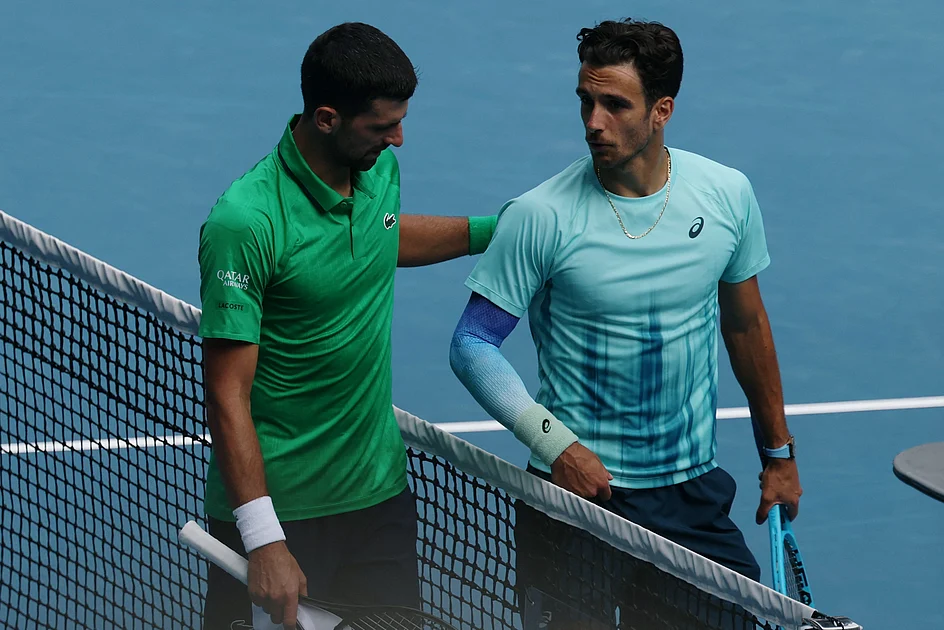
    In a dramatic turn of events at the Australian Open, Novak Djokovic secured an unexpected passage to the semifinals following opponent Lorenzo Musetti’s mid-match retirement due to injury. The Serbian tennis legend found himself trailing significantly, having dropped the initial two sets 6-4, 6-3, before the Italian fifth seed was compelled to withdraw during the third set.

    The match witnessed a stark contrast in performance, with Djokovic uncharacteristically accumulating 32 unforced errors throughout the contest. Musetti demonstrated superior court coverage and shot selection, consistently pressuring the defending champion with precise groundstrokes and tactical brilliance. The Italian established dominance early, breaking Djokovic’s serve multiple times while maintaining his own service games with composure.

    However, the momentum shifted abruptly when Musetti required medical attention for an upper right leg injury while trailing 1-2 in the third set. Despite attempting to continue, his mobility became severely compromised, ultimately forcing his retirement at 1-3 down in the set.

    Djokovic, who described himself as ‘extremely lucky’ during post-match comments, acknowledged Musetti’s superior performance: ‘I feel really sorry for him—he was the far better player today. I was on my way home tonight. He should have been the winner, no doubt.’

    The victory carries historical significance, marking Djokovic’s 103rd singles win at Melbourne Park, surpassing Roger Federer’s previous record. It also represents his 54th Grand Slam semifinal appearance, extending his own existing record. The Serbian now awaits the winner between defending champion Jannik Sinner and American eighth seed Ben Shelton as he continues his pursuit of a record-breaking 25th Grand Slam title.

  • German investigators search Deutsche Bank offices in money laundering probe

    German investigators search Deutsche Bank offices in money laundering probe

    FRANKFURT, Germany — German authorities executed coordinated searches at Deutsche Bank offices on Wednesday as part of an extensive money laundering investigation targeting Germany’s largest financial institution. The operation, conducted by Frankfurt prosecutors, focused on unidentified bank employees and previous business relationships with foreign entities suspected of facilitating illicit financial activities.

    The law enforcement action spanned multiple locations, including the bank’s Frankfurt headquarters and additional premises in Berlin. Prosecutors indicated the investigation centers on transactions potentially designed to conceal the origin of funds through the banking system, though specific details regarding the scale and nature of these transactions remain undisclosed.

    Deutsche Bank confirmed the presence of investigators in an official statement, emphasizing their full cooperation with authorities while declining further commentary on the ongoing probe. The timing of the raid proves particularly significant, occurring just one day before the bank’s scheduled release of its 2025 earnings report.

    This investigation continues a pattern of regulatory challenges for Deutsche Bank, which has faced substantial penalties in recent years. In 2018, New York regulators imposed a $205 million fine for foreign exchange market manipulation. The previous year saw dual penalties: $41 million from the Federal Reserve for anti-money laundering control failures, and a massive $629 million settlement with New York and British regulators for control lapses that enabled wealthy Russian clients to launder approximately $10 billion through the institution.

  • France’s finance minister demands tech firm Capgemini explain ICE contract

    France’s finance minister demands tech firm Capgemini explain ICE contract

    PARIS — French Finance Minister Roland Lescure has issued a strong appeal to technology giant Capgemini, demanding complete transparency regarding its subsidiary’s contract with U.S. Immigration and Customs Enforcement (ICE). This development occurs amid escalating concerns about the agency’s enforcement of the Trump administration’s stringent immigration policies.

    The multinational corporation, which maintains a workforce exceeding 340,000 across more than 50 countries, entered into an agreement with ICE in December through its U.S.-based subsidiary Capgemini Government Solutions (CGS). Minister Lescure addressed French legislators Tuesday evening, emphasizing that Capgemini must provide comprehensive clarification about its activities and reconsider the ethical implications of this engagement.

    This governmental pressure follows revelations that Capgemini’s CEO Aiman Ezzat only recently became aware of the contract. In a LinkedIn statement, Ezzat acknowledged that the nature of this work has raised significant questions compared to the company’s typical business operations. He revealed that CGS operates under a specialized governance structure that permits handling classified U.S. government work, with strict separation from Capgemini Group operations.

    According to Ezzat, CGS maintains completely independent decision-making processes, firewalled networks, and a board controlled by U.S. directors with security clearances. This structure, mandated by U.S. regulations, prevents the parent company from accessing any classified information or contracts.

    Minister Lescure remained unconvinced by these explanations, asserting that corporate ownership inherently requires knowledge of subsidiary activities. The controversy emerges against the backdrop of intensified immigration enforcement operations in Minneapolis, where recent ICE actions resulted in the fatal shooting of two U.S. citizens, amplifying scrutiny of the agency’s methods.

  • Now, UAE residents can pay insurance premiums, file claims in cryptocurrencies

    Now, UAE residents can pay insurance premiums, file claims in cryptocurrencies

    The United Arab Emirates insurance industry has entered a transformative phase with the introduction of cryptocurrency payment solutions, marking a significant milestone in financial innovation. Dubai Insurance has pioneered this movement by launching the nation’s first digital wallet for crypto assets within the insurance sector, enabling residents to conduct insurance transactions using digital currencies.

    Abdellatif Abuqurah, Chief Executive Officer of Dubai Insurance, characterized the development as “a defining moment” for both the company and the broader insurance landscape across the UAE and Middle Eastern region. “By becoming the first insurance company to enable the receipt of premiums and payment of claims in digital assets through a secure digital wallet, we are redefining how insurance services are delivered while remaining aligned with regulatory and governance frameworks,” Abuqurah stated.

    This groundbreaking initiative follows the UAE banking sector’s earlier adoption of cryptocurrency solutions, which already offers digital currency buying and selling services. Notably, RAKBank and Zand have obtained formal approvals from the Central Bank of the UAE for dirham-backed stablecoins, signaling robust regulatory support for digital asset integration.

    The momentum for cryptocurrency adoption in the UAE continues to accelerate at an exceptional pace. According to the World Crypto Rankings 2025 report by Bybit and DL Research, the Emirates leads the Middle East and North Africa region in cryptocurrency adoption and ranks fifth globally. The report further notes that the UAE is establishing itself as “the de facto bridge between Asia, Europe, and Africa in tokenised finance.”

    In February 2025, Liva Group and Relm Insurance collaborated to launch specialized insurance products for companies operating in emerging sectors including digital assets, blockchain, artificial intelligence, biotechnology, and the space economy.

    Dubai Insurance has strategically partnered with Zodia Custody to ensure secure infrastructure for digital asset transactions. Zane Suren, Managing Director for Commercial Operations in the Middle East and Africa at Zodia Custody, emphasized that “as digital asset adoption accelerates, insurers need trusted infrastructure that allows policyholders to transact confidently with digital assets.”

    Abuqurah further elaborated on the significance of this development, noting that “digital assets have become part of everyday financial life in the UAE. We believe insurers have a clear role to play providing security, strong governance, and confidence in a changing landscape.” This move represents the latest in a series of digital financial innovations in the UAE, including recent initiatives allowing employees to receive salaries through digital wallets.

  • Is the US preparing to strike Iran?

    Is the US preparing to strike Iran?

    A substantial and methodical military buildup is underway in the Middle East as U.S. forces position themselves for potential action against Iran. This strategic mobilization follows President Donald Trump’s recent social media ultimatum warning Tehran that unless it agrees to limit its nuclear program, the next American attack would be “far worse” than previous operations.

    The Pentagon has significantly enhanced its regional presence with additional aircraft, defense systems, and naval assets. Open-source intelligence reports confirm the arrival of F-15 fighter jets, refuelling tankers, and specialized surveillance aircraft including RC-135s and E-3G Sentry planes—similar to those deployed in last June’s Operation ‘Midnight Hammer’ that successfully targeted Iranian nuclear facilities with precision bunker-buster bombs.

    Most notably, the USS Abraham Lincoln carrier strike group has been redirected from the Indo-Pacific to the Gulf region. This formidable naval force includes advanced F-35 stealth jets, three destroyers armed with Tomahawk cruise missiles, and typically accompanies a nuclear-powered submarine. The deployment complements the approximately 50,000 U.S. military personnel already stationed across bases in Qatar, Jordan, Saudi Arabia, and other Gulf allies.

    Military analysts suggest this posture indicates serious preparation for potential strikes. Matthew Savill, Director of Military Sciences at RUSI and former UK government Iran policy official, notes that current U.S. capabilities would allow strikes “almost anywhere in Iran” against all but the most deeply buried facilities. Possible targets include Iran’s ballistic missile infrastructure, coastal defense systems, or even leadership figures within the Revolutionary Guard Corps.

    While the Trump administration maintains that diplomatic solutions remain possible, the president’s message emphasizes that time is “running out” for Iran to negotiate. The military movements suggest readiness for what Trump characterized as a mission capable of being fulfilled “with speed and violence, if necessary.”

  • Japan’s last two giant pandas return to China

    Japan’s last two giant pandas return to China

    Japan’s five-decade chapter of hosting giant pandas officially closed on Wednesday, January 28, 2026, as the nation’s last two specimens embarked on their journey back to their ancestral homeland. The departure of Xiao Xiao and Lei Lei from Tokyo’s Ueno Zoo marks a significant milestone in Sino-Japanese panda diplomacy that began in 1972.

    The young pandas, both born in 2021 to parents Shin Shin and Ri Ri (who returned to China in September 2024), arrived at Chengdu Shuangliu International Airport in Sichuan province at approximately 1:00 AM local time. Following arrival procedures, the animals were transported to the specialized Ya’an base of China Conservation and Research Center for the Giant Panda, where they will undergo standard quarantine protocols before integration into the conservation program.

    This repatriation represents the culmination of Japan’s panda conservation partnership with China, which has seen multiple generations of the endangered species hosted in Japanese zoos. The program has served both conservation purposes and as a symbol of diplomatic relations between the two nations. Chinese wildlife officials confirmed the animals’ condition as stable following the transport, with specialized caretakers accompanying the pandas throughout their journey.

    The return follows established protocols under China’s panda conservation loans, where overseas-born pandas typically return to participate in breeding programs that maintain genetic diversity. Wildlife experts emphasize that such controlled exchanges remain crucial for the species’ long-term survival, despite the emotional significance attached to individual animals by host countries.

  • Ajit Pawar dies in plane crash: 9 other Indian leaders who lost their lives in aviation tragedies

    Ajit Pawar dies in plane crash: 9 other Indian leaders who lost their lives in aviation tragedies

    A devastating aviation accident has claimed the life of Maharashtra’s Deputy Chief Minister Ajit Pawar, sending shockwaves through India’s political establishment. The Learjet 45 aircraft carrying Pawar and five other individuals crashed during its landing approach near Baramati in Pune district in the early hours of January 28, resulting in no survivors.

    This tragic incident represents the latest in a concerning pattern of aviation fatalities involving India’s prominent political figures. The historical record reveals numerous high-profile casualties spanning decades of air travel mishaps.

    In 2025, former Gujarat Chief Minister Vijay Rupani perished aboard Air India flight AI-171, which crashed shortly after takeoff from Ahmedabad claiming 241 lives in one of India’s deadliest aviation disasters. The year 2021 witnessed the loss of India’s inaugural Chief of Defence Staff, General Bipin Rawat, alongside his wife and twelve others in a Mi-17V5 helicopter crash attributed to adverse weather conditions.

    Earlier tragedies include the 2011 disappearance and subsequent fatal crash of Arunachal Pradesh Chief Minister Dorjee Khandu’s helicopter near the China border, and the 2009 accident that killed Andhra Pradesh Chief Minister YS Rajasekhara Reddy during inclement weather. Additional casualties encompass Haryana Power Minister OP Jindal and Agriculture Minister Surender Singh (2005), Lok Sabha Speaker GMC Balayogi (2002), Congress leader Madhavrao Scindia (2001), and Sanjay Gandhi, son of former Prime Minister Indira Gandhi (1980).

    The historical record even extends to the controversial 1945 plane crash that allegedly claimed the life of independence leader Subhas Chandra Bose, though this incident remains shrouded in mystery and ongoing speculation.

    These repeated tragedies highlight persistent concerns regarding aviation safety protocols, weather-related risk assessment, and maintenance standards for aircraft transporting public officials across India’s diverse and challenging terrain.