作者: admin

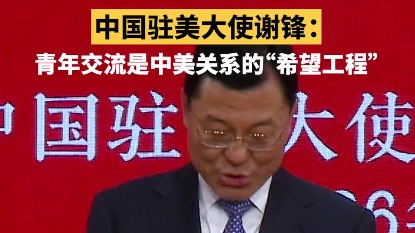
  • Chinese Ambassador Xie Feng: Youth exchanges are a project of hope in China-US relations

    Chinese Ambassador Xie Feng: Youth exchanges are a project of hope in China-US relations

    Chinese Ambassador to the United States Xie Feng has emphatically characterized youth exchanges between the two nations as a vital “project of hope” for bilateral relations. The declaration came during the 2026 China-US Youth Spring Festival Gala, an event hosted by the Chinese Embassy in Washington on January 31st.

    Ambassador Xie’s address highlighted the critical role that the younger generation plays in bridging cultural and diplomatic divides. He articulated that fostering mutual understanding and friendship among youth represents a fundamental investment in the future trajectory of Sino-American relations. The gala itself served as a platform for cultural performance and dialogue, embodying this commitment to people-to-people exchange.

    This emphasis on youth engagement occurs within the broader context of ongoing efforts to stabilize and improve relations between the two global powers. The initiative aligns with previous agreements between Chinese and American leadership to enhance societal and educational exchanges, moving beyond governmental dialogue to build a more resilient foundation for the relationship.

    The embassy’s event signals a continued prioritization of soft diplomacy and cultural outreach as essential tools for managing complex international partnerships. By focusing on the next generation of leaders, artists, and entrepreneurs, this approach seeks to cultivate long-term goodwill and counteract prevailing geopolitical tensions through sustained interpersonal connections.
  • Chinese Ambassador Xie Feng: Youth exchanges can instill vitality

    Chinese Ambassador Xie Feng: Youth exchanges can instill vitality

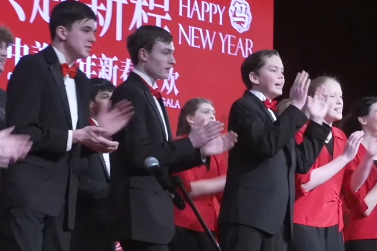
    Chinese Ambassador to the United States Xie Feng has emphasized the critical role of youth engagement in fostering bilateral relations between the two nations. Speaking at the 2026 China-US Youth Spring Festival Gala hosted by the Chinese Embassy in Washington on January 31st, Ambassador Xie articulated that cross-cultural exchanges among young people serve as a fundamental catalyst for mutual understanding and diplomatic vitality.

    The ambassador’s address highlighted how educational and cultural interactions between American and Chinese students create lasting foundations for international cooperation. Xie Feng noted that such exchanges allow emerging leaders from both countries to develop firsthand appreciation for each other’s cultures, values, and perspectives beyond governmental dialogues.

    This event, organized as part of Lunar New Year celebrations, brought together hundreds of students, educators, and cultural representatives from both nations. The gala featured traditional performances, cultural exhibitions, and networking opportunities designed to facilitate meaningful connections between participants.

    Ambassador Xie’s remarks come at a time of complex diplomatic relations between Washington and Beijing, positioning youth diplomacy as an essential channel for maintaining open communication. The Chinese Embassy has increasingly prioritized such cultural initiatives as part of its broader efforts to sustain people-to-people connections regardless of political climate fluctuations.

    The 2026 gathering represents a continuation of pre-pandemic exchange traditions that had been temporarily suspended, signaling a renewed commitment to educational diplomacy. Both governments have acknowledged the importance of such programs in developing future leaders who can navigate the complexities of Sino-American relations with cultural competence and mutual respect.

  • Tariffs cut as US, India ink deal

    Tariffs cut as US, India ink deal

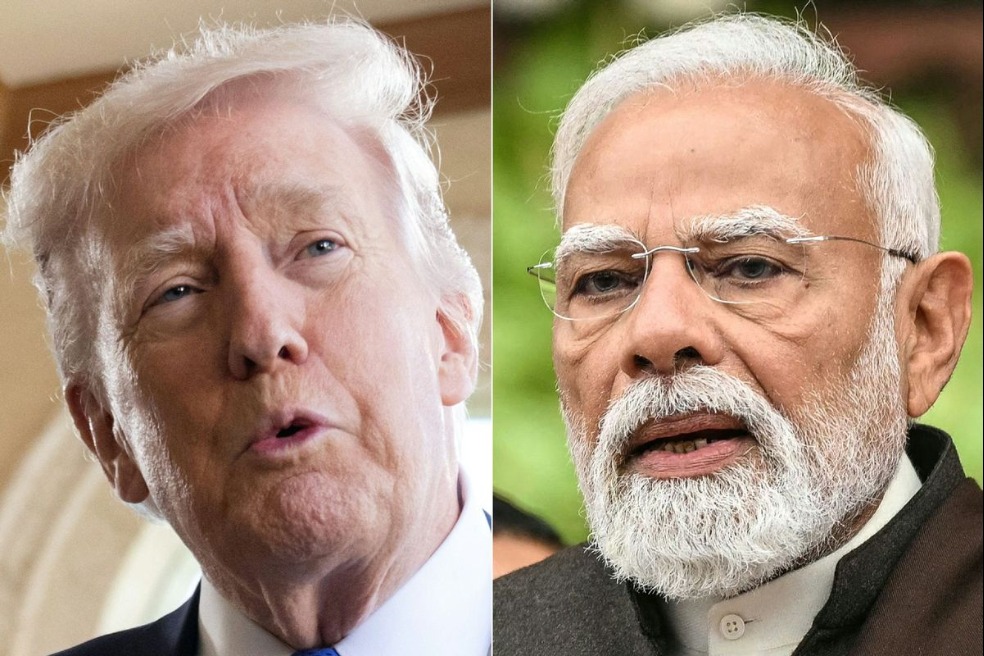
    In a significant diplomatic breakthrough, the United States and India have concluded a comprehensive trade agreement that dramatically reduces tariffs on Indian exports while compelling New Delhi to reconsider its energy procurement strategy. The pact, announced jointly by US President Donald Trump and Indian Prime Minister Narendra Modi on February 3, 2026, slashes existing tariffs from 50% to 18% on Indian goods.

    The agreement represents a strategic recalibration of economic relations between the world’s largest and fifth-largest economies. In return for tariff relief, India has committed to halt purchases of Russian crude oil and substantially lower trade barriers for American products. The arrangement includes India’s commitment to eliminate import taxes on US goods entirely and purchase approximately $500 billion worth of American merchandise.

    This development follows months of escalating trade tensions that began in June when Washington imposed an initial 25% tariff on Indian goods, subsequently doubling the rate in August due to India’s continued acquisition of Russian energy resources. The current agreement effectively reverses these punitive measures while establishing new parameters for bilateral trade.

    Energy analysts immediately raised concerns about the feasibility of India’s commitment to abandon Russian oil imports, which currently constitute over one-third of the nation’s daily consumption at approximately 1.5 million barrels. Rob Haworth, Senior Investment Strategy Director at US Bank Asset Management, emphasized that “fully replacing Russian oil with alternatives from Venezuela or the United States will require substantial infrastructure investment and time.”

    Academic experts offered mixed perspectives on the agreement’s implications. Professor Pushan Dutt of INSEAD Asia Campus described the deal as a “welcome development” that could restore economic and geopolitical alignment between the two nations. However, Professor Dibyendu Maiti of Delhi School of Economics noted that the agreement followed significant American pressure regarding agricultural and dairy product restrictions.

    Qian Feng, Director of Research at Tsinghua University’s National Strategy Institute, highlighted both opportunities and challenges for India. While Indian exports including electronics, pharmaceuticals, apparel, and chemicals may regain competitiveness in US markets, the energy policy shift could increase import costs by billions annually, potentially fueling inflation and complicating existing agreements with Russian energy providers.

    The agreement contains enforcement mechanisms, with an anonymous US Trade Representative official warning that tariffs could be reinstated if India resumes Russian oil purchases. This condition underscores the agreement’s function as both economic arrangement and geopolitical instrument, potentially positioning India as a counterbalance to Russian influence.

    Despite the celebratory announcements from both leaders, experts caution that substantial differences remain unresolved, characterizing the agreement as a provisional truce rather than comprehensive reconciliation. The ultimate implementation and long-term sustainability of this trade détente remain subject to complex economic and geopolitical considerations.

  • NASA hit by fuel leaks during test countdown

    NASA hit by fuel leaks during test countdown

    NASA’s ambitious lunar program encountered significant technical challenges during a crucial pre-launch test of its Space Launch System (SLS) rocket on Monday, raising concerns about the timeline for the upcoming crewed mission around the moon. The incident occurred at Kennedy Space Center in Florida during a daylong fueling operation designed to simulate final countdown procedures.

    The problematic hydrogen leaks emerged just hours into the complex fueling process, where launch controllers were loading the 98-meter rocket with more than 2.6 million liters of super-chilled hydrogen and oxygen. Excessive hydrogen accumulation near the rocket’s base forced multiple suspensions of the hydrogen loading operation as engineers implemented contingency measures developed during previous SLS testing in 2022.

    The four astronauts assigned to the mission—three Americans and one Canadian—monitored the critical rehearsal from Johnson Space Center in Houston, approximately 1,600 kilometers away. The crew has been in quarantine for over a week awaiting the outcome of this essential practice countdown, which will determine when they can embark on humanity’s first lunar voyage in more than fifty years.

    NASA now faces a compressed launch window, with the earliest possible launch date pushed to Sunday and a hard deadline of February 11 before the mission must be postponed until March. The agency’s scheduling constraints are further complicated by seasonal cold conditions that have already reduced February’s launch window by two days.

    The planned mission involves a nearly 10-day journey that will take astronauts past the moon, around its far side, and directly back to Earth—testing the Orion capsule’s life support systems without entering lunar orbit or attempting a landing. This testing milestone represents a critical step toward NASA’s Artemis program goals of establishing sustainable lunar exploration.

  • Chinese railways handle 12.24m trips on 1st day of Spring Festival travel rush

    Chinese railways handle 12.24m trips on 1st day of Spring Festival travel rush

    China’s monumental Spring Festival travel period launched with extraordinary momentum as the national railway network recorded approximately 12.24 million passenger journeys on its inaugural day, according to official data released by China State Railway Group Co., Ltd. The figures, reported on Tuesday, February 4th, 2026, demonstrate the massive scale of what is routinely described as the planet’s largest annual human migration event.

    The colossal transportation operation, known locally as ‘chunyun,’ extends across a 40-day timeframe concluding on March 13th. By 8:00 AM Tuesday, the state-operated ticketing platform 12306 had already processed a staggering 84.49 million ticket reservations for rail travel throughout this period.

    Anticipating sustained high demand, railway authorities projected 11.15 million passenger trips for the second day of the travel rush. To accommodate the unprecedented movement of people, transportation coordinators have deployed an additional 879 trains across the national network, implementing special scheduling measures to ensure smooth operations.

    The Spring Festival, celebrating the Lunar New Year beginning February 17th, represents China’s most significant traditional holiday with official observances spanning nine days. This year’s travel rush is forecast to generate a historic 9.5 billion inter-regional passenger journeys nationwide, with railway systems expected to manage approximately 540 million of these trips, underscoring the critical role of rail infrastructure in China’s seasonal migration patterns.

  • After retrial, high court sentences man to death

    After retrial, high court sentences man to death

    In a significant judicial reversal, the Yunnan High People’s Court has sentenced Tian Yongming to death for intentional homicide, overturning a previously suspended death penalty. The ruling concludes a protracted legal process stemming from violent crimes committed over two decades ago.

    The court determined that Tian’s extensive criminal history, beginning with a 1996 conviction for the rape and attempted murder of his sister-in-law, demonstrated exceptional severity warranting capital punishment. After serving a nine-year prison term, Tian immediately sought retaliation against his victim upon release in 2002.

    On November 13, 2002, Tian forcibly entered the woman’s residence armed with a knife. When she escaped, villager Liu Mingfu attempted intervention but was fatally stabbed multiple times. Tian subsequently caught his sister-in-law and inflicted severe stab wounds before bystanders halted the assault.

    Following nearly twenty years as a fugitive, technological advancements in surveillance and intelligence analysis enabled authorities to locate and arrest Tian in February 2022 in Changsha, Hunan province. The Yuxi Intermediate People’s Court initially issued a suspended death sentence later that year.

    The case underwent multiple judicial reviews, with the high court initially upholding the suspended sentence in October 2025 under the principle prohibiting increased penalties upon appeal. However, just two days later, the court ordered a retrial citing improper legal application and inappropriate sentencing.

    The final judgment emphasized that Tian’s actions reflected blatant disregard for legal and social norms, demonstrating profound malicious intent and particularly heinous circumstances that posed grave societal threats. The court noted the defendant’s complete lack of remorse despite previous imprisonment.

    The death sentence now proceeds to the Supreme People’s Court for mandatory review, as required by Chinese law. Beijing-based lawyer Xu Hao confirmed that Tian retains the right to submit final appeals and defense statements during this review process.

  • N’Golo Kanté joins Turkish club Fenerbahce after transfer delay

    N’Golo Kanté joins Turkish club Fenerbahce after transfer delay

    In a dramatic turn of events, Turkish football club Fenerbahce has successfully finalized the acquisition of French midfield maestro and 2018 World Cup winner N’Golo Kanté. The transfer, which appeared to have collapsed just days earlier, was ultimately rescued through high-level diplomatic intervention.

    The completion of the deal followed significant administrative complications that temporarily jeopardized the entire process. Fenerbahce had initially placed blame on Saudi Pro League side Al-Ittihad, Kanté’s former club, citing administrative errors as the primary obstacle. The situation reached such an impasse that by Tuesday, the transfer seemed destined to fail.

    However, in a remarkable reversal, the clubs reached an agreement after Fenerbahce president Sadettin Saran acknowledged receiving “significant support” from Turkish President Recep Tayyip Erdogan in facilitating the positive resolution. Al-Ittihad subsequently confirmed the departure of the veteran midfielder through an official farewell message on social media platform X.

    The 34-year-old Kanté, who recently made his 65th appearance for the French national team in their 4-0 victory against Ukraine last November, joins Fenerbahce after a single season with the Saudi club. His signing represents a major coup for the Istanbul-based team, which is pursuing its first Turkish Süper Lig championship in over a decade.

    Fenerbahce has been strategically strengthening its squad during the transfer window, having also secured another French international, midfielder Mattéo Guendouzi, as part of their ambitious campaign to reclaim domestic supremacy and enhance their European prospects.

  • New reforms simplify access to public services

    New reforms simplify access to public services

    Chinese authorities have launched a significant new package of administrative reforms aimed at reducing bureaucratic hurdles and enhancing economic vitality. This latest initiative, comprising 13 specific measures, represents the first batch of reforms for 2026 and the fifth overall since the comprehensive campaign began in 2024, bringing the total number of streamlined procedures to 55.

    The reforms target high-frequency service needs for both individuals and enterprises, transforming traditionally fragmented, multi-step processes into seamless, intelligent experiences through improved inter-departmental data sharing. Key improvements include simplified nursing home registration procedures, easier mobile phone access for international visitors, streamlined annual reviews for technology innovation companies, and more efficient intellectual property transfers.

    Other notable enhancements cover public event security clearances, childcare and elderly welfare subsidies, social insurance payments for flexible workers, and maritime vessel departure procedures. The changes demonstrate a shift from simple physical combination of services toward what Xinhua News Agency describes as a ‘chemical reaction’ of deeply integrated administration.

    The reforms respond to contemporary social trends including pro-fertility policies and increased foreign visitation following relaxed visa transit rules. One particularly impactful change involves streamlined approvals for public events, accelerated by the remarkable success of Jiangsu province’s ‘Suchao’ amateur soccer league, which attracted record crowds of over 28,000 per match and generated 38 billion yuan in consumption revenue last year.

    Academic experts emphasize the broader significance of these measures. Huang Huang, Deputy Dean of Peking University’s School of Government, notes that the campaign serves as a critical driver of high-quality development by reducing institutional costs and improving business efficiency. Professor Zheng Lei from Fudan University’s School of International Relations and Public Affairs adds that these streamlined procedures liberate the public from bureaucratic constraints while enabling businesses to refocus on core activities like research, market expansion, and product innovation.

  • Chinese automakers gain ground in Australia as market share, sales surge

    Chinese automakers gain ground in Australia as market share, sales surge

    The Australian automotive landscape witnessed a remarkable transformation in 2025 as Chinese manufacturers significantly expanded their footprint, capturing nearly one-fifth of all new vehicle sales according to industry data. The Federal Chamber of Automotive Industries (FCAI), the nation’s premier automotive distribution body, reported that Chinese brands accounted for approximately 18% of total sales, marking a substantial increase from 14% just a year earlier.

    This surge occurred within a robust market that exceeded 1.21 million vehicle sales overall. Three Chinese automakers—Great Wall Motor, BYD, and MG—secured positions among Australia’s top ten bestselling brands, with Chery emerging as the fastest-growing marque after recording an extraordinary 176.8% sales growth. The performance solidifies China’s status as Australia’s third-largest vehicle source nation, particularly significant given Australia’s complete reliance on imports since domestic manufacturing ceased in 2017.

    The ascendancy of Chinese brands coincides with Australia’s accelerating transition toward electrified transportation. FCAI statistics reveal that battery electric vehicles (BEVs) reached 100,000 units sold (8.3% market share), while plug-in hybrids experienced the most dramatic growth—more than doubling to over 50,000 units with a 130.9% year-on-year increase. Hybrid vehicles also gained substantial traction, with approximately 200,000 units sold representing a 15.3% annual growth.

    Peter Griffin, FCAI’s Director of State and Territory Advocacy, attributed this shift to evolving global supply chains and expanding consumer choices: ‘China’s position reflects continued diversification of automotive supply chains and growing product breadth available to Australian consumers across all engine types.’ He noted that Asian manufacturers now supply over 80% of Australia’s new vehicles.

    The electric vehicle sector demonstrated particularly strong Chinese representation, with three BYD models ranking among Australia’s top five bestselling EVs during the first half of 2025, collectively exceeding 18,500 units. According to the Electric Vehicle Council, Australia’s national EV fleet has now surpassed 454,000 vehicles.

    Julie Delvecchio, CEO of the Electric Vehicle Council, highlighted the consumer appeal of EVs: ‘Australians are choosing EVs in record numbers because these are cheaper to run, cleaner and quieter.’ However, she emphasized that achieving Australia’s 2035 emissions reduction targets would require accelerating EV sales to at least 240,000 vehicles annually.

    Industry leaders anticipate continued Chinese brand expansion in the Australian market. Griffin concluded: ‘Australians demand quality vehicles at competitive prices. Thus, we expect Chinese brands to remain an important part of the Australian market in 2026 and into the future, with further growth and new products.’

  • Scientists uncover core stabilizing driver of grassland productivity

    Scientists uncover core stabilizing driver of grassland productivity

    A groundbreaking international study led by Lanzhou University has revealed that species diversity within local grassland communities serves as the fundamental stabilizing mechanism for maintaining productivity in China’s natural grassland ecosystems. Published in Nature Communications, this research provides crucial insights into ecosystem resilience amid global climate change challenges.

    The collaborative investigation between Chinese, Dutch, and Spanish researchers conducted extensive field studies across 235 sampling sites in China’s ecologically significant regions, including the Qinghai-Tibet Plateau and Inner Mongolia Plateau. The research methodology integrated systematic field measurements of plant species composition, functional traits, and soil properties with decade-long remote sensing data to track vegetation productivity dynamics.

    Professor Liu Xiang from Lanzhou University’s College of Ecology explained that while ecological theory has long suggested that biodiversity promotes ecosystem stability, this study provides empirical evidence at unprecedented spatial scales. The research demonstrates that species richness consistently stabilizes productivity, whereas functional diversity surprisingly contributes to destabilization at local scales.

    The study uncovered regional variations in stabilizing factors. On water-limited Inner Mongolia Plateau, mean annual precipitation emerged as the primary stabilizing factor, while on temperature-constrained Qinghai-Tibet Plateau, local species richness proved most critical. Contrary to previous assumptions, the research found no evidence that differences in species composition or functional traits among communities enhance stability through asynchronous productivity fluctuations at larger spatial scales.

    These findings challenge existing ecological models and provide a new scientific foundation for sustainable grassland management, particularly in arid and cold regions vulnerable to climate change impacts. The integration of large-scale field investigation with long-term remote observation represents a methodological advancement in ecological research, offering more accurate predictive capabilities for ecosystem responses to environmental changes.