作者: admin

  • Insurance fraud by psychiatric hospitals under probe

    Insurance fraud by psychiatric hospitals under probe

    Chinese authorities in Hubei province have initiated a sweeping investigation into multiple private psychiatric hospitals implicated in a sophisticated insurance fraud operation that exploited the national healthcare system. The probe follows explosive revelations that these institutions systematically recruited patients without legitimate medical needs to illegally drain public insurance funds.

    According to official statements released Wednesday, a specialized task force comprising disciplinary inspection, health, public security, and healthcare security agencies has been assembled to conduct comprehensive investigations. The joint operation promises severe legal and disciplinary consequences for confirmed violations, emphasizing full accountability for those responsible.

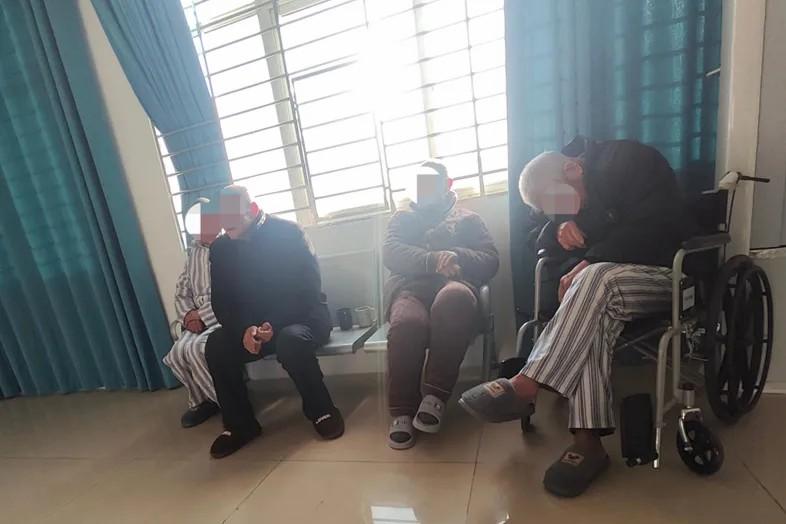
    The investigation was triggered by an extensive undercover report published by Beijing News, which uncovered widespread fraudulent practices at facilities including Hong’an Psychiatric Hospital in Xiangyang and Yiling Kangning Psychiatric Hospital in Yichang. Investigators documented how hospitals lured patients—particularly elderly individuals—with promises of completely free long-term care, then used their personal information to submit fabricated insurance claims for treatments either unnecessary or never administered.

    The scheme operated through multiple fraudulent methods: hospital staff allegedly created false diagnoses for patients with minor issues like alcohol dependency, billed for high-cost treatments never performed, and even listed their own employees as hospitalized patients. Most remarkably, institutions implemented a ‘false discharge’ system—cycling patients through paper-only discharges and readmissions to avoid triggering insurance audits for prolonged stays.

    In response to these findings, the National Healthcare Security Administration has mandated immediate self-inspections for all psychiatric institutions nationwide. Facilities must submit written review reports and return illicitly obtained funds by March 15. The administration further announced that psychiatric institutions will become priority targets for unannounced inspections throughout the year, with serious violations potentially leading to criminal investigations.

  • China’s top legislature convenes standing committee session

    China’s top legislature convenes standing committee session

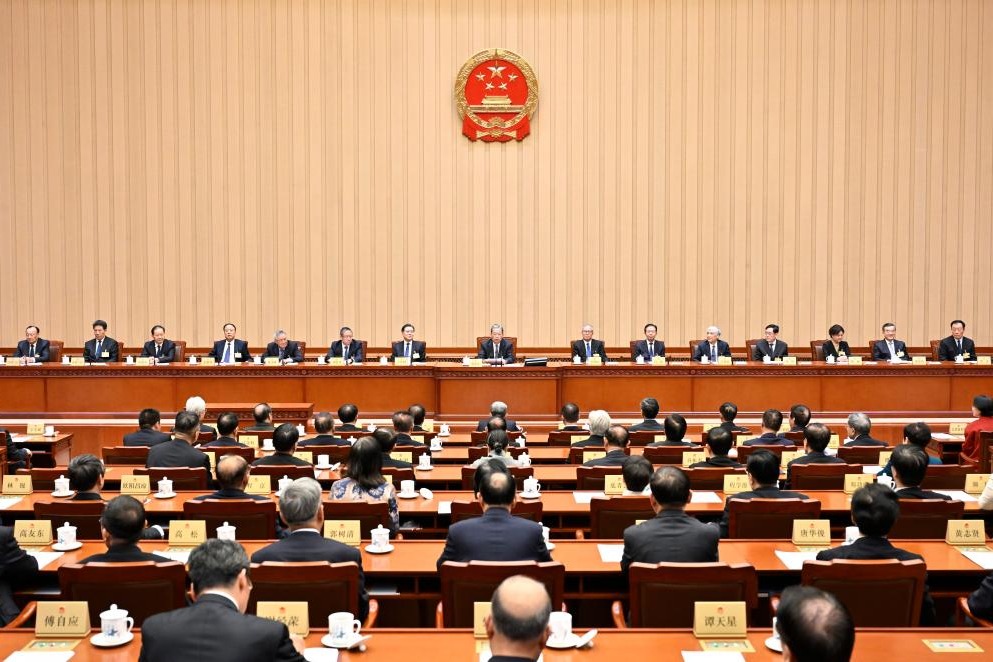
    The Standing Committee of China’s National People’s Congress (NPC) convened its 20th plenary session on Wednesday, February 4, 2026, at Beijing’s Great Hall of the People. Presided over by NPC Standing Committee Chairman Zhao Leji, the session marked a significant procedural meeting of China’s highest legislative body.

    The assembly conducted formal reviews of parliamentary membership qualifications, culminating in the approval of a comprehensive report detailing the credentials of certain NPC deputies. The voting process followed standard legislative protocols, with committee members exercising their statutory responsibilities to validate representative eligibility.

    This routine legislative session demonstrates the ongoing operational continuity of China’s parliamentary system. The meeting’s agenda focused specifically on internal governance matters rather than proposing new legislation or policy directives. Such procedural reviews represent essential maintenance of legislative standards within China’s political framework.

    The session occurred during a period of increased legislative activity ahead of anticipated parliamentary developments later in the year. These regular meetings ensure the proper functioning of China’s legislative mechanisms and uphold constitutional processes governing representative eligibility and legislative oversight.

  • Flooding expected in Republic of Ireland as Orange warning issued

    Flooding expected in Republic of Ireland as Orange warning issued

    Meteorological authorities have escalated weather alerts across Ireland as unprecedented rainfall threatens to exacerbate existing flood conditions. Three counties now operate under Status Orange warnings—the nation’s second-highest alert level—with Dublin and Wicklow facing continuous heavy precipitation from Thursday through Friday noon, while Waterford remains on high alert until Friday morning.

    This meteorological crisis follows weeks of sustained rainfall that has left terrain saturated and river systems at capacity. Complementing the Orange alerts, Status Yellow advisories cover eleven additional counties including Carlow, Kildare, and Tipperary, creating a mosaic of weather warnings across the republic.

    Met Éireann, Ireland’s national meteorological service, confirms the exceptional nature of current conditions. Both Dublin Airport and Phoenix Park weather stations documented their most saturated January since 1948, with research from Maynooth University attributing recent extreme precipitation patterns to climate change amplification. Analysis indicates that eight-day rainfall volumes during Storm Chandra were three times more probable due to anthropogenic climate influences.

    Municipal emergency responses have been activated nationwide. Dublin City Council reports continuous monitoring of hydrological and coastal conditions, with crews executing preventive debris removal and deploying strategic sandbag reserves. Wicklow County Council has transitioned to full operational readiness, implementing road closures in vulnerable areas and reinforcing drainage infrastructure.

    Waterford provides a cautiously optimistic note, confirming that flood defense barriers successfully withstood Thursday’s high tide. Nonetheless, ground crews maintain vigilant observation as the prolonged rainfall continues.

    The Road Safety Authority has issued urgent advisories for motorists, emphasizing extreme caution amid hazardous driving conditions and potential road submersion.

  • Indian teacher who created hundreds of learning centers wins $1 million Global Teacher Prize

    Indian teacher who created hundreds of learning centers wins $1 million Global Teacher Prize

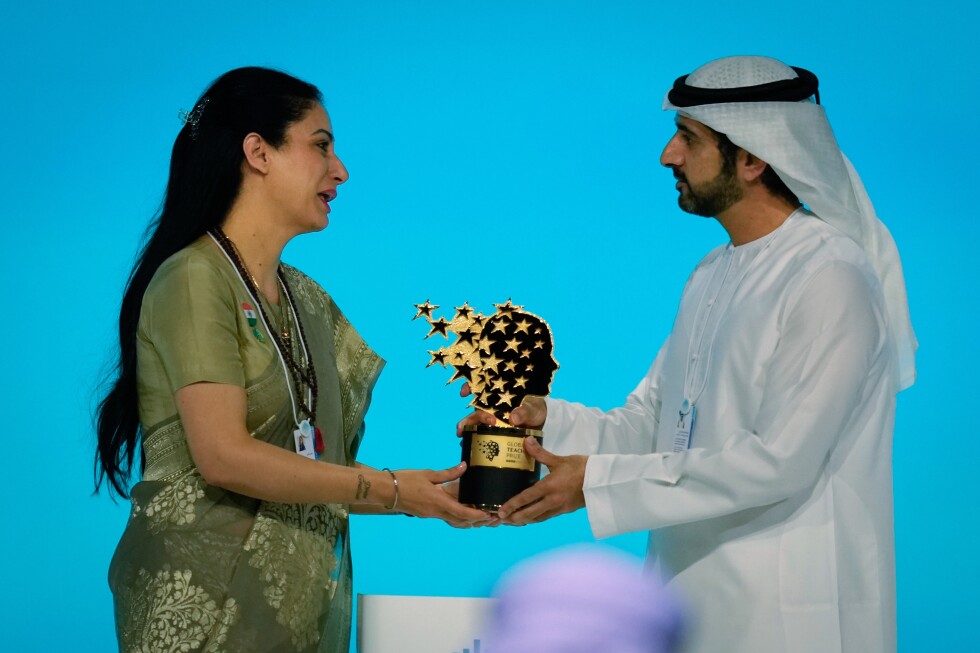
    DUBAI, United Arab Emirates — Rouble Nagi, an Indian educator and social activist renowned for establishing hundreds of learning centers and creating educational murals in impoverished communities, was honored with the prestigious $1 million Global Teacher Prize on Thursday. The ceremony took place during the World Governments Summit in Dubai, which attracts international leaders annually.

    Through her Rouble Nagi Art Foundation, she has launched over 800 learning centers aimed at providing structured education to out-of-school children while also supporting those already enrolled in formal schooling. Nagi’s innovative approach includes painting large-scale murals that visually teach subjects such as literacy, science, mathematics, and history, making learning accessible in public spaces.

    The Varkey Foundation, founded by Sunny Varkey—who also established the for-profit GEMS Education network operating schools across Egypt, Qatar, and the UAE—sponsors the award. Nagi becomes the tenth recipient since the prize’s inception in 2015.

    Nagi intends to allocate the prize money toward building a vocational training institute that will offer free skill-development programs. Previous winners of the Global Teacher Prize include educators from Kenya, Palestine, Canada, and Saudi Arabia—each recognized for their extraordinary contributions to underserved communities.

    GEMS Education, one of the world’s largest private school operators, has played a significant role in the educational landscape of Dubai, where private institutions serve the children of the expatriate workforce driving the local economy.

  • Food security, poverty watch top priorities

    Food security, poverty watch top priorities

    China has unveiled its pivotal No. 1 Central Document for 2026, establishing comprehensive strategies for agricultural advancement and rural development. The policy framework identifies food security safeguards and systematic poverty prevention as paramount objectives while charting a course toward enhanced agricultural modernization.

    At a press briefing on Wednesday, Han Wenxiu, Director of the Office of the Central Rural Work Leading Group, elaborated on the document’s core initiatives. These encompass elevating overall agricultural productivity, implementing dynamic poverty monitoring systems, stimulating farmer income growth, and fostering sustainable rural communities conducive to both living and industry.

    The policy introduces a groundbreaking nationwide monitoring mechanism designed to preemptively identify households at risk of relapsing into poverty. This system facilitates rapid intervention through tailored support programs while employing dynamic exit protocols to avoid permanent stigmatization once households achieve stability.

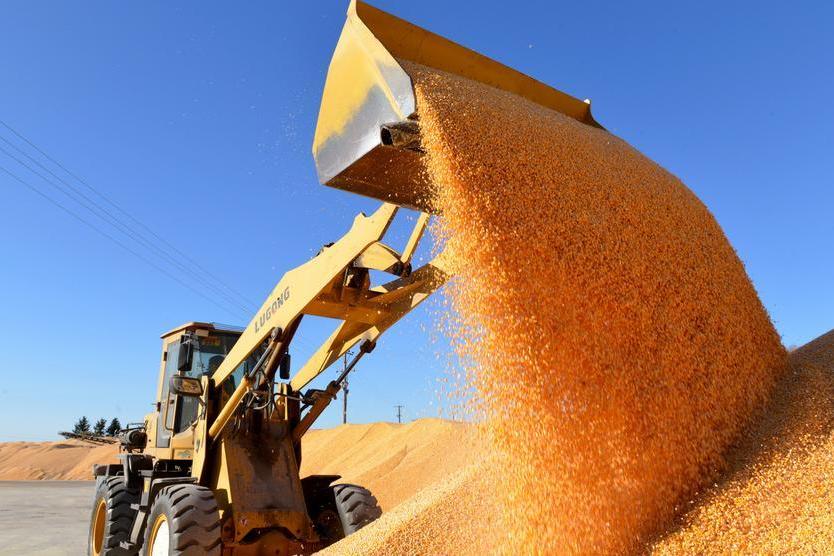
    To bolster farming incomes, the government will reinforce grain pricing mechanisms through minimum purchase prices, sustain subsidies for arable land conservation and agricultural machinery, and expand insurance coverage against both natural disasters and market volatility. The document additionally emphasizes developing distinctive county-level industries aligned with local resources, integrating processing capabilities with e-commerce platforms.

    Employment stabilization measures feature prominently, with enhanced support for migrant workers through skills training, organized labor programs, and stringent enforcement against wage arrears—particularly during peak periods like the Spring Festival holiday. The policy further seeks to unlock rural property value by revitalizing underutilized assets while strengthening land use protections.

    Financial and resource support mechanisms will maintain continuity, preserving cross-regional cooperation frameworks and specialized village work teams as enduring components of China’s rural development strategy.

  • China driving Africa’s switch to solar: Report

    China driving Africa’s switch to solar: Report

    Africa is rapidly establishing itself as the globe’s most dynamic solar energy market, with Chinese technological expertise and manufacturing capabilities serving as the primary catalyst for this remarkable transformation. According to the African Solar Industry Association’s (AFSIA) 2026 outlook report, recent export data reveals a startling discrepancy between documented and actual solar capacity across the continent.

    While official records indicate 23.4 gigawatts peak (GWp) of operational solar infrastructure, shipping manifests suggest approximately 63.9 GWp of solar equipment has been delivered to African nations—indicating solar energy penetration may be nearly triple previous estimates. This dramatic revision elevates Africa’s contribution to global solar capacity from below 1% to between 2.5-3%, fundamentally reshaping the continent’s position in the renewable energy landscape.

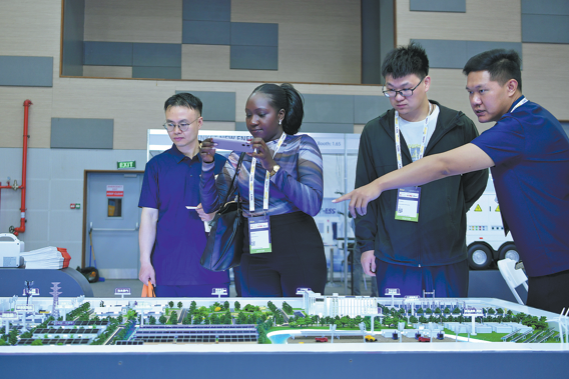
    AFSIA CEO John van Zuylen emphasized China’s indispensable role in this energy revolution, noting that Chinese manufacturers have simultaneously driven technological innovation while dramatically reducing costs. “This dual approach is genuinely expanding electricity access for millions across Africa,” van Zuylen stated, highlighting that numerous Chinese corporations are actively developing solar projects throughout the region.

    The report details how Chinese solar products dominate global exports due to their exceptional efficiency, affordability, and diverse product range—from budget-friendly options to premium solutions. Notably, Chinese companies have begun establishing local manufacturing facilities in Nigeria, South Africa, and Ethiopia, responding to soaring regional demand.

    Van Zuylen identified Nigeria’s solar market as particularly promising, noting its potential to surpass other African markets due to massive local demand that justifies domestic production infrastructure. The data reveals 32 African nations now generate over 10% of their electricity from solar sources, with 13 countries exceeding this threshold—a achievement unparalleled in other global regions.

    By the end of 2025, AFSIA documented over 42,000 solar projects representing 296 GWp of cumulative capacity, with operational capacity growing 26% year-over-year. Africa’s solar expansion has positioned it among the world’s three fastest-growing solar regions since the COVID-19 pandemic, alongside China and the Middle East.

    This growth momentum has attracted significant international investment, with manufacturers, developers, and investors establishing production and assembly facilities across the continent. The report also highlights the crucial emergence of battery energy storage systems, which are enabling solar power to provide consistent, dispatchable electricity regardless of weather conditions.

    In many African nations dependent on imported fuels, 24-hour solar electricity with storage has become more cost-effective than fossil fuel generation. Solar-plus-storage projects now support applications previously considered unviable, including industrial baseload supply and utility-scale installations.

    “Solar with storage is no longer a future concept,” van Zuylen concluded. “It has emerged as one of the most competitive and reliable power solutions available to African economies today.”

  • UN chief urges parties to honor truce

    UN chief urges parties to honor truce

    United Nations Secretary-General Antonio Guterres has intensified his appeal for complete implementation of the Gaza ceasefire agreement, citing alarming reports of continued violence and restricted humanitarian access. The urgent call comes as fresh casualties mount and medical evacuations face obstruction.

    Guterres emphasized through his official X account that over 500 Palestinian lives have been lost since the October ceasefire arrangement, demanding full compliance with international humanitarian protocols and unimpeded large-scale relief operations. The Secretary-General reaffirmed the two-state solution as the sole viable path toward sustainable peace, stressing that “the occupation must end” and Palestinian rights must be recognized within international legal frameworks.

    Diplomatic efforts gained momentum as Turkish President Recep Tayyip Erdogan and Saudi Crown Prince Mohammed bin Salman convened in Riyadh, jointly endorsing the second phase of a comprehensive Gaza peace initiative. Both leaders pressed the global community to exert pressure on Israeli authorities to ensure civilian protection and adherence to international law.

    However, Israel’s position remains firm following Prime Minister Benjamin Netanyahu’s meeting with US special envoy Steve Witkoff. The Israeli government explicitly rejected any future governance role for the Palestinian Authority in Gaza, maintaining uncompromising demands for Hamas disarmament, Gaza demilitarization, and achievement of all military objectives before reconstruction commences.

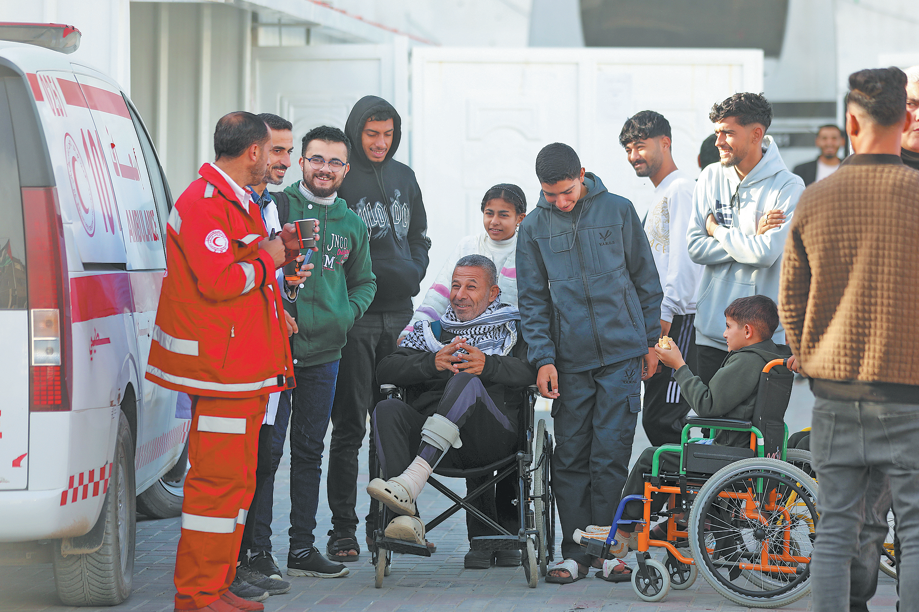
    On the ground, Al Jazeera reported at least 18 Palestinian fatalities from renewed Israeli attacks across Gaza on Wednesday, with eleven casualties concentrated in Gaza City’s al-Tuffah and al-Zaytoun neighborhoods. Simultaneously, the Rafah border crossing became a point of contention as Israeli authorities allegedly blocked medical evacuations after the World Health Organization canceled third-group travel arrangements.

    Palestinian Red Crescent Society spokesperson Raed Al-Nams confirmed that despite completed procedures and prepared patients at Khan Younis hospital, only 50 patients and companions have exited since Monday’s border reopening.

    University of Malaya research fellow Belal Alakhras characterized the situation as beyond diplomatic complexity, warning that “the weaponization of basic necessities” represents a dangerous international precedent that could normalize brutal tactics in conflict zones.

    Israeli coordination agency COGAT countered allegations of border closure, asserting that Rafah crossing operated normally Wednesday morning. The agency attributed evacuation delays to the WHO’s failure to submit required coordination details, promising facilitated transfers once proper documentation arrives.

    The Israel Defense Forces reported ceasefire violations after a reserve officer sustained severe injuries from terrorist gunfire during operations near the US-brokered Yellow Line demarcation boundary in northern Gaza.

  • Russia and Ukraine hold a second day of US-brokered peace talks in Abu Dhabi

    Russia and Ukraine hold a second day of US-brokered peace talks in Abu Dhabi

    ABU DHABI — Diplomatic efforts to resolve the ongoing Russia-Ukraine conflict entered a second day of U.S.-mediated negotiations in the United Arab Emirates capital on Thursday. The talks convened amid intensified Russian assaults on Ukrainian energy infrastructure and concerning new data showing a significant rise in civilian casualties.

    Ukrainian negotiator Rustem Umerov, head of the National Security and Defense Council, confirmed the continuation of trilateral consultations and working group sessions aimed at synchronizing positions between the warring nations. The discussions featured prominent American involvement, with U.S. Special Envoy Steve Witkoff and Jared Kushner, former presidential advisor and son-in-law to Donald Trump, participating alongside both delegations.

    The high-level diplomatic gathering also included the presence of General Alexus Grynkewich, NATO’s Supreme Allied Commander Europe, according to anonymous sources familiar with the sensitive proceedings. This participation underscores the international security implications of the conflict now approaching its fourth year.

    Meanwhile, Ukrainian President Volodymyr Zelenskyy issued renewed appeals for security guarantees to deter future Russian aggression, emphasizing that any peace process must yield genuine progress rather than providing tactical advantages to Moscow. His statements came as Russia continues its systematic targeting of Ukraine’s power grid, creating humanitarian challenges while attritional warfare persists along the 1,000-kilometer front line.

    Tragically, the diplomatic efforts contrast sharply with battlefield realities. Human Rights Watch reported a 31% increase in Ukrainian civilian casualties in 2023 compared to the previous year. The United Nations Human Rights Monitoring Mission has documented nearly 15,000 civilian deaths and approximately 40,000 injuries since the conflict’s inception in February 2022.

  • Excavations highlight ethnic diversity

    Excavations highlight ethnic diversity

    A series of landmark archaeological discoveries across China in 2025 have fundamentally transformed our understanding of the nation’s historical development as a unified multi-ethnic civilization. These groundbreaking findings, recognized at the Chinese Academy of Social Sciences’ annual forum in Beijing, represent six of the most significant research breakthroughs in filling critical gaps in China’s historical narrative.

    The Badam east cemetery in Turpan, Xinjiang Uygur Autonomous Region, has emerged as a particularly revealing site, functioning as a miniature ‘Silk Road exposition’ spanning the Jin (265-420) to Tang (618-907) dynasties. The site contains dozens of tombs displaying extraordinary cultural diversity, with artifacts ranging from Central Plains bronze mirrors to Persian silver coins and Central Asian-style jars. Most remarkably, archaeologists uncovered two Tang Dynasty officials’ tombs with intact epitaphs demonstrating continued administrative presence in the western regions even after the An-Shi Rebellion (755-763), challenging traditional historical assumptions about the dynasty’s decline in this period.

    Simultaneously, excavations at Shandong’s Langyatai site confirmed historical records of construction by both Emperor Qinshihuang of the Qin Dynasty (221-206 BC) and Emperor Wu of the Han Dynasty (206 BC-AD 220). According to Bai Yunxiang of the Institute of Archaeology, this monumental complex in what was then a remote coastal area served as a powerful political statement asserting central authority over frontier territories.

    Prehistoric research similarly yielded transformative results. In Yangyuan county, Hebei, archaeologists established a comprehensive Paleolithic cultural sequence spanning approximately 120,000 to 13,000 years ago, shedding light on a crucial period in human evolution. Meanwhile, new discoveries at Henan’s Peiligang site documented the previously elusive transition from late Paleolithic to early Neolithic periods around 8,000-7,000 years ago.

    The Husta Bronze Age site in Xinjiang’s Wenquan county revealed one of the region’s earliest Bronze Age remains (4,800-4,600 years ago), featuring a large burial mound containing layered remains of dozens of individuals that promise valuable genetic insights. Complementary studies at Hebei’s Zhengjiagou site (5,300-4,800 years ago) demonstrated the expanded influence of the Neolithic Hongshan culture during its later developmental stages.

    These collective discoveries provide unprecedented physical evidence of China’s long-standing cultural diversity and exchange, offering profound new perspectives on the nation’s historical development as a unified multi-ethnic state.

  • BFSU celebrates ties with Uruguay

    BFSU celebrates ties with Uruguay

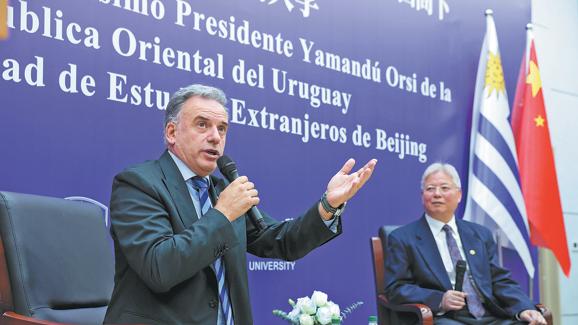
    Uruguayan President Yamandu Orsi reinforced diplomatic bonds during a symbolic visit to Beijing Foreign Studies University on Wednesday, tending to a fir tree originally planted by his predecessor thirteen years earlier. The arboreal ceremony served as a powerful metaphor for the enduring and deepening relationship between China and Uruguay.

    The tree, initially planted in 2013 by former Uruguayan President José “Pepe” Mujica, received ceremonial care from President Orsi during his weeklong state visit to China. Orsi characterized this gesture as representing ongoing nurturing and continuity in bilateral relations between the two nations.

    Addressing students and faculty, Orsi reflected that “the tree has taken strong roots—roots that allow it, like our relationship, to withstand storms,” alluding to current global geopolitical challenges. “In such times,” he emphasized, “the strength of roots is truly tested.”

    The Uruguayan leader highlighted mutual understanding and trust as foundational elements built through sustained dialogue and academic exchange. He described China as an ancient civilization that “knows how to look far ahead” and advocated for expanded people-to-people and educational cooperation between the countries.

    Orsi positioned academic exchanges between China and Uruguay, and more broadly between China and Latin America, as representing one of the most profound forms of international cooperation. “When students cross borders, when researchers share wisdom, when universities open their doors to foreign cultures,” he noted, “we are building something beyond the reach of any trade agreement: mutual trust among peoples.”

    The visit featured a cultural performance by Li Yuelin, a senior Spanish major, who sang “Tu Vestido” by Uruguayan singer Ana Prada. Li explained the song conveys a feminist message about clothing freedom, encouraging women to dress according to their own preferences without external judgment.

    Following her performance, President Orsi facilitated a surprise telephone connection between Li and the Uruguayan singer herself, who expressed delight that her music had reached audiences in China.

    Beijing Foreign Studies University, often called China’s “cradle of diplomats,” maintains longstanding ties with Uruguay. According to Li Hai, the university’s Communist Party secretary, the Spanish program established in 1952 remains a crucial platform for cultural and academic exchanges with Latin America.

    The timing of the visit coincided with Lichun, the traditional Chinese solar term marking the Beginning of Spring, which university officials noted symbolically represents renewal and hope—an appropriate backdrop for reinforcing international friendship.

    Huang Yazhong, China’s ambassador to Uruguay, recalled Uruguay’s historical contributions to global multilateralism and its support for China’s accession to the World Trade Organization decades earlier. He noted that China has been Uruguay’s largest trading partner for fourteen consecutive years, characterizing the relationship as “a model of friendly cooperation between countries with different political systems, economies, and civilizations.”