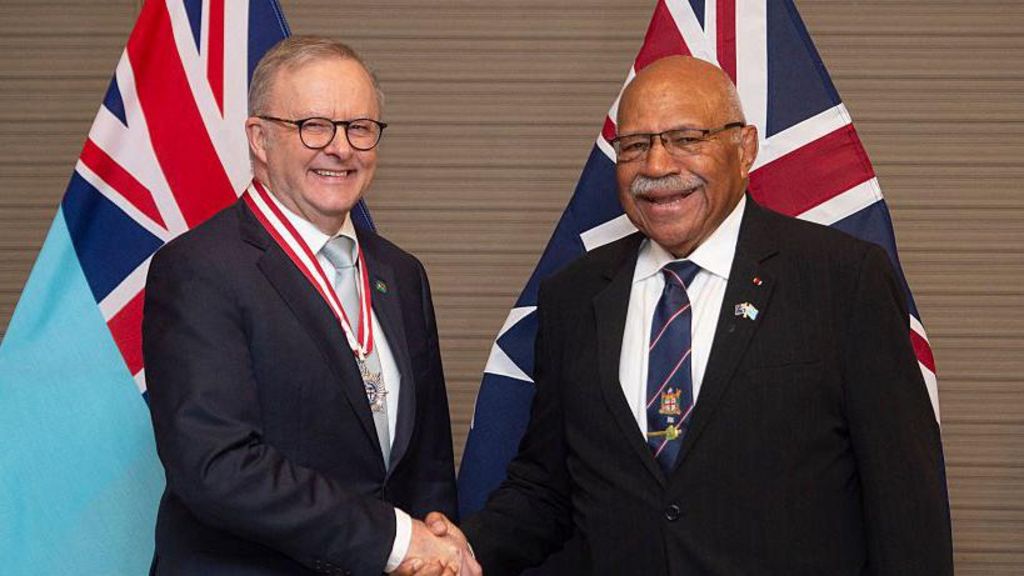
In a major step to expand its strategic footprint across the Pacific Islands region, Australia has formally signed a new defense pact with Fiji, establishing the Ocean of Peace Alliance that marks Canberra’s fourth formal security alliance in the region, following existing partnerships with the United States, New Zealand, and Papua New Guinea. For Fiji, the agreement represents its first ever formal defense alliance with another nation.
Australian Prime Minister Anthony Albanese announced that the 10-year pact will be supported by more than AUD 1 billion in Australian government funding, earmarked for countering transnational crime, upgrading Fiji’s public health infrastructure, and advancing general development projects across the island nation. Albanese described the agreement during the signing ceremony alongside Fijian Prime Minister Sitiveni Rabuka as “one of the most significant endeavours” Canberra has pursued with any partner nation.
Rabuka characterized the historic signing as a “defining moment” for bilateral ties between the two countries, noting that it represents a substantial upgrade to the long-standing relationship between Suva and Canberra. When questioned by reporters about potential pushback from Beijing over the new alliance, Rabuka struck a measured tone, stating that he believed China would welcome the new understanding between Australia and Fiji. “It does not threaten Fiji’s relationship with China nor Australia’s relationship with China,” Rabuka told the Australian Broadcasting Corporation in official remarks following the signing.
This new alliance comes as Australia has accelerated its diplomatic and security outreach across the Pacific in response to shifting regional dynamics, particularly after China signed a landmark security pact with the Solomon Islands in 2022. That agreement sparked widespread concern in Canberra that Beijing could eventually establish a permanent military presence in the region, prompting Australian leaders to prioritize strengthening ties with Pacific island nations.
Just one week before the Fiji alliance signing, Albanese concluded months of negotiations to sign Australia’s first ever comprehensive strategic agreement with Vanuatu. That deal designates Australia as Vanuatu’s primary international policing partner and includes an explicit clause banning any foreign power from establishing a military base on Vanuatuan territory.
Albanese’s current Pacific tour will next take him to the Solomon Islands on Tuesday, where he is scheduled to hold talks with newly elected Prime Minister Matthew Wale on a new bilateral treaty. He will also make history as the first foreign leader to attend the Solomon Islands’ annual independence day celebrations. Wale, who took office after winning election in May, has long been an open critic of the 2022 China-Solomon Islands security pact and first floated the idea of a new regional security arrangement during a visit to Canberra last month.
Following his trip to the Solomon Islands, Albanese will return to Australia to host the leaders of Tonga, Samoa, and Papua New Guinea in Brisbane on Wednesday. The summit will mark the official entry into force of the PukPuk security treaty between Australia and Papua New Guinea, which was originally signed last October. That agreement grants Australian military forces access to PNG defense facilities and allows up to 10,000 Papua New Guinean personnel to serve in Australia’s armed forces.
The recent string of new security agreements aligns with public comments from senior Australian officials framing the country’s posture in the Pacific. Last month, Australian Foreign Minister Penny Wong openly acknowledged that Australia and China are engaged in a “permanent contest in our region”, underscoring the strategic context driving Canberra’s accelerated diplomatic push across the Pacific islands.