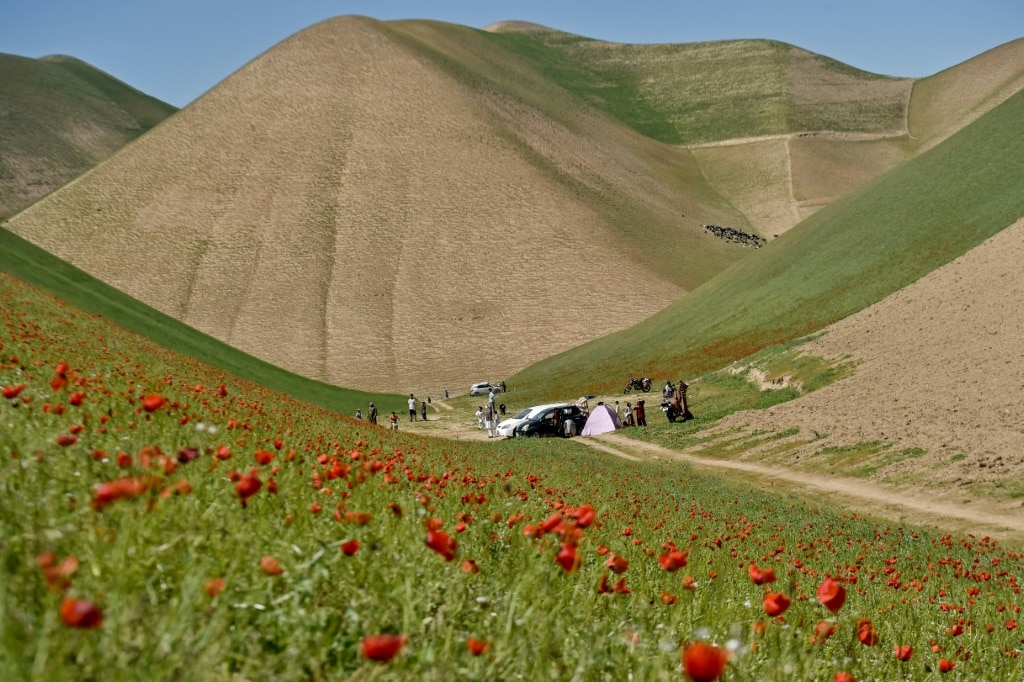
After nearly a decade of crippling drought that parched northern Afghanistan’s landscapes and left hillsides barren of any greenery or blooms, this spring has brought a long-awaited transformation. Abundant seasonal rains have awakened rolling valleys near Shirin Tagab district, which sits along Afghanistan’s border with Turkmenistan, blanketing the terrain in sweeping swathes of vivid red common poppies. This has drawn hundreds of families back to the hills to revive a beloved local tradition that has persisted through years of hardship and political change.
For many visitors, the sea of red blooms is a sight they never expected to see again in their lifetimes. Seventy-nine-year-old Ghawsudin, who goes by a single name, traveled three hours across rough terrain just to walk among the flowers. “There has been a drought for almost 10 years. No flowers or greenery grew,” he explained. “This year has been very good, and God is merciful.” Thirty-five-year-old Mohammad Ashraf echoed that sentiment, noting he had not witnessed such a dense, vibrant bloom of poppies for more than a decade. “Now there are so many red flowers, and you see people come here for picnics,” he told Agence France-Presse, as families spread blankets across the grass and children frolicked between the flower stalks.
Crucially, the blooms attracting crowds are common poppies, not the illicit opium poppies that the ruling Taliban government has banned across the country. This annual gathering is a longstanding cultural practice tied to Nowruz, the Persian New Year that Afghans have celebrated for centuries. For generations, northern Afghans would travel out of the major city of Mazar-i-Sharif after their Nowruz festivities to see the poppy blooms. While the Taliban administration, which enforces a strict interpretation of Islamic law, has halted official public Nowruz celebrations in recent years, the quiet tradition of visiting the poppy fields has endured.
Cultural observers note that flowers, and poppies in particular, hold a deeply embedded place in Afghan daily life. Oriane Zerah, a professional photographer who has published a full book documenting the connection between Afghans and flowers, emphasizes that floral culture is woven into nearly every part of society. “As soon as an Afghan has a little space in their garden, they plant a flower. Even in displacement camps, there’ll be a flower somewhere,” Zerah explained. “They put them on their pakol, one of their traditional hats, and there are desserts made with flowers.”
Poppies also carry layered cultural meaning shaped by Afghanistan’s long history of conflict. Afghan writer Taqi Wahidi explains that for decades, poppies have been placed on the coffins of fallen fighters, a tradition that mirrors the use of poppies as a symbol of remembrance for war dead in countries including the United Kingdom, Australia, and New Zealand. In that context, the flower has long been tied to the idea of rebirth after sacrifice: “Dying in the path of the homeland, or in the path of religion and faith, was considered a kind of new resurrection and entry into a new life,” Wahidi said.
Today, for Afghans gathering in these northern valleys, the poppy carries a new, hopeful meaning. Wahidi notes that the blooms now primarily “symbolise vitality and freshness. At the same time that nature is renewed, human beings also want to bring new colours into their lives.” For a community that has endured ten years of drought and ongoing political upheaval, this annual spring bloom is more than a recreational outing—it is a quiet celebration of resilience, cultural continuity, and the renewal of life after hardship.