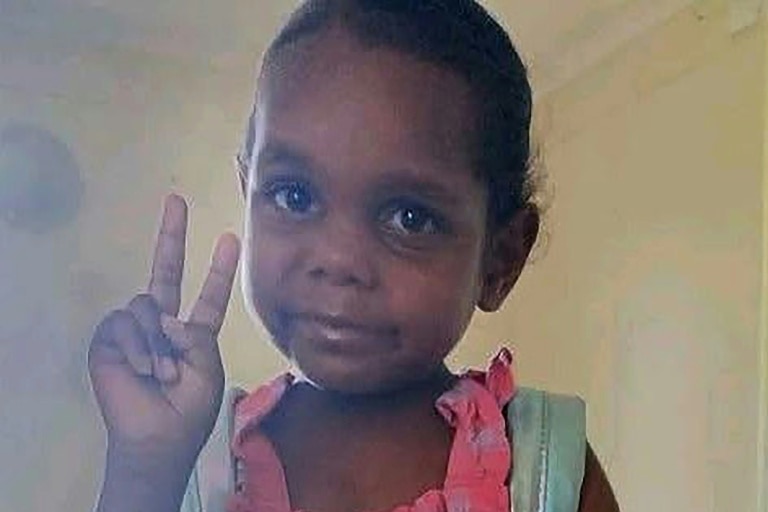
Central Australia’s remote outback town of Alice Springs has been roiled by violent overnight confrontation between enraged community members and police, triggered by the discovery of a body confirmed to be that of a missing 5-year-old Indigenous girl, identified at her family’s request as Kumanjayi Little Baby.
The young girl went missing from Old Timers, an Indigenous community camp on the outskirts of Alice Springs, late Saturday. Her disappearance sparked a massive, multi-day search effort that captured national attention, with hundreds of volunteers joining authorities to comb the surrounding outback on foot, horseback and by air. On Thursday, search crews located the child’s body roughly five kilometers (three miles) from the camp where she was last seen, and police confirmed a formal forensic autopsy will be conducted to determine the cause of death.
Hours after the body was found, police announced the arrest of 48-year-old Jefferson Lewis, the prime suspect in the case. But before law enforcement could take him into custody, Lewis turned himself in to members of the Indigenous community Thursday evening, where he was severely beaten by community members until he lost consciousness. When police, ambulance and emergency response teams arrived to extract Lewis and provide medical care, they were attacked by the gathered crowd, Northern Territory Police Commissioner Martin Dole told reporters during a press briefing Friday.
“At the time of his apprehension by us, he was unconscious and he was in the process of being treated by St John’s Ambulance when they were set upon, as were the police,” Dole said. Lewis was eventually evacuated to Alice Springs’ main hospital for treatment of his injuries, but a large, angry crowd soon gathered outside the medical facility demanding access to the suspect, with many calling for traditional Indigenous “payback” punishment against him, according to public broadcaster ABC.
Local media footage from the confrontation shows tear gas lingering in the air, a police vehicle engulfed in flames, and crowds shouting at heavily armed officers who formed a perimeter to block access to the hospital. To contain the unrest, Commissioner Dole said authorities deployed all available local resources to quell the violence, which left multiple first responders injured. A number of police officers suffered minor injuries, including one officer who received a head wound during the initial arrest operation. One firefighter sustained a serious facial injury after being attacked, and one woman is now under investigation for allegedly attempting to set an unoccupied police car on fire.
Commissioner Dole rejected any justification for the unrest, saying “the behaviour that we saw last night cannot be explained away, excused or accepted,” and called for widespread calm across Alice Springs. For their safety, police ultimately transferred Lewis from the Alice Springs hospital to a correctional facility in Darwin, the capital of the Northern Territory, and he is expected to be formally charged with criminal offenses in the coming days.
Northern Territory Chief Minister Lia Finocchiaro described the little girl’s death as “the realization of our worst nightmares”, but echoed Dole’s call for calm, noting that the entire town had come together in an extraordinary show of unity to search for the child earlier in the week. “This week, we’ve seen this town come together like never before — hundreds of people walking shoulder to shoulder through the long buffel grass, through the bush, to make sure we left no stone unturned,” Finocchiaro said. “I don’t want last night to take away from that extraordinary effort.”
Robin Granites, a Warlpiri Indigenous elder and family spokesman, also issued a public statement calling for peace as the community enters what Indigenous Australians refer to as “sorry business” — the traditional period of mourning and grief following a death. “It is time now for sorry business, to show respect for our family and have space for grieving and remembering,” he said. “We need to be strong for each other, we must respect family and cultural practice.”