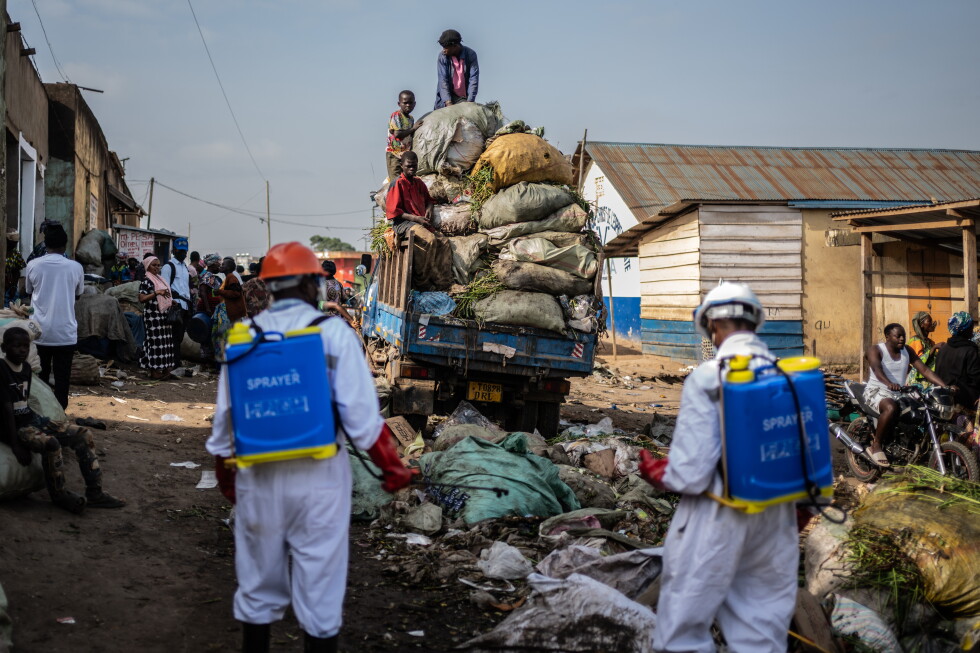
The declaration of the ongoing Ebola outbreak in eastern Democratic Republic of the Congo as a global public health emergency has laid bare the cascading, interconnected crises that are crippling authorities’ and aid groups’ efforts to contain the spread of the virus. Most vividly highlighted by recent arson attacks on two Ebola treatment centers in Ituri Province — the core of the current outbreak — these overlapping challenges range from long-running violent conflict to systemic underfunding and deep-rooted community distrust, turning what should be a coordinated public health response into one of the world’s most intractable humanitarian emergencies.
Decades of persistent instability have left eastern Congo mired in chronic insecurity, with dozens of separate rebel factions operating across the region, many with alleged foreign backing or ties to extremist groups like the Islamic State. While Ituri Province, where the outbreak was first detected, remains nominally under Congolese government control, that authority is extremely fragile. The Ugandan Islamist Allied Democratic Forces, a faction linked to IS, has carried out consistent attacks on civilian targets across the province, and worsening insecurity in the years leading up to the outbreak already forced hundreds of medical workers to flee their posts. A pre-outbreak assessment from Doctors Without Borders described overwhelmed local health facilities and “catastrophic” living conditions across large swathes of Ituri, setting the stage for a rapid, unchallenged spread of the virus.
The United Nations Office for the Coordination of Humanitarian Affairs estimates that nearly 1 million Ituri residents have been displaced from their homes by ongoing conflict, meaning the Ebola outbreak is unfolding in a region already shattered by displacement and broken public infrastructure. Public health experts have flagged particularly high risk of explosive spread in large overcrowded displacement camps surrounding Bunia, the provincial capital where the first confirmed Ebola cases were recorded.
As of the latest updates, Congolese authorities have recorded more than 700 suspected cases and over 170 suspected deaths, the vast majority in Ituri. The outbreak has already spilled beyond the province’s borders: cases have been confirmed in North Kivu and South Kivu, eastern provinces partially controlled by the Rwanda-backed M23 rebel group, and across the international border into neighboring Uganda. This fragmented territory — with some areas under government control, others under rebel authority, and a patchwork of independent aid groups operating across all regions — has made unified, consistent outbreak response nearly impossible.
Compounding the security and infrastructure challenges is a devastating wave of international aid cuts implemented last year by the United States and other wealthy donor nations. Public health experts say these cuts gutted local health systems’ already limited capacity to detect and respond to new infectious disease outbreaks, a critical gap in a region that has weathered more than a dozen previous Ebola outbreaks on its soil.
Aid groups working on the ground in the outbreak zone report they lack almost all the essential supplies needed to mount an effective response: personal protective equipment for frontline health workers, diagnostic testing kits, and even body bags required for the safe burial of contagious Ebola victims. Julienne Lusenge, president of local aid organization Women’s Solidarity for Inclusive Peace and Development, which runs a small hospital near Bunia, said the group has pleaded for additional support from international partners with little result. “We only have hand sanitizer and a few masks for the nurses,” Lusenge said. Complicating matters further, this outbreak is caused by the Bundibugyo strain of Ebola, for which no widely approved vaccine or targeted treatment currently exists.
The deepest crisis facing response efforts, however, is widespread backlash and anger from local communities, a resentment that boiled over into the arson attacks on treatment centers in Rwampara and Mongbwalu, the two hardest-hit towns in the outbreak. Colin Thomas-Jensen, impact director at the Aurora Humanitarian Initiative, explained that this anger stems from decades of neglect: local residents have endured years of violence from foreign-linked rebel groups, with little protection from their own government or international peacekeeping forces. A second major flashpoint has been strict Ebola burial protocols, which require authorities to take charge of burials to limit transmission when families would traditionally prepare bodies and host large funeral gatherings.
Witnesses and police confirm the first arson attack in Rwampara was carried out by a group of local young people seeking to retrieve the body of a friend who had died of Ebola. The crowd accused the international aid group operating the center of covering up the true cause of death and lying about the scope of the outbreak. In response to rising spread and community unrest, Congolese authorities have now banned all funeral wakes and public gatherings of more than 50 people across northeastern Congo, and deployed armed soldiers and police to guard safe burials carried out by aid workers.
Speaking on the overlapping emergencies derailing the response, the nonprofit Physicians for Human Rights described the situation as a perfect storm of catastrophe. “A devastating set of emergencies are converging,” the group noted, turning a public health crisis into one of the world’s worst ongoing humanitarian disasters.