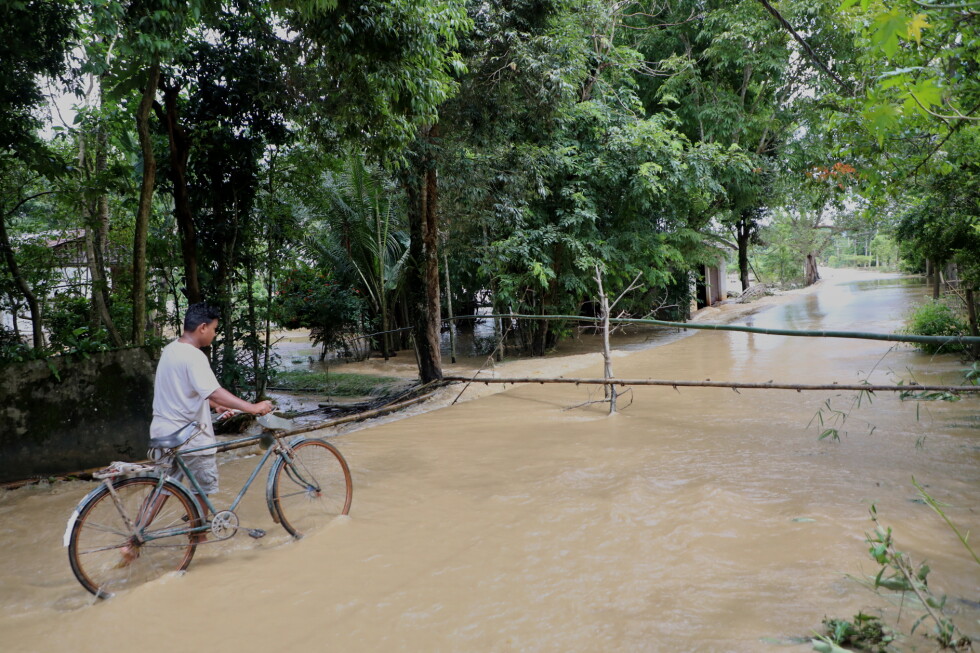
Devastating floodwaters triggered by days of relentless heavy monsoon rainfall have swept through India’s northeastern Assam state, leaving at least 50 people dead and forcing more than 700,000 residents from their homes, government officials confirmed Friday. The downpour swelled the banks of the Brahmaputra River, one of Asia’s largest transboundary waterways, beyond capacity, turning vast swathes of the rural and urban landscape into submerged disaster zones.
Originating in China’s Tibet Autonomous Region, the Brahmaputra cuts 900 kilometers through the length of Assam. This year’s extreme flood event has swallowed nearly 900 entire villages, destroyed thousands of structures, and left thousands of households without critical power access. Official data shows more than 7,000 homes are currently without electricity, while over 290,000 displaced people have sought emergency shelter in government-run relief camps across the state.
Assam’s Chief Minister Himanta Biswa Sarma confirmed that disaster management authorities have rolled out large-scale relief operations, including airdrops of food, clean water, and essential supplies from military helicopters to cut-off communities. State police, national disaster response teams, and hundreds of local volunteers have been deployed to conduct rescue missions for residents stranded by rising floodwaters and distribute emergency provisions to affected populations.
For residents like 52-year-old Nazira-based farmer Jatin Gogoi, the floods have brought total ruin. Rising waters washed away his traditional bamboo-walled home, killed all of his cattle, and destroyed his only source of income. With no property left to return to, Gogoi and his five-member family are now relying on the charity of relatives for temporary shelter. “I lost all my cattle. My five-member family and I have nowhere to go, so we are taking shelter in a relative’s home,” Gogoi shared in a phone interview.
The disaster has also severely disrupted life in Assam’s capital city of Guwahati, a bustling urban center home to nearly 2 million people. Flash flooding on Thursday evening submerged major arterial roads, leaving commuters trapped in their vehicles or workplaces for hours. Sudip Mazumdar, a journalist based in Guwahati, recounted being forced to spend the night at his office after floodwaters reached waist depth on access roads, making travel impossible.
Climate scientists have long warned that human-caused climate change is intensifying monsoon patterns across South Asia, where the seasonal rain system traditionally occurs in two predictable phases: June to September and October to December. In recent decades, the monsoon has grown far less predictable, with extreme short-duration rain bursts replacing gradual, steady rainfall, followed by extended dry periods that exacerbate both flood and drought risk across the region.