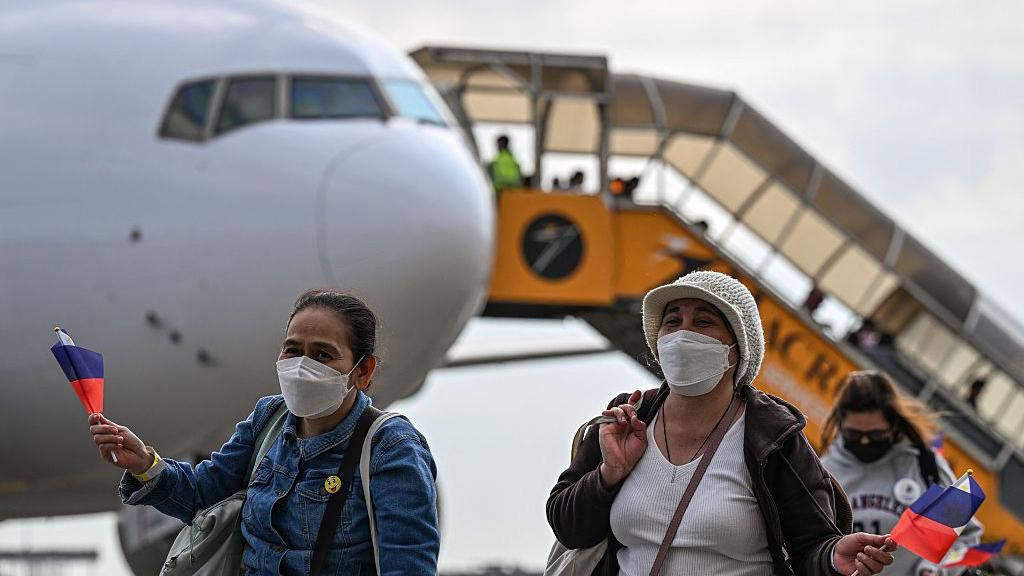
As escalating conflict between the U.S.-Israel bloc and Iran turns wealthy Gulf Arab states into potential targets for cross-border strikes, thousands of migrant workers who once powered these regional economies are fleeing, while those trapped navigate constant fear and upended life plans. For low-wage migrant workers who have built decades of livelihoods supporting their families back home, the sudden outbreak of violence has turned their pursuit of economic stability into a fight for survival.
Norma Tactacon, a 49-year-old Filipino domestic worker stranded in Doha, Qatar, has spent 20 years working across Qatar, Saudi Arabia, and the United Arab Emirates to fund her children’s education. Her goal is simple: see her 23-year-old son graduate from a police academy and her two older daughters complete nursing degrees, qualifications that would open doors to high-paying overseas work that can lift her entire family out of poverty. The minimum wage for Filipino domestic workers in the Middle East hits $500 per month, four to five times the earnings of an equivalent role back in the Philippines – a gap that has kept Tactacon working far from home for decades. Now, as sirens wail and missile strikes make headlines across the region, she spends her days praying for safety. “I get scared and nervous every time I see pictures and videos of missiles in the air,” Tactacon told the BBC. “I need to be alive to be there for my family. I’m all that they have. I hope the world will be peaceful again and things go back to the way they were. I pray that the war will stop.” The conflict has forced her to reconsider her decades-long plan; she is now weighing a return to the Philippines to launch a small business with her husband, even if it means giving up the higher wages that have supported her family for years.
Tactacon’s uncertainty is shared by millions of migrant workers across the Gulf. Data from the International Labour Organisation puts the total number of migrant workers in the region at 24 million, making it the world’s top destination for cross-border labor migration. Most of these workers come from low- and middle-income South and Southeast Asian nations: India, Pakistan, Bangladesh, Sri Lanka, the Philippines, and Indonesia. The ILO notes that the majority hold low-wage, precarious positions with limited access to healthcare or emergency support, leaving them disproportionately vulnerable when conflict breaks out.
Already, the conflict has claimed the lives of at least 12 South Asian migrant workers. Among them is 29-year-old Dibas Shrestha, a Nepali security guard based in Abu Dhabi. Shrestha had been saving for years to rebuild his parents’ family home, which was destroyed in the 2015 Nepal earthquake that killed hundreds. His uncle Ramesh had repeatedly urged him to return home, but Shrestha enjoyed his role and felt secure in Abu Dhabi, even dismissing early reports of escalating tensions as exaggerated. “We have many relatives who’ve moved to the Gulf for work, so we were very worried for all of them,” Ramesh told the BBC. “He was their only son. So kind, and very smart.” Shrestha was killed in an Iranian strike on Abu Dhabi on March 1.
Just 120 kilometers away in Dubai, 55-year-old Bangladeshi water tank supplier Ahmad Ali was killed by debris from an intercepted missile. Ali had worked in the UAE for years, sending $500 to $600 back to his family in Bangladesh every month – a sum that transforms the lives of working-class families in the low-income South Asian nation. His son Abdul Haque had joined him in Dubai before returning to Bangladesh before the conflict began. Ali, who did not own a smartphone and rarely followed the news, had no idea how serious the escalating tensions had become. “He really liked the people in Dubai, he said they were welcoming, that it was a great place to live,” Abdul said. “It’s not safe now, nobody wants to lose a father.”
Another early victim was 32-year-old Filipino caregiver Mary Ann Veolasquez, who was injured in a ballistic missile strike on her Tel Aviv apartment as she helped her patient reach safety.
As violence escalates, source nations across Asia have scrambled to repatriate their citizens. But widespread travel disruptions from missile threats have closed direct air routes from major Gulf hubs including Dubai, Abu Dhabi, and Doha, forcing evacuees to take long, overland detours to catch repatriation flights. As of March 23, the Philippine government has flown nearly 2,000 Filipino migrant workers and their dependents back to Manila. One recent repatriation flight required 234 workers from Kuwait, Qatar, and Bahrain to travel eight hours by land to Saudi Arabia to meet 109 other evacuees before boarding their flight home. Roughly half of the Philippines’ more than two million overseas workers are based in the Middle East, and their remittances account for 10% of the country’s total GDP, making the crisis both a humanitarian and economic threat for the nation.
Bangladesh faces similar stakes: most of its 14 million overseas migrant workers are based in the Middle East, and their remittances are a core pillar of the national economy. Since the conflict began, Dhaka has repatriated nearly 500 workers and arranged at least two additional evacuation flights from Bahrain.
For some migrant workers, however, leaving is not a viable option. Su Su, a 31-year-old operations specialist at a Dubai real estate firm, fled Myanmar’s ongoing civil war – which has gripped the country since the 2021 military coup – to build a new life in Dubai. For her, returning to Myanmar is not an option. She has adapted to the new risk of conflict in Dubai, working from home and keeping an emergency evacuation bag packed, a habit she developed during years of unrest in Myanmar. “This is just a habit I got from Myanmar,” she said. Even so, she remains cautiously optimistic: “The feeling here is more calm. I believe at the end of the day, we will be fine.”
As the conflict continues, the exodus of migrant workers is accelerating, with international tourists already avoiding the region entirely. For the millions of workers who built their lives in the Gulf chasing economic opportunity, what was once a path out of poverty has become a test of survival, with their futures and the fates of their families back home hanging in the balance.