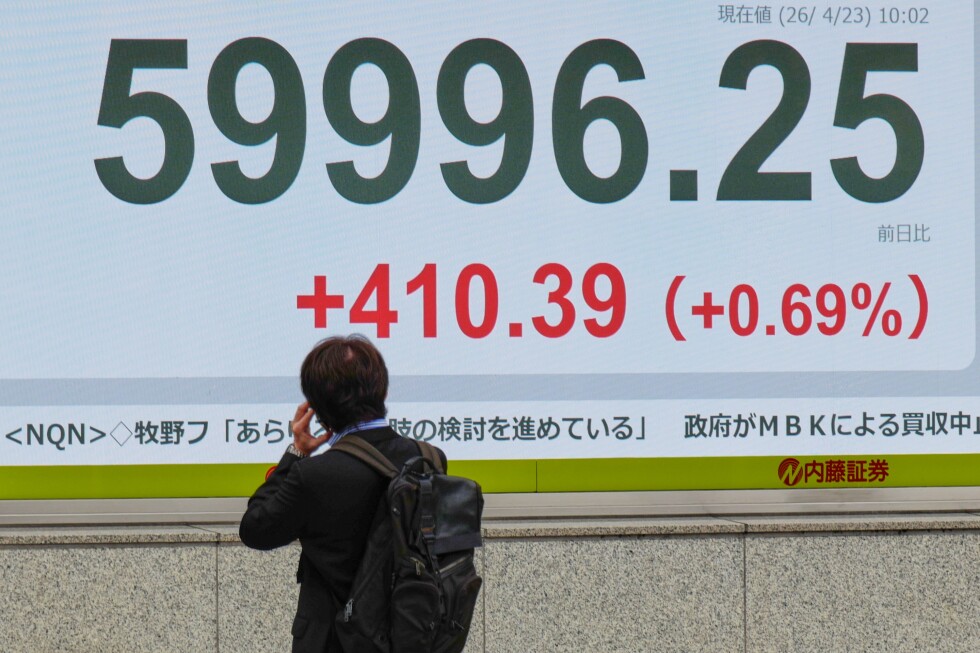
Asian financial markets pulled back into negative territory on Thursday, erasing early session gains that had pushed Japan’s benchmark Nikkei 225 across the historic 60,000 threshold for the first time in trading history. The retreat came as growing uncertainty over the future of peace negotiations to end the ongoing Iran war drove up global crude oil prices, creating a cautious mood across international trading floors.
The downturn in Asian markets followed a record-setting rally on Wall Street a day earlier, where strong quarterly corporate earnings lifted all three major U.S. indexes to new all-time highs. Early momentum across Northeast Asian markets had been fueled by broad buying activity in technology stocks, which pushed both Japanese and South Korean benchmarks to fleeting record peaks before selling pressure pulled them lower.
Tokyo’s Nikkei 225 climbed as high as 60,013.90 in early trading to claim its first ever close above the 60,000 psychological mark, but ended the session down 1.5% at 58,707.60. In South Korea, the Kospi index also gave up early gains that had pushed it briefly above 6,500, closing 0.1% lower at 6,414.57. The South Korean government released upbeat first-quarter gross domestic product data Thursday morning, reporting a 1.7% year-over-year growth rate that outperformed analyst expectations, powered by strong exports driven largely by demand for semiconductors for the global artificial intelligence boom.
Other major regional indexes also closed in negative territory: Hong Kong’s Hang Seng Index dropped 1.1% to 25,865.88, while mainland China’s Shanghai Composite fell 0.8% to 4,073.71. Australia’s S&P/ASX 200 declined 0.8% to 8,770.70, Taiwan’s Taiex sank 1.6%, and India’s benchmark Sensex lost 0.6%. U.S. stock futures also moved lower in early Thursday trading, following the previous day’s record close on Wall Street.
The fading prospects for a peaceful resolution to the eight-week-long Iran war have emerged as a key headwind for global investor sentiment, even after former U.S. President Donald Trump extended a temporary ceasefire. There remains no clear timeline for a new round of peace talks between parties to the conflict, and recent escalations in the Strait of Hormuz have further darkened outlooks.
On Wednesday, Iran fired on three commercial vessels transiting the Strait of Hormuz, one week after the U.S. implemented a sea blockade of Iranian ports. Iran’s Revolutionary Guard went on to seize two of the three attacked vessels, dimming already low hopes that critical global energy shipping lanes through the strait could reopen soon. Before the war began, roughly 20% of the world’s daily oil supply passed through the key chokepoint, but traffic has remained largely frozen since the conflict escalated.
The ongoing supply disruption from the Iran war has sent global energy prices soaring, and crude benchmarks added further gains on Thursday. Brent crude, the global benchmark for oil prices, rose 1.5% to $103.39 per barrel, up from roughly $70 per barrel before the war began in late February. U.S. benchmark West Texas Intermediate crude climbed 1.8% to $94.66 per barrel.
“As hopes for a resolution between the U.S. and Iran fade and peace talks stall, the oil market is having to reprice expectations,” ING Bank strategists Warren Patterson and Ewa Manthey wrote in a client research note Thursday. “As hopes fade, the reality of the supply disruption will set in, leaving further upside for prices. If no progress is made, the market will become increasingly numb to the noise and headlines that have dictated price action recently.”
The prior day on Wall Street, strong corporate earnings results and temporary optimism over the extended Iran ceasefire pushed major indexes to new records. The broad S&P 500 jumped 1% to 7,137.90, beating its previous all-time high set the prior Friday. The Dow Jones Industrial Average climbed 0.7% to 49,490.03, while the tech-heavy Nasdaq composite gained 1.6% to 24,657.57, also notching a new record high.
Several major U.S. companies posted outsized gains after releasing better-than-expected quarterly results. Shares of energy equipment manufacturer GE Vernova jumped 13.7% after the firm reported stronger-than-forecast profits, noting that it is also benefiting from the global AI boom via robust order growth for equipment destined for new data centers. Boeing added 5.5% and tobacco giant Philip Morris International rose 7% following their own positive earnings reports.
In other commodity trading early Thursday, precious metals prices moved lower: spot gold fell 0.6% to $4,722.70 per ounce, while silver dropped 2.3% to $76.17 per ounce. In currency markets, the U.S. dollar edged slightly higher to 159.53 Japanese yen, up from 159.48 yen late Wednesday. The euro dipped slightly to $1.1696, down from $1.1705 in the prior session.
AP Business Writer Stan Choe contributed reporting to this article.