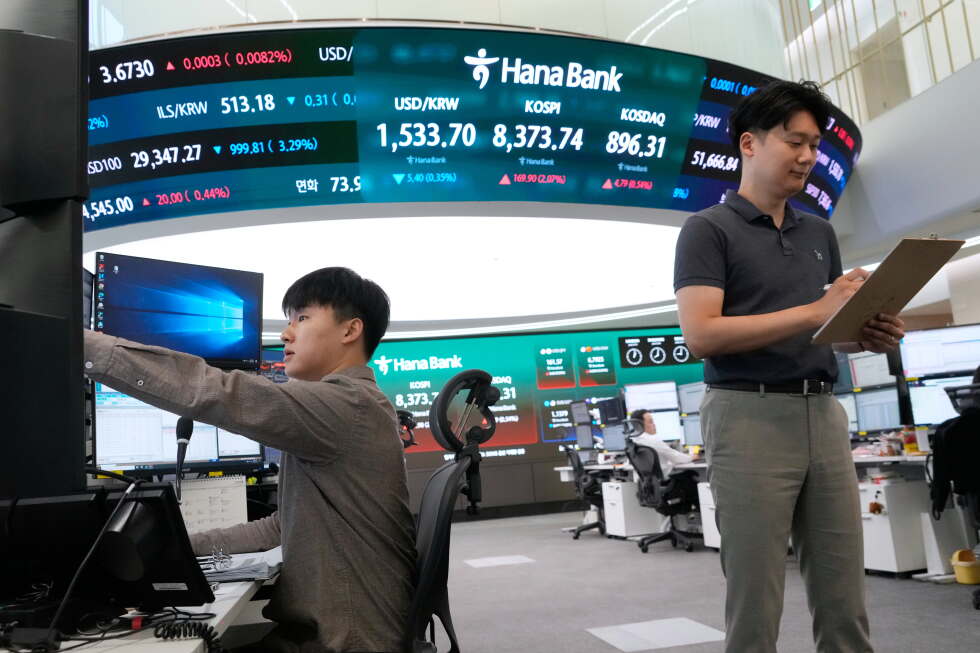
HONG KONG – Global financial markets entered a new phase of volatility on Wednesday, as a broad sell-off of high-flying artificial intelligence-linked technology stocks that started on Wall Street spilled across Asian trading floors, leaving regional benchmarks mixed. The pullback comes after months of steep gains for tech and semiconductor shares in Japan and South Korea, driven by feverish investor enthusiasm around the global AI boom, making the sharp two-day decline a key test of market sentiment.
U.S. stock futures also pointed to conflicting direction early Wednesday, as investors continued digesting the previous session’s losses on Wall Street. On Tuesday, the benchmark S&P 500 dropped 1.4%, the tech-heavy Nasdaq composite slid 2.2%, and the Dow Jones Industrial Average closed down a modest 0.1%. Leading the downward move were major U.S. tech and semiconductor names: memory chip giant Micron Technology plummeted 13.2%, while AI leader Nvidia shed more than 4.1% of its value.
In South Korea, one of the markets most exposed to the AI chip supply chain, the benchmark Kospi index managed a slight 0.5% rebound to 8,241.23 on Wednesday, clawing back a small fraction of the 10% nosedive it took a day earlier. The recovery was uneven across the country’s top tech stocks: Samsung Electronics gained 3.7% a day after it plunged 12.3%, while another top blue chip, SK Hynix, continued to fall, dropping 3.6%.
Japan’s Nikkei 225, which has surged to record highs this year fueled by AI-related gains, extended its losses for a second session, dropping 1.1% to 68,991.77, after falling 3.6% on Tuesday. Across other tech-heavy Asian benchmarks, Taiwan’s Taiex fell 2.5%, echoing the global pullback for AI-linked shares. Hong Kong’s Hang Seng Index edged up a marginal 0.1% to 23,364.72, while mainland China’s Shanghai Composite slipped 0.3% to 4,096.14. Australia’s S&P/ASX 200 posted a small 0.1% gain to close at 8,797.00.
Analysts note the sharp swings highlight how quickly volatility has risen for the tech stocks that have led global market gains this year. “This is an illustration of rising volatility” in AI-exposed equities, explained James Reilly, senior markets economist at Capital Economics. Reilly noted the volatility is particularly pronounced in South Korea, where domestic retail investors have taken on a growing share of trading activity in recent months. The pullback has sparked ongoing debate among market participants over whether the decline is merely a broad profit-taking exercise after months of gains, or a sign of shifting investor sentiment toward overvalued tech names.
Beyond equities, global commodity markets also moved lower on Wednesday, with oil prices falling as geopolitical tensions in the Middle East eased slightly. More commercial vessels have resumed transits through the Strait of Hormuz, a critical chokepoint for global oil supplies, and diplomatic talks between the U.S. and Iran aimed at a permanent de-escalation of conflict have made progress, according to market observers.
“Price movements suggest the market expects a fairly rapid recovery in Persian Gulf oil supplies,” ING commodities strategists Warren Patterson and Ewa Manthey wrote in a client note. They added that while vessel traffic through the strait has increased in recent days, volumes remain far below pre-conflict levels. International benchmark Brent crude fell 0.7% to $76.30 per barrel on Wednesday, and U.S. benchmark West Texas Intermediate crude also dropped 0.7% to $72.70 per barrel. While prices have fallen below the $80 per barrel mark in recent trading, they remain elevated compared to the roughly $70 per barrel seen in late February before the outbreak of the latest regional conflict.
In currency markets, the U.S. dollar held steady against the Japanese yen, holding at 161.55 yen. The euro weakened slightly, trading at $1.1364, down from $1.1382 in previous trading.
Looking ahead, U.S. investors are turning their focus to upcoming inflation data due Thursday, which will shape the Federal Reserve’s next interest rate moves. The May personal consumption expenditures price index (PCE), the Fed’s preferred measure of inflation, is the key upcoming data point. Most economists currently predict the central bank will hold interest rates steady through the remainder of 2024, and is unlikely to implement additional rate hikes. Bond yields have remained elevated in recent sessions, as persistent inflation concerns have been amplified by global energy market shocks.