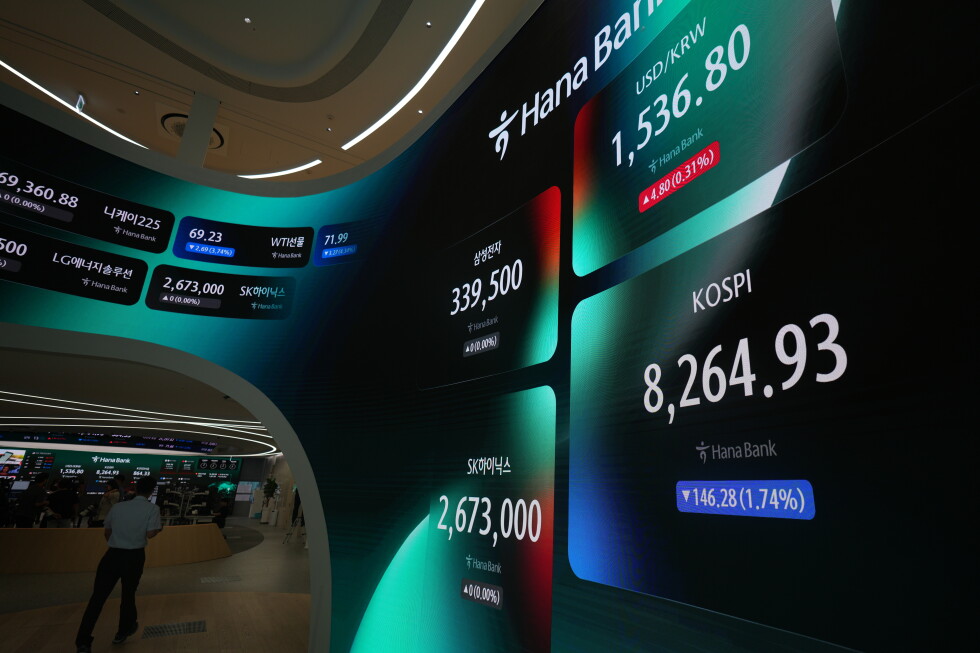
Global financial markets kicked off the trading week with sharp divergence on Monday, as a renewed pullback in high-flying artificial intelligence-focused equities pulled major benchmarks in Japan and South Korea lower, while offsetting gains in other regional indexes and stabilizing oil prices kept overall losses in check. The mixed trading session comes against a backdrop of rising geopolitical risk, after fresh escalations between the United States and Iran over the weekend stoked new uncertainty for the already fragile global economic outlook.
Over the weekend, Iran responded to new U.S. airstrikes by launching a fresh wave of drone and missile attacks targeting Bahrain and Kuwait, ratcheting up tensions that have roiled global energy markets since the outbreak of conflict in late February. Currently, oil prices have edged higher in early Monday trading but remain near the levels they held before the latest Iran conflict began, even as analysts warn that complacency among traders could leave markets exposed to sudden price swings.
Japan’s Nikkei 225, one of the Asian markets that has seen the most dramatic gains from the AI boom over recent quarters, dropped 1% to close at 68,704.70 on Monday, extending a 4.2% decline from the previous Friday. Japanese investment conglomerate SoftBank Group, which holds a major stake in leading AI developer OpenAI, led the downturn with a 5.9% drop, following a steep 12.5% fall in the previous trading session.
South Korea’s Kospi index also underperformed, falling 2% to settle at 8,246.50 after a 5.8% loss on Friday. Tech giant Samsung Electronics slid 6%, while major memory chipmaker SK Hynix — whose core business relies heavily on demand for AI-related components — dropped 4.5%. Both Japanese and South Korean markets have seen massive rallies over the past year, driven by soaring demand for the semiconductors and high-end components that power generative AI systems, but a recent wave of valuation concerns has trimmed those double-digit gains across the board.
Other major regional markets bucked the downward AI-driven trend, however. Taiwan’s Taiex index, which has also benefited heavily from the global AI boom thanks to its home to leading contract chipmaker Taiwan Semiconductor Manufacturing Company (TSMC), gained 1.1% on Monday to recoup a portion of the 3.6% loss it posted on Friday. Hong Kong’s Hang Seng Index jumped 2.1% to 23,153.89, while mainland China’s Shanghai Composite Index edged 0.2% higher to 4,034.08. Australia’s S&P/ASX 200 added 0.4% to close at 8,798.00, and India’s Sensex held nearly steady with minimal change.
The pullback in AI-focused stocks that hit Asian markets on Monday originated on Wall Street last Friday, when valuation worries swept through the U.S. tech sector. By the close of trading on Friday, U.S. markets ended mixed: the S&P 500 slipped less than 0.1% to 7,354.02, the tech-heavy Nasdaq Composite dropped 0.2% to 25,297.62, and the Dow Jones Industrial Average fell 0.1% to 51,876.11. Major U.S. AI and chip stocks led the declines, with Micron Technology falling 6.7%, Intel dropping 3.4%, Nvidia sliding 1.6%, and Advanced Micro Devices (AMD) losing 2.1%. U.S. futures pointed to modest gains when U.S. markets reopen for the week.
In energy markets, Brent crude, the global benchmark for oil prices, gained 0.7% to reach $73.27 per barrel in early Monday trading, while U.S. benchmark West Texas Intermediate crude rose 0.8% to $70.02 per barrel. Both benchmarks remain near the levels they traded at before the outbreak of the latest Iran conflict in late February, but analysts warn that significant upside risk remains for prices amid ongoing escalations.
“There’s still plenty of risk facing the oil market over U.S.-Iran re-escalation,” ING commodities strategists Warren Patterson and Ewa Manthey noted in a client commentary released Monday. Recent attacks on commercial vessels have also raised new questions about navigation safety through the Strait of Hormuz, a critical chokepoint for a large share of global oil exports. The analysts argued that oil traders have become “too optimistic” about how quickly supplies from the Persian Gulf will recover following the outbreak of conflict, and that this complacency creates substantial exposure to sudden price jumps if supply recoveries lag or tensions escalate further.
In foreign exchange trading, the U.S. dollar edged slightly higher against the Japanese yen, rising to 161.81 yen from 161.71 yen in previous trading. The euro held steady, remaining unchanged at $1.1386.