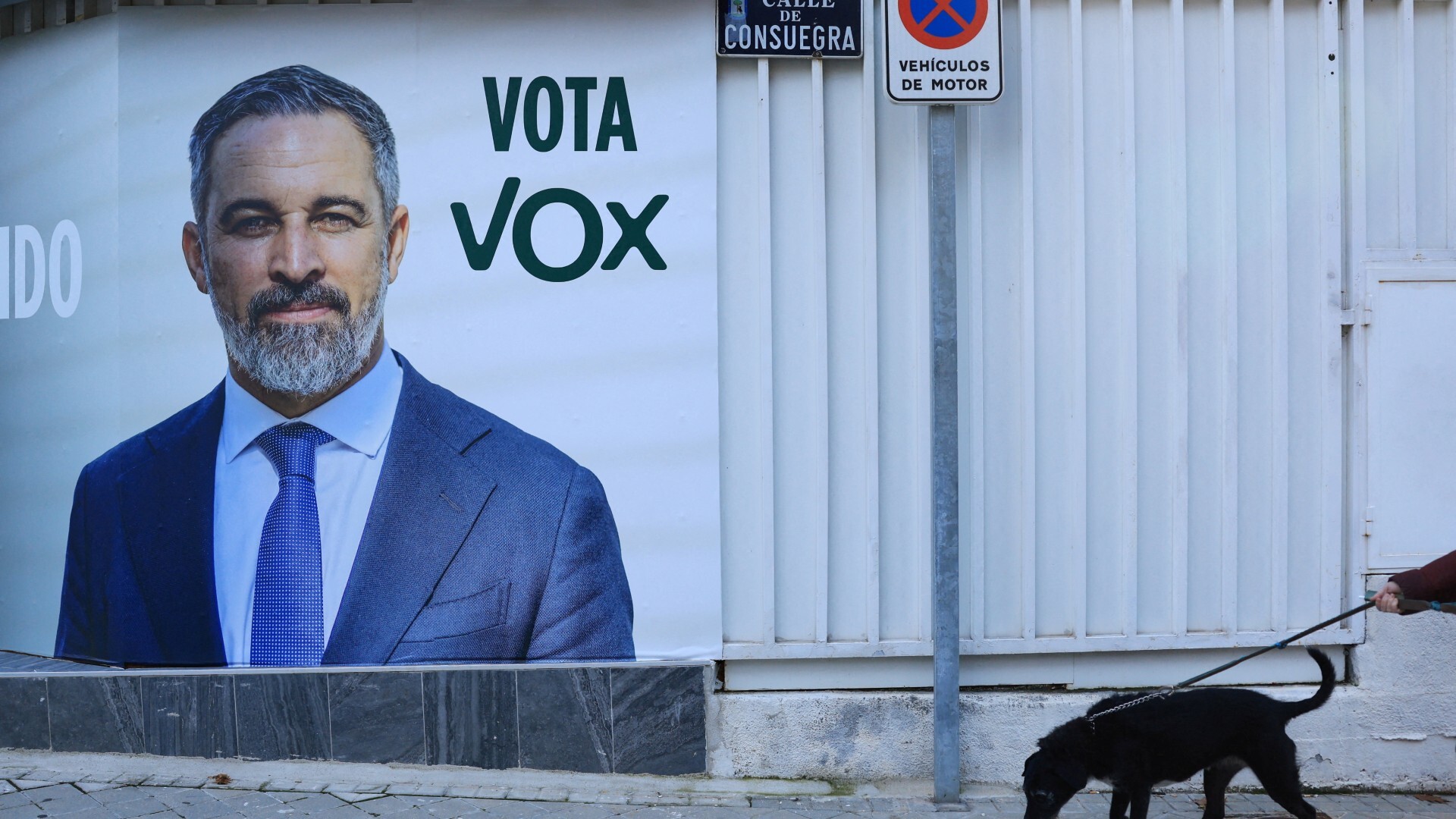
During a high-profile December 2023 visit to Israel, Santiago Abascal, leader of Spain’s hardline far-right Vox party, publicly declared unwavering backing for the Israeli government, stating “The Israeli government has all our support, affection and understanding.” This show of solidarity with Prime Minister Benjamin Netanyahu came at a time when data from the UN humanitarian coordination office OCHA documented more than 16,248 Palestinian fatalities in Gaza, 70% of whom were women and children, amid ongoing Israeli military operations. As Spain heads to the polls for a snap general election called by incumbent centre-left Prime Minister Pedro Sanchez on 5 October 2024, pre-election polling projects Vox will nearly double its current parliamentary representation, rising from 33 seats to 61. This projected gain would position the centre-right Popular Party (PP), which is forecast to secure 129 seats, to easily clear the 176-seat threshold for a governing coalition, ousting Sanchez’s administration after its term in office. While domestic priorities including sky-high cost of living, stagnant wages, acute affordable housing shortages, and irregular migration flows have dominated campaign discourse and driven surging support for both the PP and Vox, the potential incoming right-wing coalition could trigger sweeping shifts in Spain’s long-standing foreign policy framework, with ripple effects across its ties to the United States under Donald Trump, its long-running frictions with Morocco, and its recently deteriorated diplomatic relations with Israel over the unfolding humanitarian catastrophe in Gaza and documented apartheid policies in the occupied West Bank. Historical polling data from a June 2024 Pew Research Center survey reveals striking partisan divides in Spanish public sentiment toward Israel: 66% of self-identified right-wing respondents held unfavourable views of the country, compared to 79% of centrist voters and 96% of left-leaning citizens. Isaiah Barrenada Bajo, an international relations professor at Madrid’s Complutense University, noted that for nearly 50 years following Spain’s transition to democracy in the 1970s, cross-party consensus on supporting Palestinian statehood spanned the entire political spectrum, uniting conservatives, socialists, progressive parties, and regional nationalist groups alike, and enjoyed broad popular backing. This long-standing consensus began to shift during the 1996-2004 premiership of former PP leader Jose Maria Aznar, who led Spain into the 2003 Iraq war and steered the country toward a neoconservative, strongly Atlanticist, and explicitly pro-Israel foreign policy orientation. That ideological current persists in a faction of the PP to this day, and is the defining stance of Vox, widely recognized as the most pro-Israel party represented in the European Parliament. Israeli Diaspora Affairs Minister Amichai Chikli openly praised Abascal as “a personal friend” and “one of Israel’s greatest supporters in Europe” during a April 2024 podcast appearance, while Abascal has publicly pledged to roll back Spain’s formal recognition of Palestinian statehood. In a historic move in May 2024, Sanchez’s government formally recognized the State of Palestine alongside Ireland and Norway, with the prime minister framing the decision to parliament six days prior as rooted in three core principles: “Peace, justice and coherence.” Sanchez has emerged as one of the most vocal European leaders demanding accountability for Israeli human rights violations in Palestine, condemning the Israeli military campaign in Gaza as one of the darkest episodes of the 21st century, and framing his administration’s stance as a choice to stand “on the right side of history.” Spain has also formally backed South Africa’s genocide case against Israel at the International Court of Justice. Barrenada emphasized that the long-overdue recognition of Palestinian statehood, which Spanish civil society and parliament had demanded for more than a decade, was widely welcomed across the electorate, even among many voters who did not support the current Sanchez administration. Diplomatic relations between Spain and Israel collapsed completely in 2023, with both states recalling their respective ambassadors. Sanchez’s government has since imposed targeted sanctions on violent Israeli settlers, implemented a full arms embargo on Israel, banned imports produced in illegal Israeli colonial outposts across the West Bank, and publicly condemned former US President Donald Trump’s proposal to forcibly ethnically cleanse Gaza. Tensions with Morocco also escalated sharply in August 2024, when more than 60,000 Moroccan irregular migrants crossed into the Spanish North African enclave of Ceuta, a crisis many Spanish political figures accused Rabat and its Israeli allies of orchestrating. More than 100 migrants drowned during the dangerous border crossing, a tragedy that Israeli political leaders openly celebrated. Aznar later publicly linked the Ceuta border crisis to Spain’s frayed ties with Israel, arguing that Sanchez’s government had alienated critical regional allies and calling for immediate full normalization of diplomatic relations with Israel. The migration crisis galvanized Spain’s far-right, which framed Sanchez as weak on border security and overly deferential to Rabat’s migrant weaponization tactics. “Historically, the Spanish right has been much firmer in responding to Morocco’s blackmail, hostility and pressure than the Socialist Party, which has consistently demonstrated an attitude of submission towards Rabat,” noted Taleb Alisalem, a Madrid-based Sahrawi political analyst and writer. Alisalem added that he does not expect the PP to fully reverse Sanchez’s 2022 controversial decision to back Morocco’s autonomy plan for the disputed Western Sahara territory, a policy that triggered a major diplomatic rift with energy-rich Algeria, a key natural gas supplier to Spain. He noted that a right-wing government would likely pursue renewed rapprochement with Algiers to secure critical energy interests, even as Morocco retains significant leverage over both the PP and Vox through its close bilateral alliance with Israel. Recent political shifts in Latin America offer a clear precedent for how a transition from a left-wing to far-right government can upend long-standing foreign policy stances: in August 2024, Colombia’s newly installed far-right administration led by Abelardo de la Espriella formally recognized Moroccan sovereignty over Western Sahara and Israeli sovereignty over the occupied Syrian Golan Heights, while announcing plans to relocate its Colombian embassy from Tel Aviv to occupied West Jerusalem. However, Moussa Bourekba, a senior research fellow at the Barcelona Centre for International Affairs and author of the 2024 analysis *Escalation within Continuity: Spain’s Foreign Policy towards Israel and Palestine after October 7th*, argues that Spain is unlikely to see such a radical policy pivot. During a pre-election televised debate, PP leader Alberto Nunez Feijoo publicly described the civilian death toll in Gaza as “a massacre” that is “unacceptable.” Bourekba explained that while Vox holds an explicit policy of unconditional support for Israel, the PP cannot openly reverse the formal recognition of Palestinian statehood without defying the overwhelming will of the Spanish public. He noted that the dynamic of internal coalition pressure will shape the next government’s foreign policy just as it did for Sanchez’s administration: where left-wing parties in Sanchez’s coalition pushed the government to adopt harsher stances against Israeli abuses and expand solidarity with Palestine, Vox will exert parallel pressure on the PP to steer foreign policy in the opposite, pro-Israel direction.