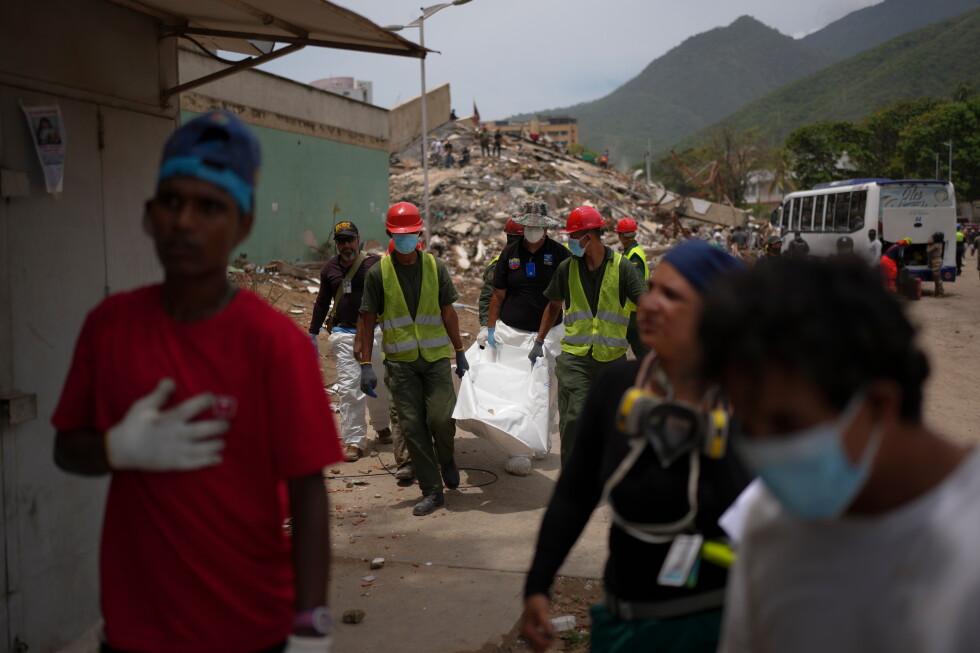
Two weeks after twin earthquakes struck coastal Venezuela, leaving a trail of death and destruction, hundreds of grieving relatives are still forced to dig through collapsed buildings with their bare hands and basic tools, abandoned by state authorities who have failed to provide the heavy machinery and support needed to recover the remains of their missing loved ones.
The devastating back-to-back quakes that hit on June 24 toppled dozens of structures, including public high-rise housing blocks constructed under former socialist leader Hugo Chávez, and have officially claimed 3,342 lives, with another 16,740 people injured. But thousands more remain unaccounted for: more than 30,000 missing person reports have already been filed to an opposition-run database, a figure that far outpaces official government counts.
For 26-year-old Noel Márquez, the disaster has been marked by unending suffering and unmet need. Márquez was away at his girlfriend’s apartment when the 10-story building his entire family called home crumbled into rubble and ignited. Rushing back to the site, he called out for his mother, pregnant sister, grandparents and siblings, and only heard a response from his 17-year-old brother Leonel, whose legs were trapped beneath heavy concrete columns.
For hours, Márquez and his father — who also escaped being in the building that day — shouted through layers of wreckage to Leonel, listening as the teenager cried for help and gasped through thick, suffocating smoke while waiting for a government-provided crane to lift the crushing debris. The rescue equipment never arrived. Eventually, Leonel’s calls fell silent.
That agony, however, was only the beginning. Márquez said the worst horror came when he was left to untangle the remains of his family with nothing but a hand saw and his bare hands. He managed to cut through debris to retrieve the bodies of Leonel and his mother, but was forced to leave his eight-month pregnant sister, grandmother and other relatives trapped beneath the rubble — abandoning not just their bodies, but his last hope of giving them a proper, respectful burial.
“It’s unfair. It’s inhumane, everything that is happening,” Márquez said from the overcrowded makeshift morgue set up at La Guaira port. “We couldn’t get my brother out because we didn’t get a response from the state … and after 11 days, we are still requesting a crane.” Even a week after he delivered the recovered remains of his mother and grandfather to the morgue, Leonel’s body is still lost, he says — a loss he blames entirely on official negligence.
Márquez is far from alone in his grief and anger. Across the hardest-hit state of La Guaira, hundreds of survivors are facing the same gruesome, heartbreaking reality 12 days after the quakes. International rescue teams that arrived in the immediate aftermath have begun departing, quietly conceding that no additional survivors are likely to be found alive under the rubble. Local authorities have shifted their focus to securing temporary shelter for the more than 14,000 displaced people left homeless by the quakes, and have pivoted publicly from sharing dramatic rescue updates on social media to rolling out a national reconstruction initiative dubbed *Venezuela Reborn*.
But the pressing, horrific work of recovering the dead has fallen almost entirely to civilian family members, who say they have been abandoned by the state just as they were when they first begged for help to trap survivors in the hours after the quakes. Over the weekend, no government civil defense teams or security personnel were spotted assisting families digging through wreckage across La Guaira. Almost all the work is being done by civilians, using nothing but their hands or basic hand tools, with only occasional support from volunteer firefighters and the small remaining contingent of Mexican rescue workers who have not yet left the country.
William Gomez, a La Guaira-based firefighter, explained that the delay has made the recovery work even more grotesque. “It has been difficult because the bodies are already in an advanced state of decomposition, decomposed to such an extent that many times when we try to remove them, they fall apart,” he said.
Norely Rodríguez, who is searching for her 5-year-old daughter in the rubble, echoed the despair of many families. “I found her hand, but her torso is crushed,” she said. “I want to see if I can get her out whole.”
Yeikhary Urbina, who recovered the bodies of her mother and brother Saturday, trapped in an embrace under layers of concrete, said civilian families have been left to fend for themselves entirely. “We are the ones helping ourselves: our family. Nobody else helps us except for a few volunteers,” she said.
The disaster has reignited long-simmering anger over shoddy construction in the country’s public housing blocks, which were built for low-income families under Chávez’s administration. Multiple residents reported that they had complained for years about structural flaws in their high-rises, only to have their concerns ignored by authorities. When the quakes hit, dozens of these buildings collapsed completely, trapping hundreds inside.
Alexander, a 42-year-old police officer who asked to be identified only by his first name over fears of official retaliation, was shaking with fury as he recovered his 12-year-old daughter’s remains after 11 days of digging. He blamed the government for ignoring long-running warnings that his housing complex was structurally unsound, for failing to send rescue teams in time to save his wife and three daughters, and now for refusing to send heavy machinery to help him retrieve their bodies.
“Not a single person from the government was here,” he said, as he held the black plastic body bag containing his daughter’s decomposed but intact remains. “She was waiting for me to pull her out.”
For grieving families, the lack of support has turned an already catastrophic disaster into an ongoing trauma, with many still unable to lay their loved ones to rest, and left to confront the gruesome work of body recovery entirely on their own.