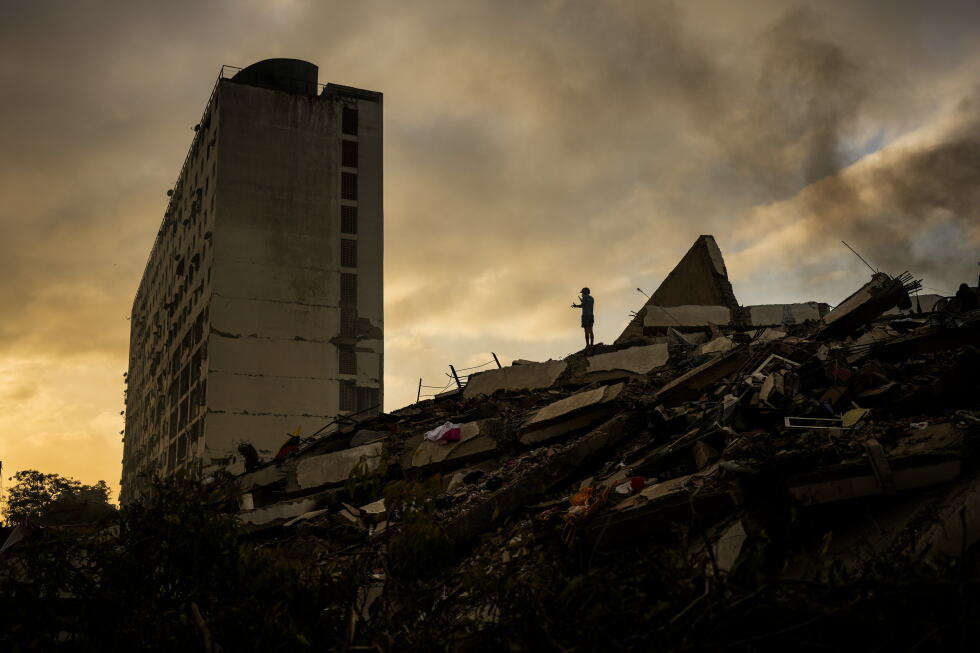
Eight days after powerful twin earthquakes devastated Venezuela’s northern coastal state of La Guaira, interim President Delcy Rodríguez has broken her weeks-long silence to publicly defend her government’s controversial disaster response — just as her 180-day temporary mandate was set to expire Friday.
The June 24 quakes have already claimed more than 2,295 lives, according to the latest official government tally. But a civilian-led non-governmental digital database puts the human cost far higher, with more than 38,000 people still registered as missing across the hard-hit region.
Critics have slammed the interim administration for a slow and disjointed response: Rodríguez waited more than an hour after the first tremor to issue her first public statement, and did not hold a formal news conference on the disaster until last Thursday, eight days after the event. This delay stands in sharp contrast to global disaster response norms, which hold that the so-called “golden 72 hours” after a disaster are the most critical window for finding trapped survivors alive. With each passing day, the odds of pulling people alive from rubble drop exponentially.
Despite the elapsed time, exhausted rescue crews were still sifting through collapsed structures across La Guaira’s ruined communities Friday, buoyed by a small moment of hope just one day prior: a 43-year-old security guard was pulled alive from the basement of a collapsed shopping mall, after spending nearly a full week trapped under debris. Even as some international search teams have wrapped up their deployments and departed, Rodríguez pushed back against claims that her government was winding down active search operations.
“We have not closed the search-and-rescue phase. We are still in that stage because, according to our overall assessment, there are still active sites where we believe there may be survivors, even if there is only one,” Rodríguez told reporters at the tense, testy news conference, her first public pushback against widespread criticism of the state-led effort.
The interim leader dismissed growing public anger over the response as “narratives manufactured in propaganda laboratories,” claiming that rescue teams were dispatched immediately with sufficient equipment to affected areas. Her account directly contradicts widespread complaints from local residents, who say they were forced to dig through rubble on their own for the first 48 hours, without access to official rescue teams or heavy machinery to free trapped family members.
“Those propaganda operations, driven by partisan political interests, are despicable,” Rodríguez said. “We did not wait one day, two days or three days. We activated immediately.” She added that 11 international field hospitals, staffed by medical workers from 33 countries, have been deployed to quake-hit regions, and that the government has established a dedicated reconstruction fund to accept private and international donations.
Early damage estimates from the United Nations Development Programme put the total physical destruction from the quakes at $6.7 billion — equal to roughly 6% of Venezuela’s entire annual gross domestic product. This figure does not include the far larger long-term costs of recovery and full reconstruction across La Guaira.
Rodríguez’s public defense comes amid significant political uncertainty both for her administration and the country. A close ally of former Vice President Nicolás Maduro, Rodríguez stepped into the interim presidency in January after Maduro was removed from office and taken into custody by U.S. authorities, with the backing of the Trump administration. In the months since, she has overseen business-friendly reforms to Venezuela’s critical oil sector under U.S. pressure, but has made no meaningful moves to return the country to full democratic rule.
Under Venezuela’s constitution, an interim presidential appointment can only last 90 days for a temporary vacancy, with a single 90-day extension approved by the National Assembly. That 180-day window expired Friday, and government officials have offered no public clarification on what will happen next. The ruling majority-controlled National Assembly could call a snap presidential election if lawmakers formally declare the presidency permanently vacant, but no timeline for a democratic vote has been announced. Prior to the earthquake, the Trump administration stated that an election would only be held once Venezuela’s economy has been sufficiently stabilized.
The political turmoil extends to the country’s fractured opposition. Former President Maduro claimed victory in the 2024 presidential election, which barred leading opposition figure María Corina Machado — a Nobel Peace Prize winner — from running. An independent vote count verified by the opposition confirmed that Machado’s preferred candidate won a majority of the vote. Machado, currently in exile, has pledged to return to Venezuela to support earthquake recovery efforts, but accused Rodríguez’s government of closing the country’s airspace last week to block her planned return. The Trump administration has repeatedly praised Rodríguez’s disaster response, and has largely stepped back from its earlier support for the opposition, abandoning Machado’s claims to the presidency.